
 雷科技
雷科技





On July 25, Luo Yonghao stated on Weibo that he had replaced his elderly family members’ TV sets twice—trying out the “Elder Mode” promoted by manufacturers—but they still couldn’t operate the smart TVs independently. Ultimately, he resorted to installing an IPTV set-top box.
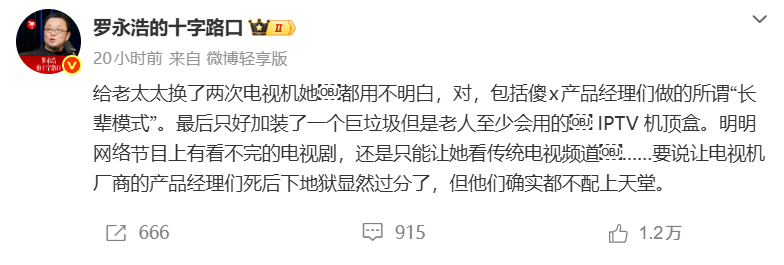
Image source: Screenshot from Weibo
The related topic quickly trended on social media, with numerous users in the comment section sharing similar frustrations: boot-up ads, cumbersome app switching for streaming shows, pop-up subscription prompts, and seniors getting hopelessly lost after pressing the wrong button.
LeiTech (ID: leitech) believes the sense of helplessness elderly users feel when operating smart TVs is genuine. However, attributing full responsibility to TV hardware manufacturers is overly simplistic. Let’s set aside emotion and examine precisely where the problem lies—and whether TV manufacturers are truly unjustly blamed.
TV Shipments Are Declining—but Usage Rates Are Actually Recovering
Before discussing TV user experience, it’s essential to clarify a fundamental premise: Has the TV category truly declined?
The widespread perception that “no one watches TV anymore” stems largely from two trends: falling TV shipment volumes and declining TV usage rates. People conflate these two distinct metrics, leading to the erroneous conclusion that TVs are no longer watched. But reality tells a different story: While shipments are indeed falling, the claim that “no one turns on their TV” is a misinterpretation.
Data from洛图科技 (LuoTu Technology) shows that China’s branded TV shipment volume in 2025 stood at 32.895 million units—a year-on-year decline of 8.5%, marking the lowest level in the past 16 years. At first glance, this figure suggests TV obsolescence. Yet shipment volume measures how many new TVs were sold this year—not how many people continue using TVs.
The average TV replacement cycle is eight to ten years—far longer than smartphones’ two-to-three-year cycle. Moreover, the national subsidy program released pent-up demand for TV upgrades in Q4 2024; by H2 2025, its stimulative effect had waned, naturally causing sales figures to dip.
Interpreting a short-term fluctuation caused by subsidy exhaustion as evidence of a terminal “TV demise” trend lacks rigor.
Image source: LeiTech production
To assess whether TVs are still being used, installed base data carries more weight than shipment figures. According to Gouzheng Technology’s “2025 White Paper on the Development of China’s Smart Large-Screen Industry in Households,” released in April 2026, the number of smart TV terminals in China has reached 439 million—covering 70% of Chinese households—with average daily viewing time exceeding 5.6 hours.
This figure even surpasses the concurrent average daily mobile internet usage time of 4.1 hours per netizen. If TVs were truly abandoned, it would be difficult to explain why over half of smart TV households power on their screens daily—and keep them running for more than five hours.
TCL founder Li Dongsheng publicly confirmed that TV usage rates dropped from 70% in 2016 to under 30% in 2024—a statistic often cited as irrefutable proof of TV decline. However, this 30% figure aggregates all TV types—including legacy non-smart TVs that have long been superseded by smart TVs but remain mounted on walls gathering dust. Including these obsolete units inevitably drags down the overall usage rate.
When considering only smart TVs, the daily usage rate stabilized at 52% in 2025. Monthly tracking by Streaming Media Network also indicates that smart TV daily active users remained consistently above 50% from January to November 2025. After years of steep declines, smart TV usage rates have now plateaued and stabilized.
TVs’ role has indeed evolved: They’re no longer the sole household entertainment gateway—everyone now holds a smartphone screen, consuming content individually. But this doesn’t mean TVs have been eliminated. A more precise description is that TVs have shifted from being the only option to becoming a shared household medium.
Irreplaceable scenarios—such as families gathering in the living room to watch the Spring Festival Gala or the World Cup—still exist. Watching movies, following fitness videos, letting children enjoy kids’ programming, or even playing console games—all remain viable uses, albeit with changed interaction patterns.
This evolution reflects precisely the value proposition of smart TVs versus traditional ones—and partly explains why their operation has grown more complex—a point we’ll expand on later. In short, a device with hundreds of millions of daily active users and over five hours of average daily usage is clearly far from obsolete.
Is TV Operation Overly Complicated? Not Entirely the Hardware Manufacturers’ Fault
Ruo Yonghao’s core complaints—boot-up ads, cumbersome app switching, intrusive subscription pop-ups, and paid screen-mirroring—are objectively real. Yet decision-making authority over these aspects does not lie solely with TV hardware manufacturers.
China enforces a licensing system for internet-connected TVs. The State Administration of Radio and Television (SARFT) has issued only seven internet TV integrated broadcasting and control licenses—granted exclusively to state-owned entities such as CCTV, Shanghai Media Group, Huashu, Guangdong Broadcasting System, and Hunan Broadcasting System—with no further licenses planned.
Video platforms like iQiyi, Tencent Video, and Youku lack such licenses. To deliver content on TV, they must partner with licensed entities to form joint ventures launching TV-specific apps. Thus, what appears on TV isn’t iQiyi itself, but “Galaxy Qiyi”—a co-branded service operated jointly by iQiyi and Galaxy Internet TV Co., Ltd.; Tencent Video becomes “Yun Shiting Jiguang” (Cloud Vision Polar Light), a collaboration between Tencent and Guangdong Southern New Media; Youku’s TV version is “CIBN Kumei Film & TV,” hosted under China International Broadcasting Network (CIBN).
TV operating systems are developed by hardware manufacturers, broadcasting platforms are managed by license holders, and content applications are provided via video platforms’ TV editions. Boot-up ads, layered subscription models, and membership architecture decisions primarily reside with the latter two layers—over which TV manufacturers hold no authority.
The root cause behind incompatible mobile and TV subscriptions—and higher TV-tier pricing—is precisely this structural separation. Video platforms incur greater operational costs on TV platforms, prompting them to price TV memberships separately—often at double the mobile rate. Holding hardware-only manufacturers accountable for these design-driven UX issues is fundamentally unreasonable.
Image source: LeiTech production
Ruo Yonghao himself acknowledged content service providers in his comments, noting that even SVIP subscribers still face ads and fake 4K—indicating he recognizes that dissatisfaction extends beyond hardware makers. Yet his Weibo critique focused squarely on product managers, mirroring a common public misconception: When problems arise, consumers instinctively blame the seller. As noted earlier, TV manufacturers genuinely find themselves in an unenviable position.
IPTV set-top boxes work well for seniors because they offer just one straightforward mode: Power on → land directly on live channels → use up/down arrows to change channels → enter numbers to jump to specific channels—with virtually no other functionality.
Smart TVs operate on an entirely different logic: Users can search for any content, install diverse video apps, even use the TV for fitness training or video calls. Layered together, each additional step becomes a significant barrier for users in their seventies or eighties.
There exists an inherent tension between feature richness and operational simplicity—a challenge not attributable to any single manufacturer’s design shortcomings. Delivering one-click live TV requires sacrificing on-demand flexibility and search freedom, reverting to passive “what’s fed, what’s watched” models. Enabling autonomous content selection inevitably introduces menus, text input, and account logins.
Globally, no manufacturer has yet delivered a truly optimal solution balancing both extremes. Smart TV complexity is the inevitable cost of offering expanded capabilities.
Manufacturers Keep Seeking Solutions—Is AI the Village’s Last Hope?
It’s true that “Elder Mode” hasn’t fully solved the problem—but this also demonstrates manufacturers’ ongoing efforts to reconcile the aforementioned contradictions. Their initiatives go far beyond merely enlarging fonts.
Take TCL’s Lingkong OS 3.0 as an example: It supports far-field voice recognition up to 12 meters away, covering a full 360-degree range, understands Mandarin plus dialects including Sichuanese, Cantonese, Northeastern Mandarin, Henanese, and Shaanxi dialects—and enables wake-word-free direct command execution.
Hisense, meanwhile, added a dedicated AI button on its remote control: Press and hold to perform voice searches, adjust volume, or switch channels—bypassing text input entirely. These designs aim explicitly to eliminate seniors’ need to learn pinyin input or navigate hierarchical menus.
The limitation of Elder Mode lies in its approach: It simplifies existing interfaces but retains the same interaction paradigm—clicking, scrolling, confirming. As long as the interaction model remains unchanged, complexity can only be reduced—not eliminated.
What could truly drive transformative change is AI and Agent technology.
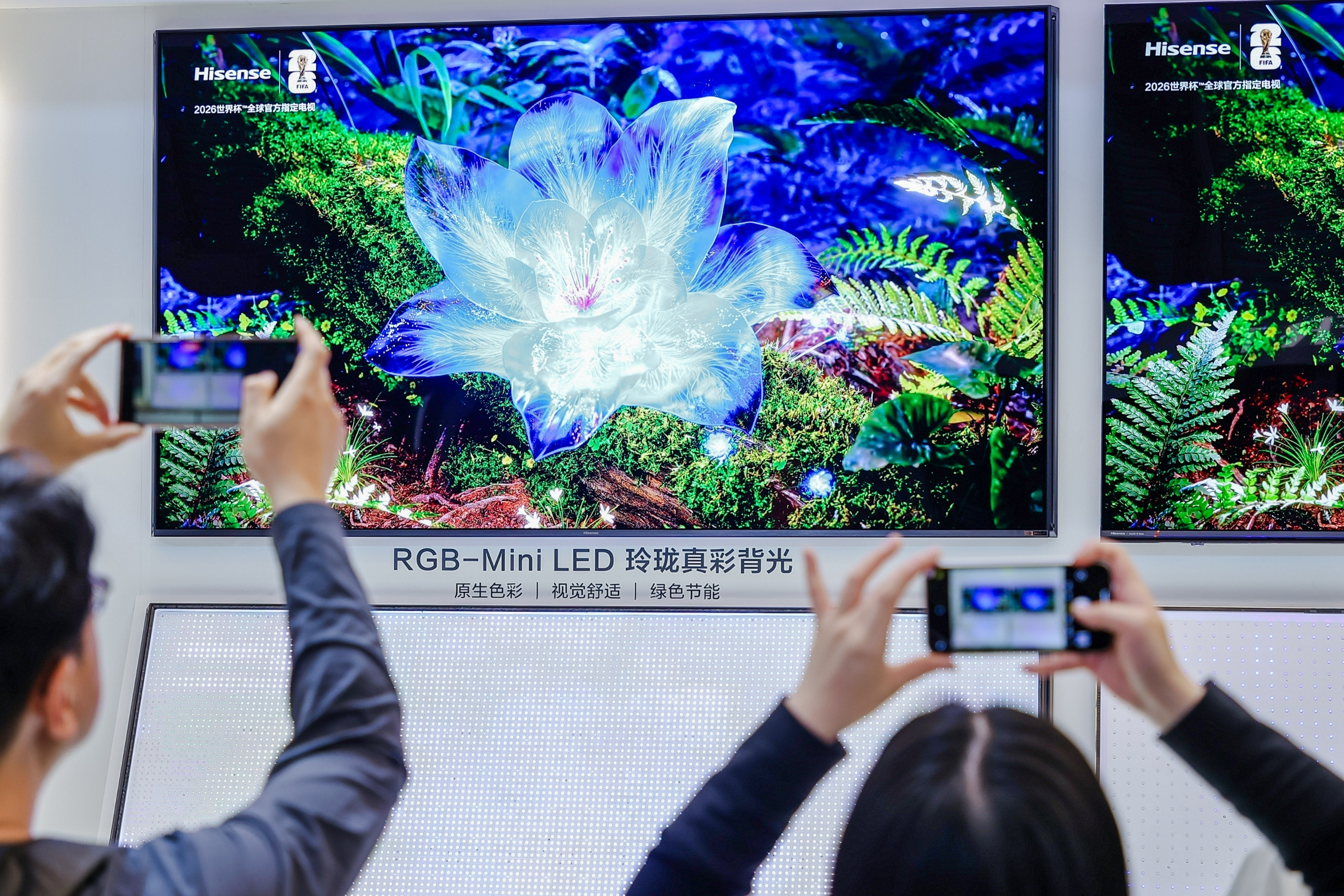
Image source: Hisense
In February 2025, Hisense became the industry’s first TV brand to integrate DeepSeek, supporting seamless switching between full-capacity R1 and V3 versions—making it the first to deploy deep-thinking intelligent agents. By mid-March, all Hisense TVs equipped with intelligent agents had completed upgrades and fully supported DeepSeek; users simply press the “Xiao Ju AI” key on the remote or issue a voice wake-up command to enter the deep-thinking dialogue interface.
Built upon its self-developed Xinghai large language model and DeepSeek’s technical foundation, Hisense TVs integrate AI agents specialized for film & TV, gaming, fitness, parenting, and more—each possessing expert-level capabilities. These agents interpret underlying user intent from spoken commands, then perform multidimensional reasoning incorporating user preferences, household composition, and critical reviews to generate personalized recommendations.
Its VIDAA OS features AI-powered real-time search, enabling deep analysis of viewing habits before recommending content—and providing voice guidance for visually impaired users and caption support for hearing-impaired users.
TCL similarly integrated the full-capacity DeepSeek-R1 via its Fuxi AI platform, building 16 intelligent agents spanning education, entertainment, health, and other domains. Its Xiao T assistant has been upgraded to version 6.1.2, allowing users to request AI-curated movie recommendations, game strategy guides, or even split-screen display of gameplay assistance information.
Lingkong Desktop abandons the conventional waterfall-feed UI, instead supporting smartphone-like customizable home screens—enabling adult children to pin frequently watched live TV channels and apps directly onto the homepage for one-tap access. The system eliminates boot-up ads, achieving sub-7-second startup from power-on to main interface. In Elder Mode, icons enlarge by 30%, and frequently used functions appear as cards on the homepage—bypassing multi-layer menus entirely. The Xiao T voice assistant understands dialects and can power on the TV with a single vocal command—even while in standby mode.
Both brands share the same goal: eliminating the need for seniors to memorize operational steps—simply speak or press once to get desired content. In the future, as Agent technology matures, seniors will be able to say something like “Play a war drama” or “Show me CCTV News Broadcast,” and the system will autonomously comprehend, retrieve, and play the requested content—rendering today’s obstacles obsolete.
Final Thoughts
Ruo Yonghao’s critique holds value, and the difficulties seniors face with smart TVs deserve serious attention. Yet assigning full blame to TV manufacturers contradicts reality—and overlooks their recent investments in voice interaction, boot-up ad governance, and age-inclusive design.
A TV’s journey from power-on to playback traverses multiple stakeholders: license holders, broadcasting platforms, and content application providers. Hardware manufacturers exert limited control over this chain—and smart TV complexity is the necessary trade-off for delivering richer capabilities.
What will most likely enable truly effortless senior usage is further maturation of AI and Agent technologies—shifting the burden from humans adapting to technology, toward technology understanding humans. We hope the “DeepSeek moment” for the TV industry arrives soon.
On July 31, ChinaJoy 2026—themed “Journeying with AI”—will launch spectacularly.
A total of 900 cross-industry entertainment exhibitors—including Tencent, NetEase, Sony, Qualcomm, MaiCong, and Qingxian—will jointly present a global feast for the entertainment industry;
Under AI’s influence, how will hardware tech brands—from devices and peripherals to robots, displays, and chips—collaborate with game content developers to pioneer new entertainment experiences?
LeiTech’s ChinaJoy 2026 reporting team, led by Founder & Chief Editor Luo Chao, will descend upon Shanghai for exclusive coverage—stay tuned.