
 雷科技
雷科技





Gemini has finally rolled out new models.
There was no launch event. The official team simply released a podcast, and three new Gemini models — Gemini 3.6 Flash, Gemini 3.5 Flash-Lite, and Gemini 3.5 Flash Cyber — were quietly launched just like that...
To be honest, I can barely remember the last time I actually opened Gemini and used it seriously.
That’s not to say Gemini is completely unusable. Mind you, I paid for a full-year Gemini Pro subscription just last year. Back then, Gemini 3.1 Pro and Nano Banana 2 were in their prime; even by today’s standards, they still rank as upper-mid tier large language model and image generation model respectively.
The issue is, competing models have been updating far too rapidly in recent months.
(Source: Gemini)
Kimi K3 has broken into the top echelon of flagship models; the official launch of DeepSeek V4 is slated for this month; Anthropic has rolled out Fable 5 and Sonnet 5 in quick succession; OpenAI has just unveiled GPT-5.6. Only Google is still stuck repeating the same line: Gemini 3.5 Pro is coming soon.
Back in May, they promised a launch the following month. It never arrived in June, and there’s still no sign of it as July draws on. In the end, only the Flash lineup of Gemini has received updates, which is somewhat disappointing.
Three New Gemini Models Launch: Faster and Cheaper
But let’s get back on topic and talk about the new additions to the Gemini family.
Judging by the launch page and benchmark scores alone, Google sums up the selling points of Gemini 3.6 Flash in one phrase: faster, cheaper, and smarter.
Why? Because there’s barely anything noteworthy about its core specifications.
Google still hasn’t disclosed the model’s parameter count. The overall architecture, training data, and hardware details of the 3.6 Flash are largely carried over from its predecessor. It retains a 104.8-token context window, a default medium reasoning level, and supports input formats including text, images, audio, video, and PDF.
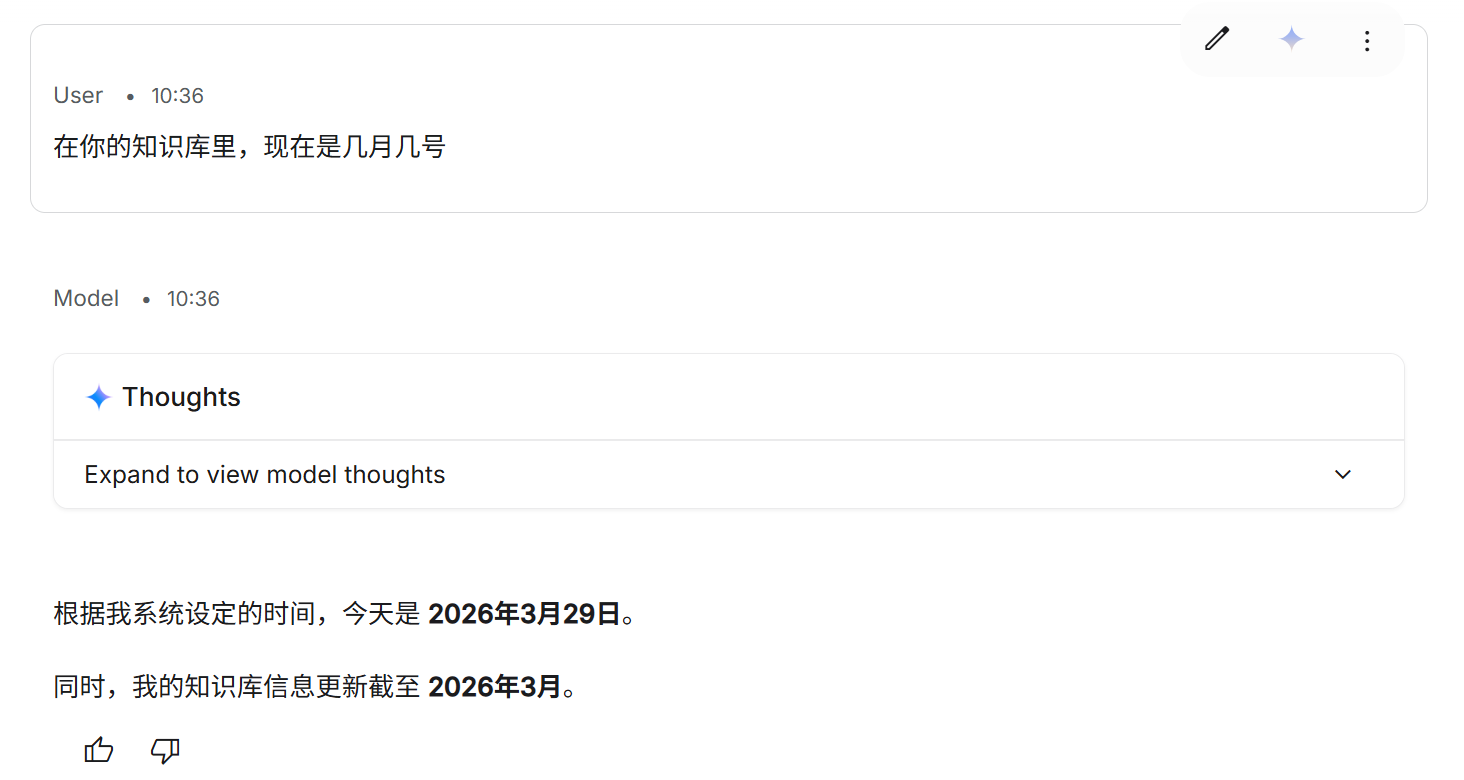
The good news is that Google has updated its knowledge base, moving the knowledge cutoff date from January 2025 to March 2026. Users can now access plenty of up-to-date information without needing an internet connection.
(Source: Google)
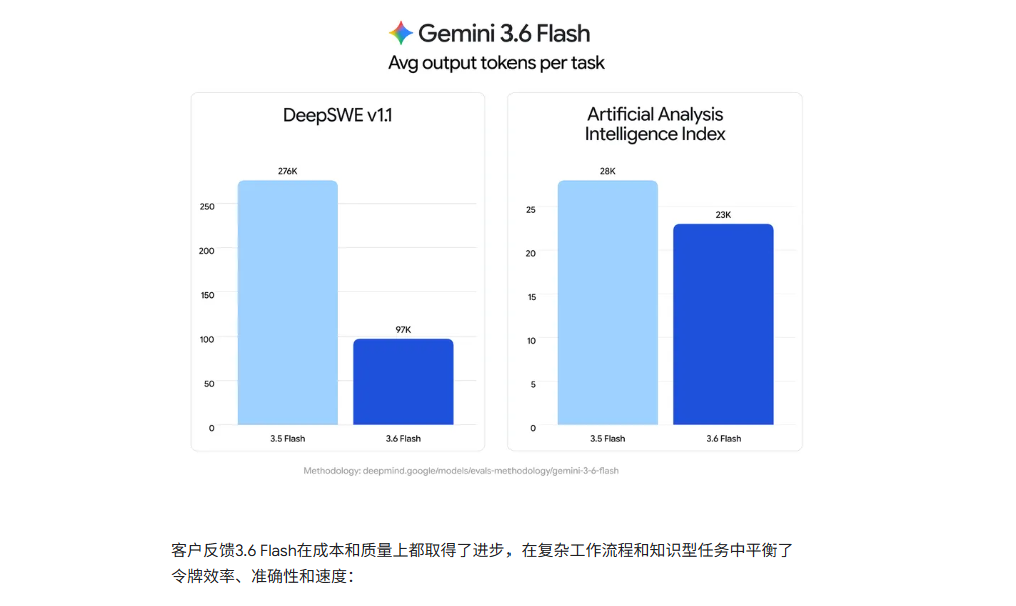
As for its specific selling points, according to the official blog, real-world tests conducted by third-party benchmarking firm Artificial Analysis Index show that the model consumes 17% fewer output tokens compared to its previous iteration. For code testing scenarios such as DeepSWE, the token reduction reaches as high as 65%.
(Source: Google)
Furthermore, the model requires fewer inference steps and tool calls to complete multi-step workflows. In the OSWorld-Verified computer-use benchmark, Flash 3.6 consumes 55.8% fewer tokens than Flash 3.5. Beyond cutting down inference steps, it also delivers superior output results.
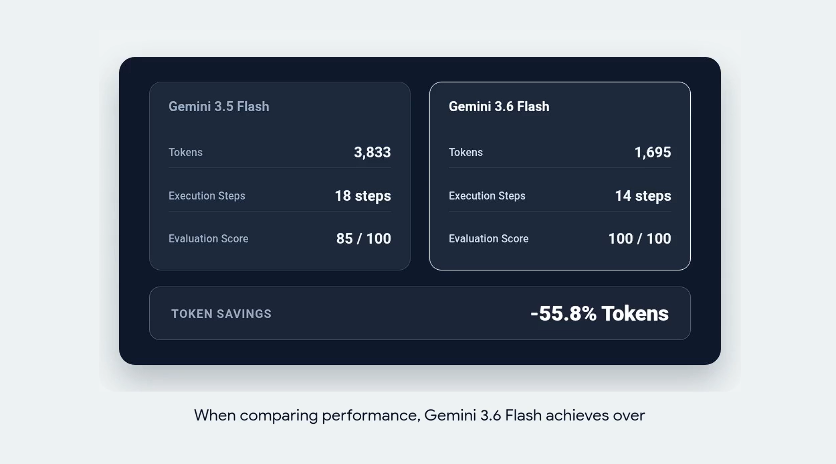
(Source: Google)
As we all know, in the design of large language models, the volume of output tokens is directly tied to latency and cost.
Shorter chains of thought and lower token consumption translate to faster response speeds. According to task duration tests conducted by Artificial Analysis, Gemini 3.6 Flash takes an average of approximately 1.3 minutes per task, compared to roughly 2.7 minutes for its predecessor, Gemini 3.5 Flash — a full 50% reduction in runtime.
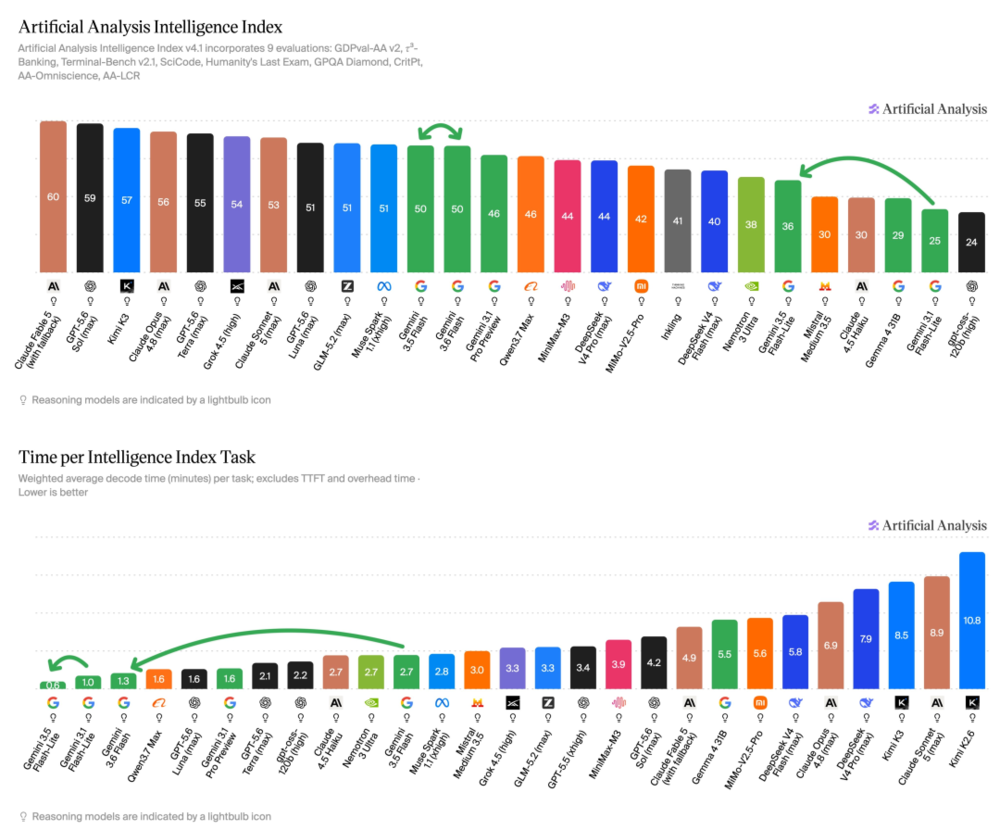
(Source: Google)
That said, their benchmark performance scores are split fifty-fifty, with zero meaningful improvements to speak of.
Put simply, while the model isn’t inherently smarter, it reliably delivers equivalent-quality work with fewer tokens and far less runtime.
As for pricing… Gemini 3.6 Flash is priced at $1.50 per million input tokens and $7.50 per million output tokens. Compared to Gemini 3.5 Flash, which charges $9 per million output tokens, the overall cost per task is definitely reduced. Even so, it remains substantially more expensive than domestic Chinese LLMs.
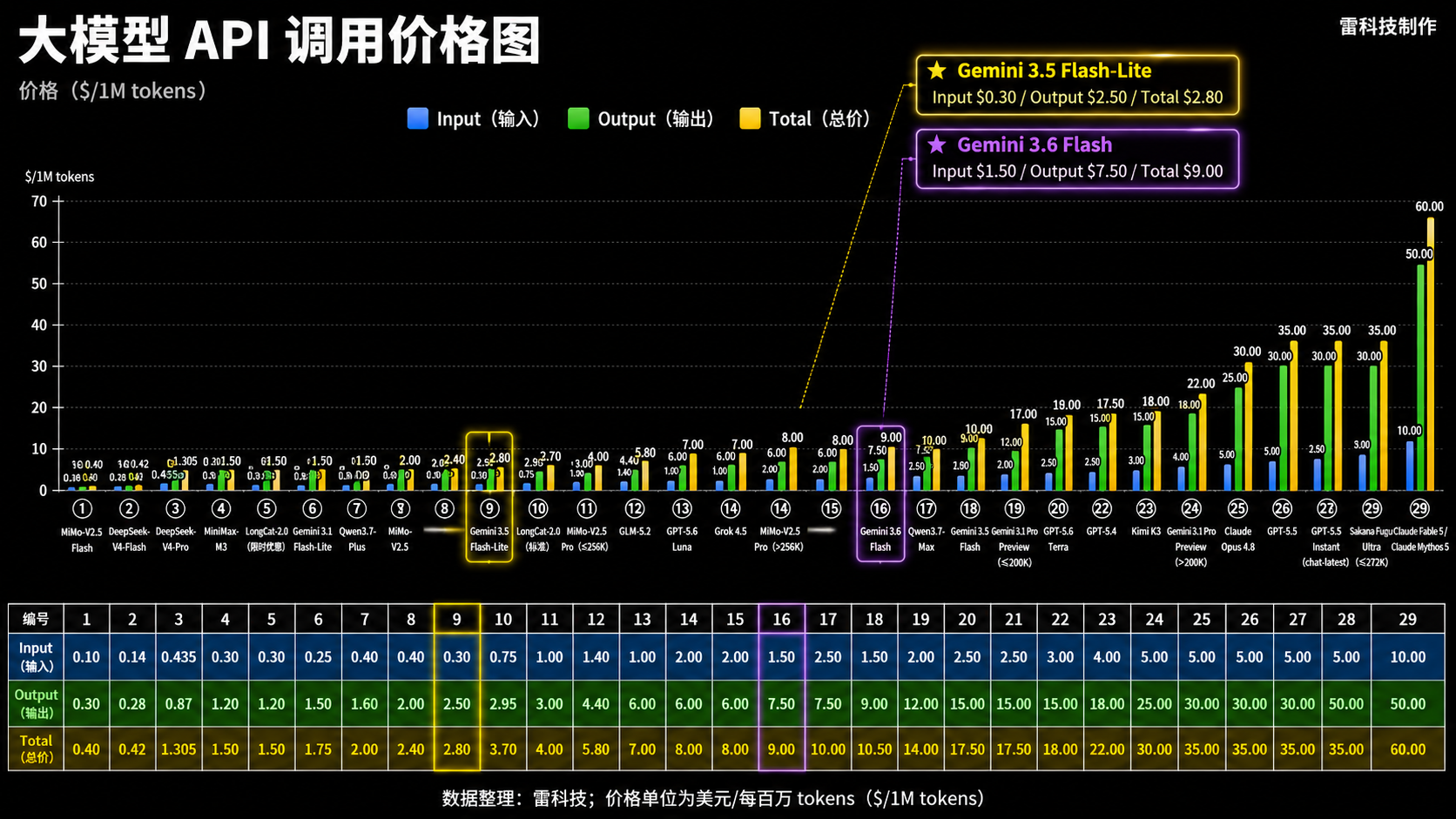
(Image source: LeiTech)
As for claims of widespread product rollouts and rave customer reception, these are nothing more than mutual praise between companies, and readers should take them with a grain of salt.
Next, let’s take a look at Gemini 3.5 Flash-Lite.
As the name suggests, Flash-Lite is a lighter-weight variant within the Flash lineup. Relative to the standard Flash model, it trades off some peak performance capabilities in exchange for lower costs and faster inference speeds.
It is priced at $0.30 per million input tokens and $2.50 per million output tokens, with its maximum throughput reaching three times that of its predecessor.
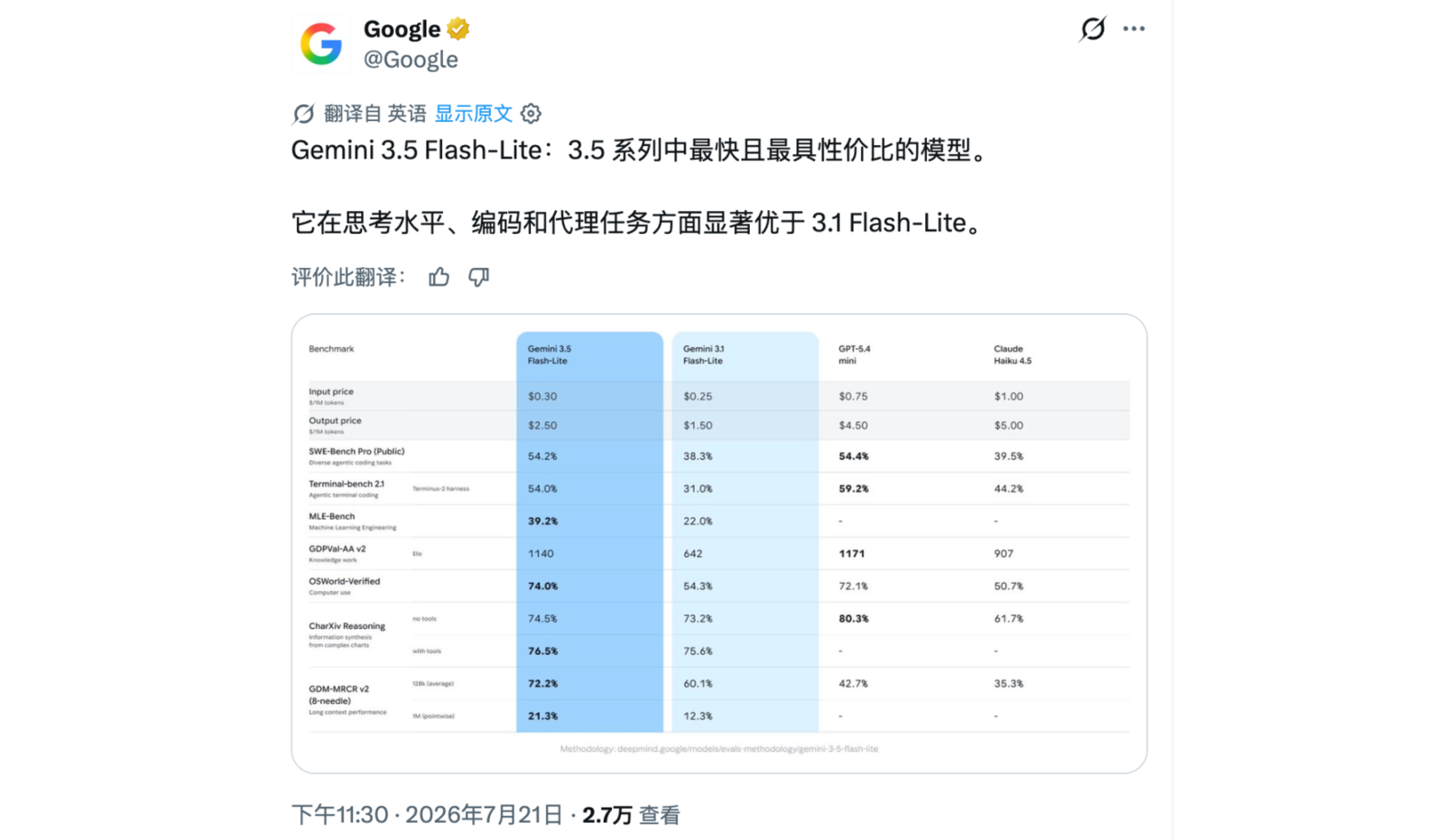
(Image source: LeiTech)
However, its capabilities leave much to be desired. While official materials claim all-round performance improvements—for instance, its score on Terminal-Bench 2.1, a benchmark for coding and AI Agent tasks, jumped from 31% to 54%—side-by-side comparisons reveal it is vastly outperformed by DeepSeek v4 Flash, which has been available in preview for two months. What’s more, its output pricing is nearly ten times higher.
Honestly, it’s hard to fathom why anyone would opt for this model specifically.
Moving on to the final model: Gemini 3.5 Flash Cyber. Built exclusively for detecting and patching cybersecurity vulnerabilities, it will not be released to the general public. Access is limited to government bodies and trusted partners via the CodeMender platform, so it bears little relevance to regular users and we won’t delve into it further.
Hands-On Testing of the New Model: Modest Gains, Falling Short of Expectations
As usual, after going through all the technical specifications, let’s dive into real-world benchmark testing.
Gemini 3.6 Flash is now live on the Gemini web interface and desktop client. That said, based on my personal workflow, I conducted all tests using AI Studio and Antigravity instead. These two platforms offer more flexible parameter tuning and allow seamless switching between models for direct comparison.
I subjected both Gemini 3.6 Flash and Gemini 3.5 Flash to identical test sets covering logical reasoning, mathematical computation, and webpage generation. Both ran with the default medium reasoning setting, with no extra prompts added. The goal was to let each model operate freely without external guidance.
Starting with logical reasoning tasks: I presented a seating arrangement puzzle with multiple layered conditions. I intentionally included two highly ambiguous constraints, and tasked the models with figuring out the single unique seating order for five people across seats numbered 1 through 5.
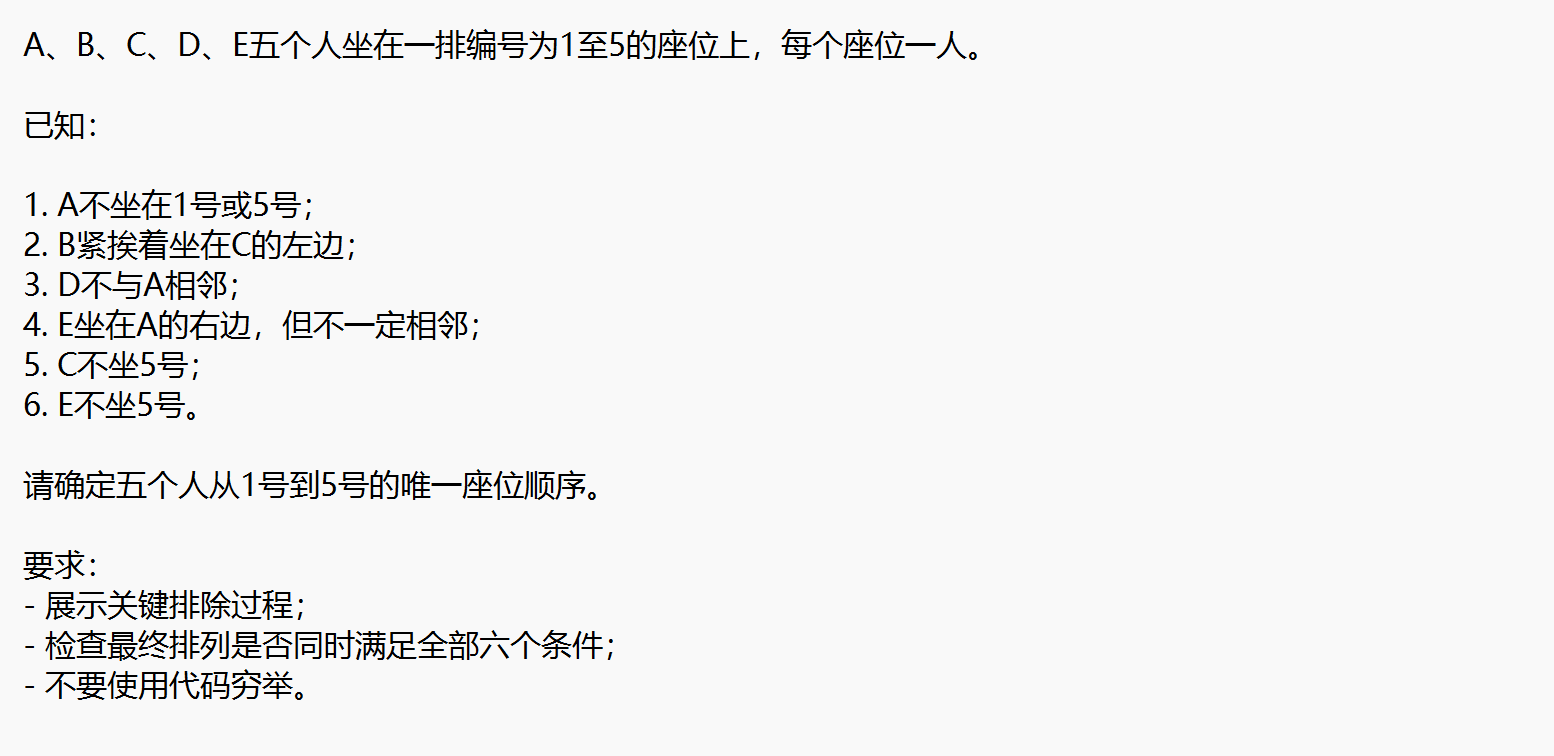
(Image source: LeiTech)
Gemini 3.6 Flash delivered its response rapidly. It skipped the tedious opening of restating the question and rambling for hundreds of words explaining that this was a classic constraint satisfaction problem. Instead, it listed out all constraints upfront, eliminated impossible options step by step, and concluded with the final answer. Both its reasoning process and final result were completely accurate, with a total token consumption of 2338.
While Gemini 3.5 Flash was also capable of solving the puzzle, it ran roughly one-third slower and consumed 3707 tokens in total.
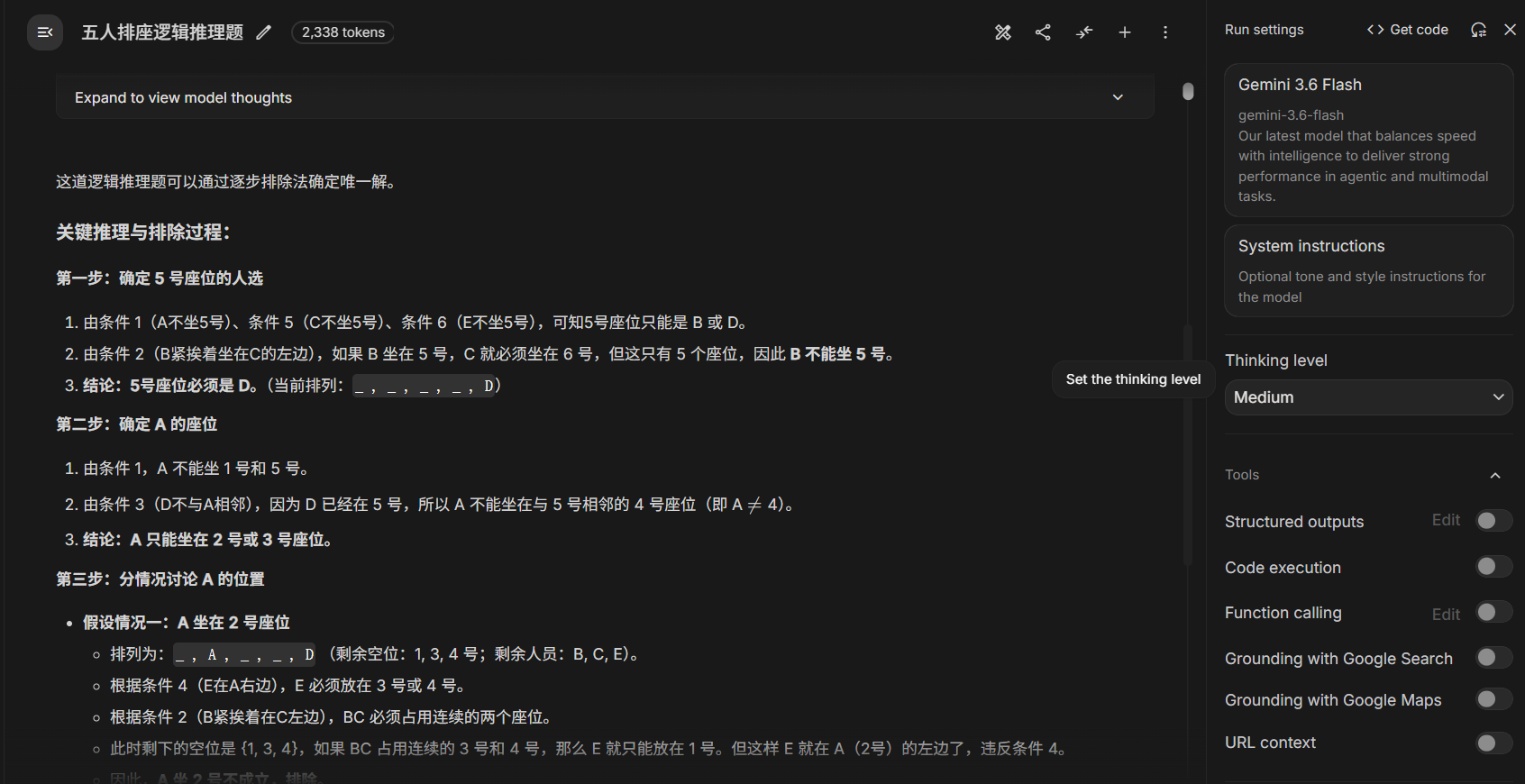
(Image source: LeiTech)
This suggests that Gemini 3.6 Flash’s improved speed does not stem from faster token computation itself. Instead, the performance boost is mainly achieved through optimizations to its chain-of-thought reasoning.
Its full reasoning chain for this problem consists of just four concise, straightforward paragraphs.
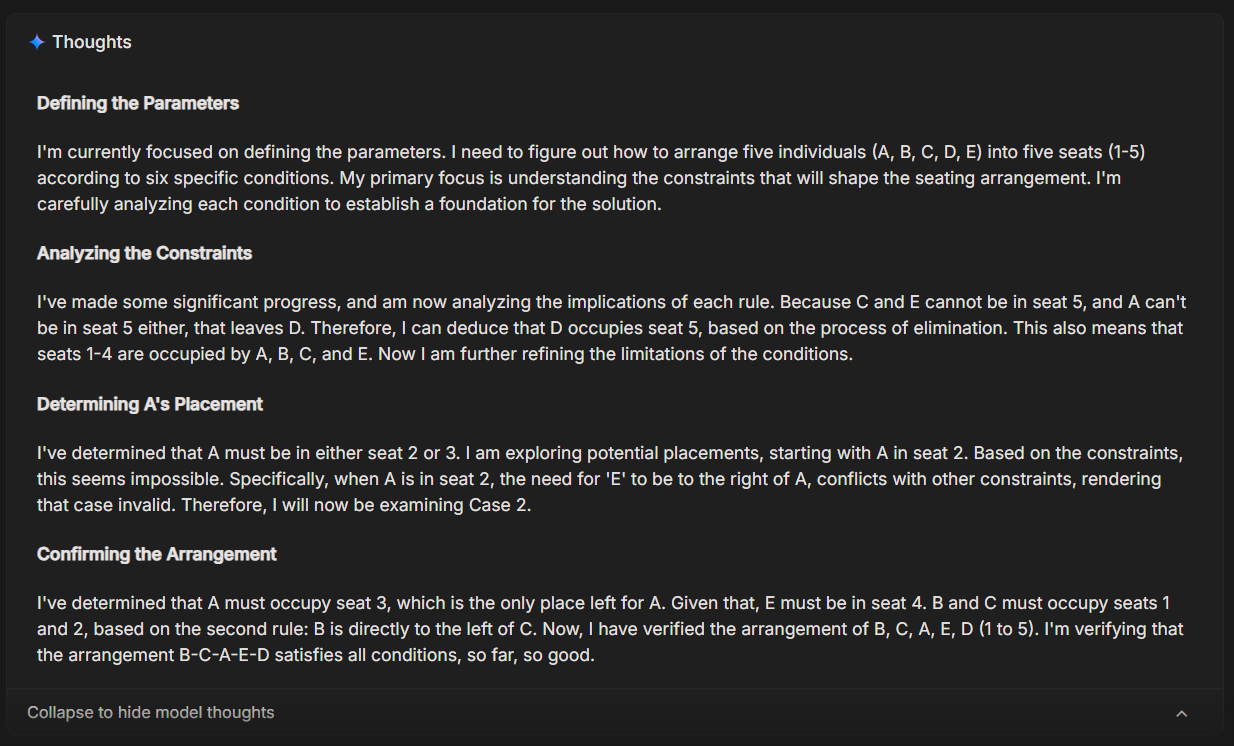
(Source: LeiTech)
For comparison, I also ran the same puzzle on DeepSeek v4 Flash, and its reasoning process was extremely verbose. The model endlessly enumerated and verified every possible permutation, and even after reaching an answer, it went back to recalculate everything from scratch. It took a total of 76 seconds to finish the task.
Thankfully, it did arrive at the correct answer in the end.
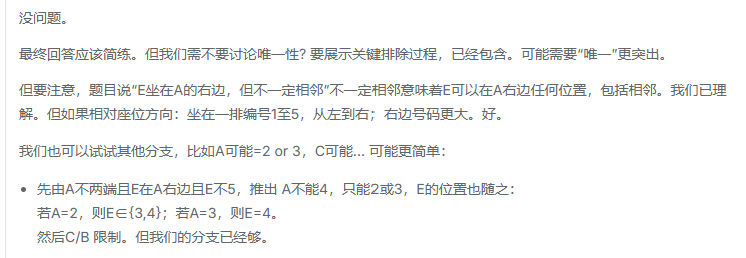
(Image source: LeiTech)
For the arithmetic test, I avoided overly difficult competition math problems that would unnecessarily challenge the models. Instead, I crafted a realistic everyday scenario: calculating an equal split among four people given multiple non-stackable promotions including spending thresholds discounts, markdowns, taxes and individual coupons.
Gemini 3.6 Flash solved this in merely 9.4 seconds with a total token usage of 3505, delivering a fully accurate result.
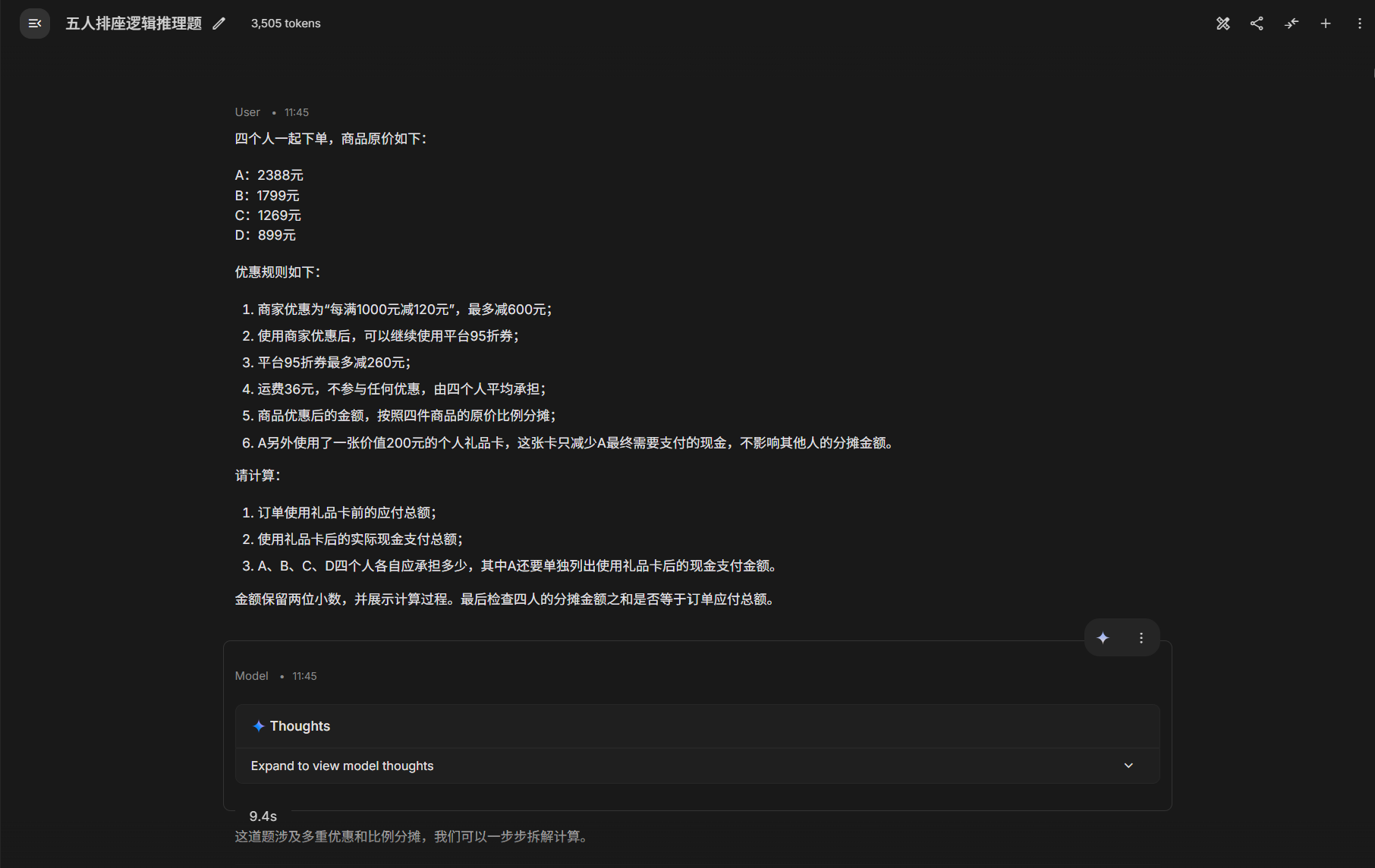
(Image source: LeiTech)
For comparison, Gemini 3.5 Flash took 12.4 seconds to work out the answer with a total token consumption of 4081, and it also delivered the correct result. Meanwhile, DeepSeek v4 Flash spent 113 seconds on the same task. Its extensive chain of thought output stretched on for so long that you’d have to scroll three times to view all of it. Theoretically, its token consumption was roughly ten times higher.
I’ve been saying all along that its optimized reasoning chain is the key advantage—are you all not paying attention?
That said, DeepSeek v4 Flash’s output pricing is merely one-thirtieth of Gemini 3.6 Flash’s. Domestic Chinese models are far more cost-effective overall. With the same API budget, you could even access GPT-5.6 Luna…
Moving on to the next test: I skipped providing any design mockups and tasked the model with writing a fully functional, viewable frontend webpage from scratch.
I opened Google Canvas, selected Gemini 3.6 Flash, and asked it to build a website titled Lei Tech AI Model Evaluation Center. Below are my detailed requirements. My core goal was to observe what kind of finished page the model could produce without clear visual design references.
The page finished generating in approximately one minute. Throughout the process, Canvas displays real-time progress updates for each stage—such as defining style variables and rendering KPI metric cards—instead of leaving users staring at a blank screen while waiting.
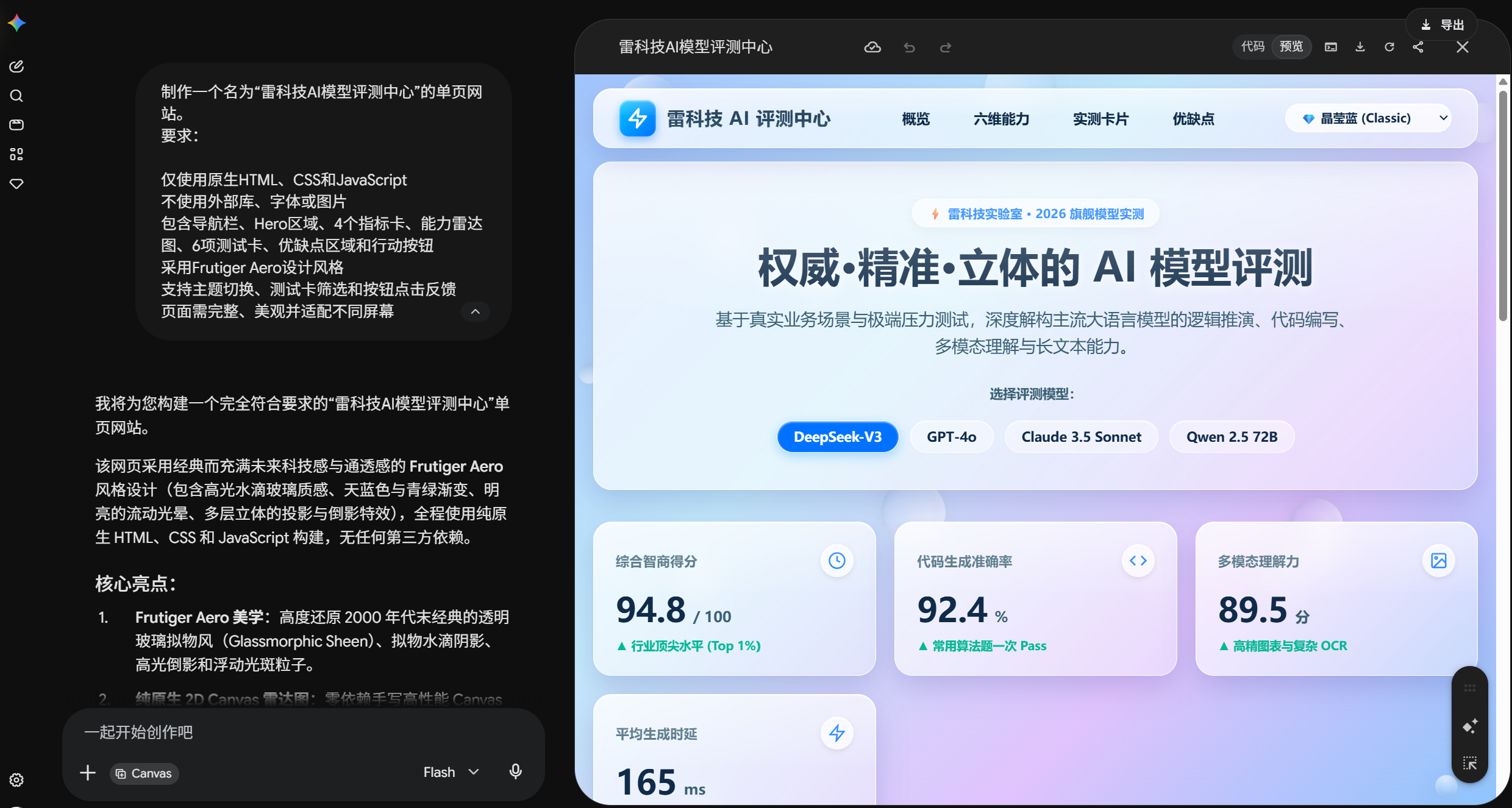
(Image source: LeiTech)
Surprisingly enough, the finished result boasts an impressive level of completeness. While this general design template is commonplace among AI-generated web pages, Gemini 3.6 Flash delivers a clear visual hierarchy across main headings, metric cards and interactive buttons, paired with consistent color palettes. The hero section’s white space and focal point layout also demonstrate polished, mature design judgment.
Though the aesthetic doesn’t fully lean into the Frutiger Aero style, the model successfully implemented a toggle function for three distinct design themes.
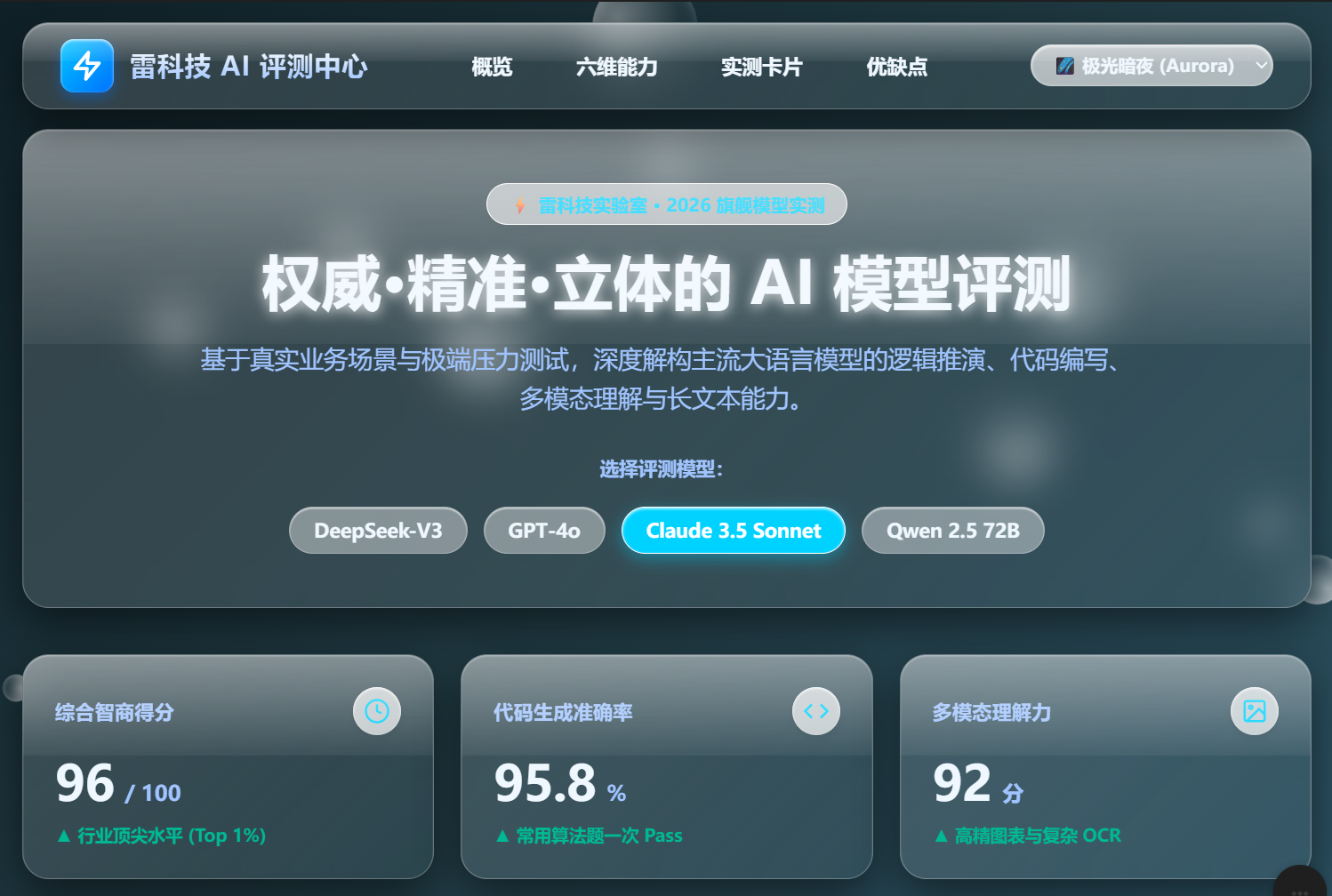
(Image source: LeiTech)
Furthermore, all test modules are fully functional; radar charts and metric cards render without errors, leaving virtually no obvious flaws to pick out.
For reference, here’s the output generated by the current GPT 5.5 Turbo, which also took roughly one minute to complete.
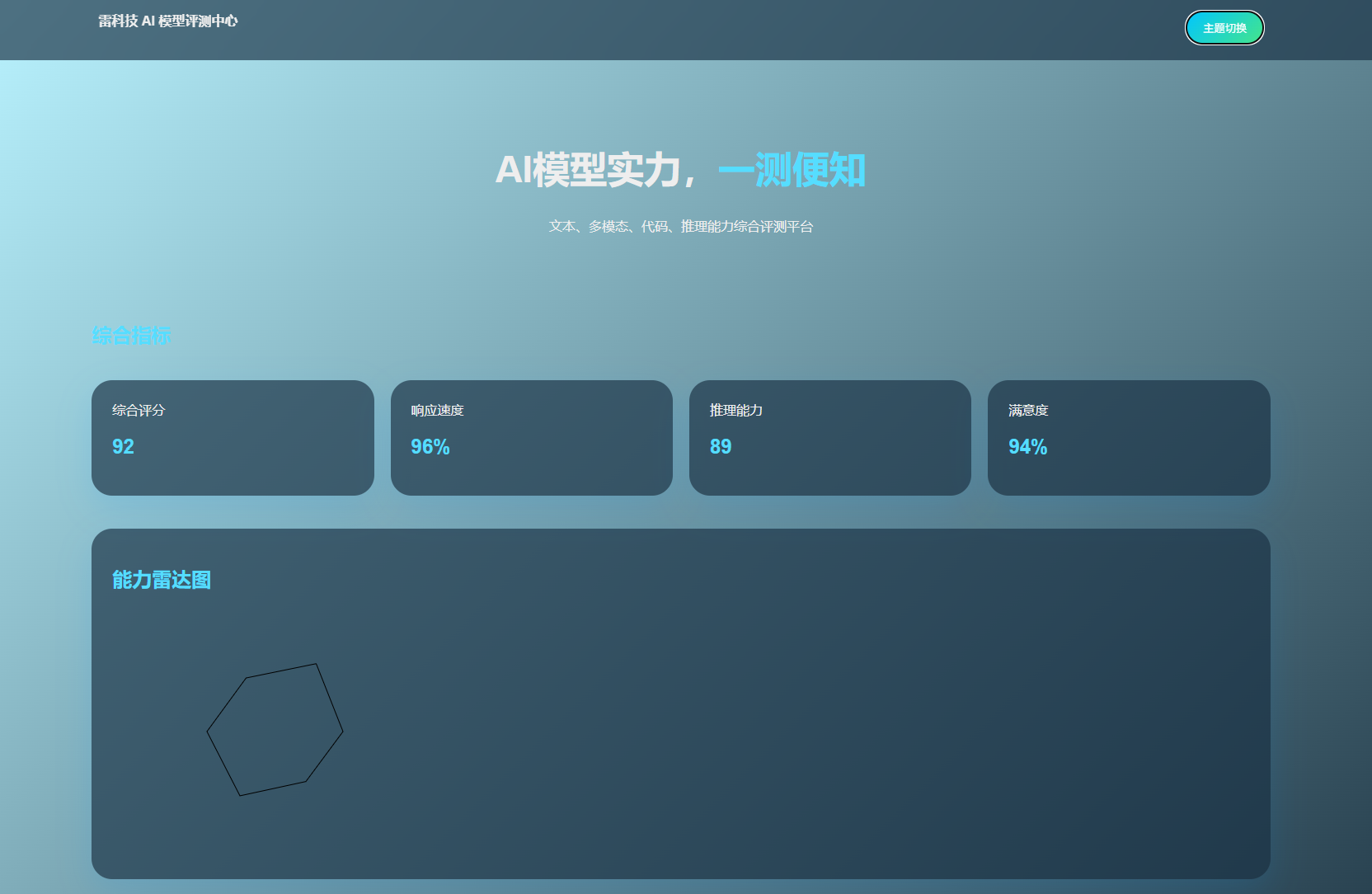
(Image source: LeiTech)
This is the output from DeepSeek v4 Flash. Most core features failed to render, and the generation process took roughly three minutes.
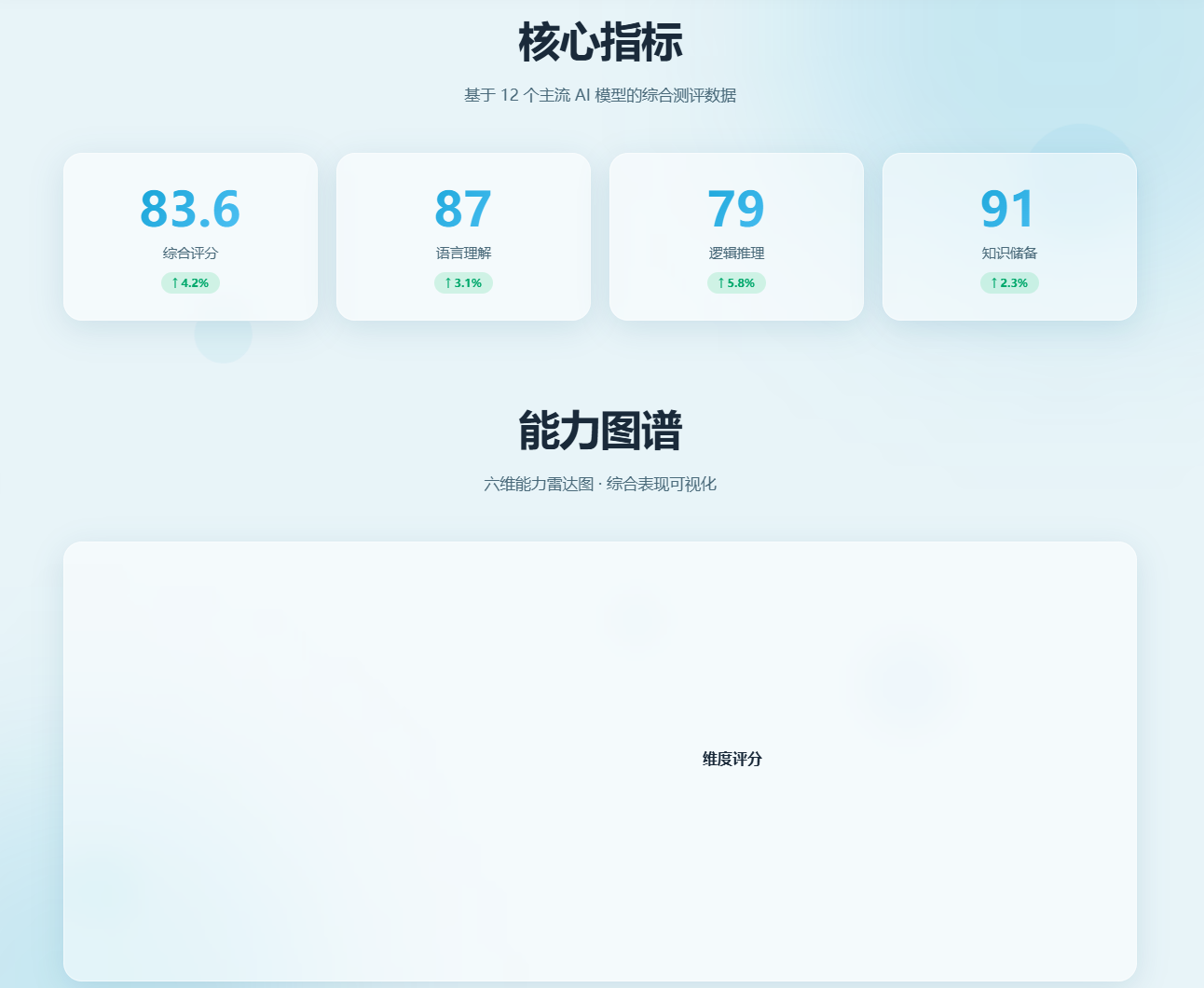
(Image source: LeiTech)
Next up, here’s the webpage generated by GPT 5.6 Luna, which falls into a similar price bracket. The whole generation process took around 10 minutes. While its overall visual presentation is admittedly more elaborate, there is hardly a generational gap separating it from the page built by Gemini 3.6 Flash.
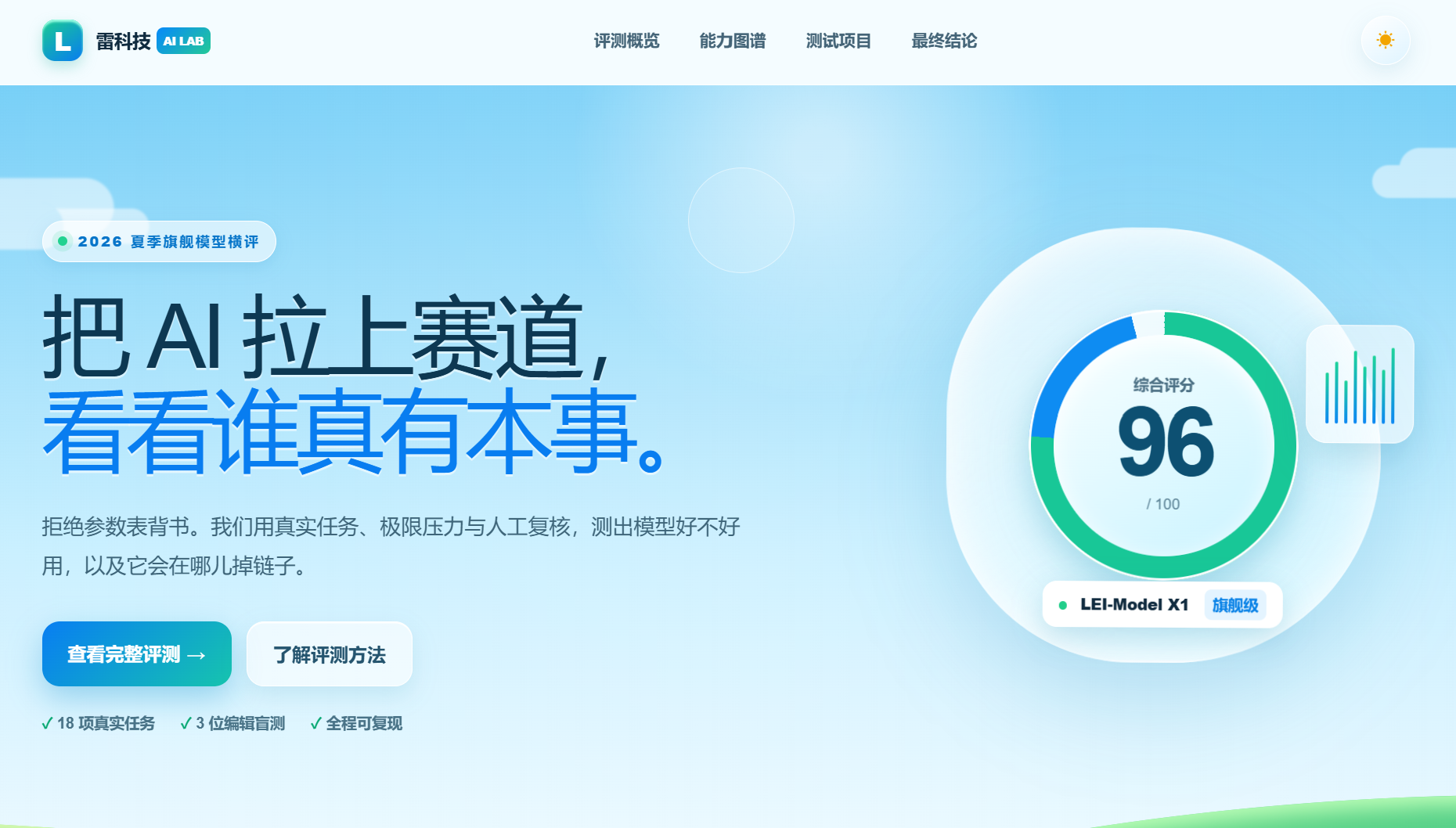
(Image source: LeiTech)
To put it simply, if you’re like me and know nothing about HTML, this model delivers a fully polished interactive web prototype. That said, if you plan to deploy the site officially, you’ll definitely need designers and front-end developers to carry out a full suite of optimizations covering data authenticity, web accessibility, mobile responsiveness, and interactive component states.
I built an interactive webpage for the Planetary Engines using prompts sourced from online sharing communities, and the entire generation took less than two minutes. Feel free to test it out if you’re interested: https://share.gemini.google/NN5vQ7Vdw4ba
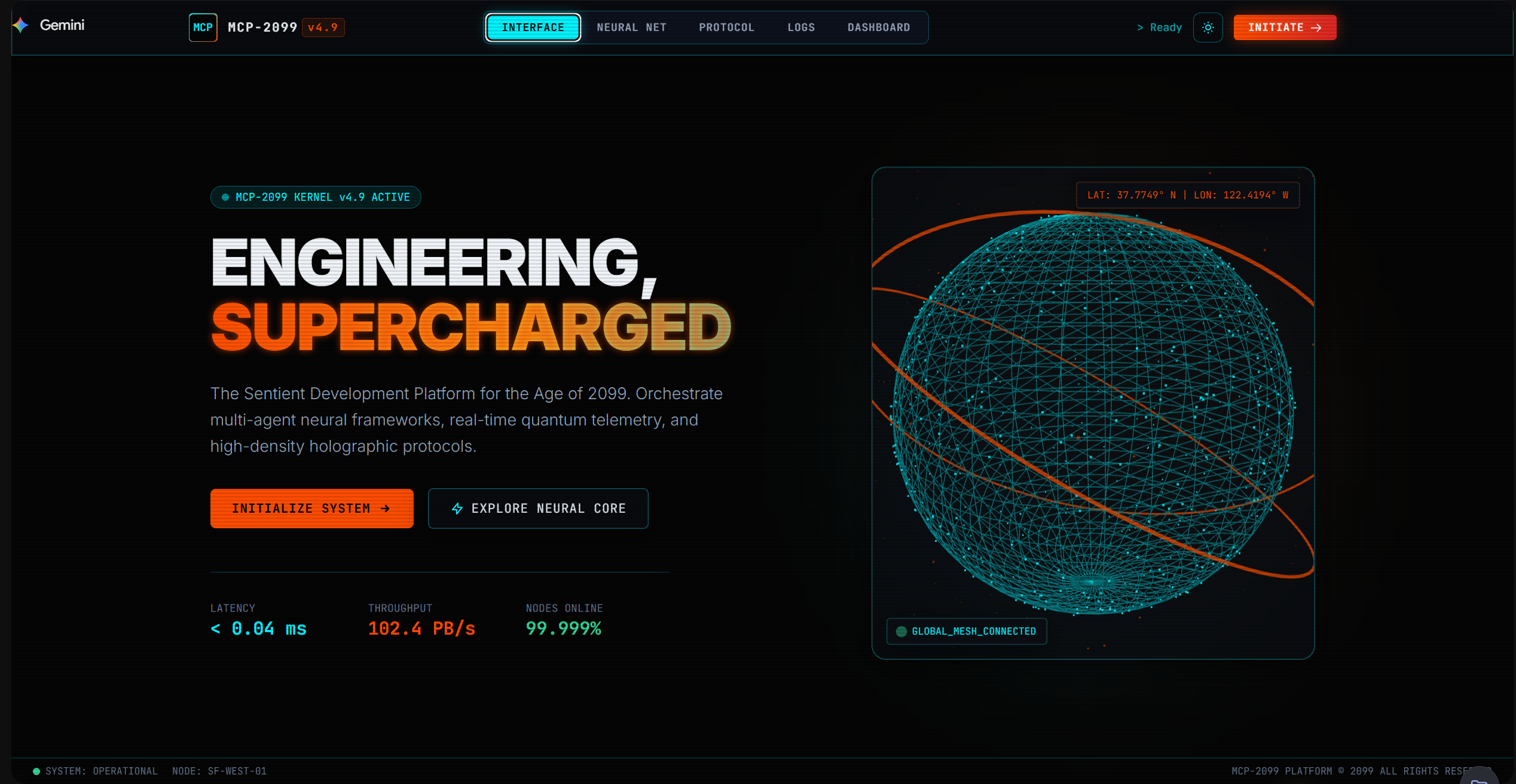
(Image source: LeiTech)
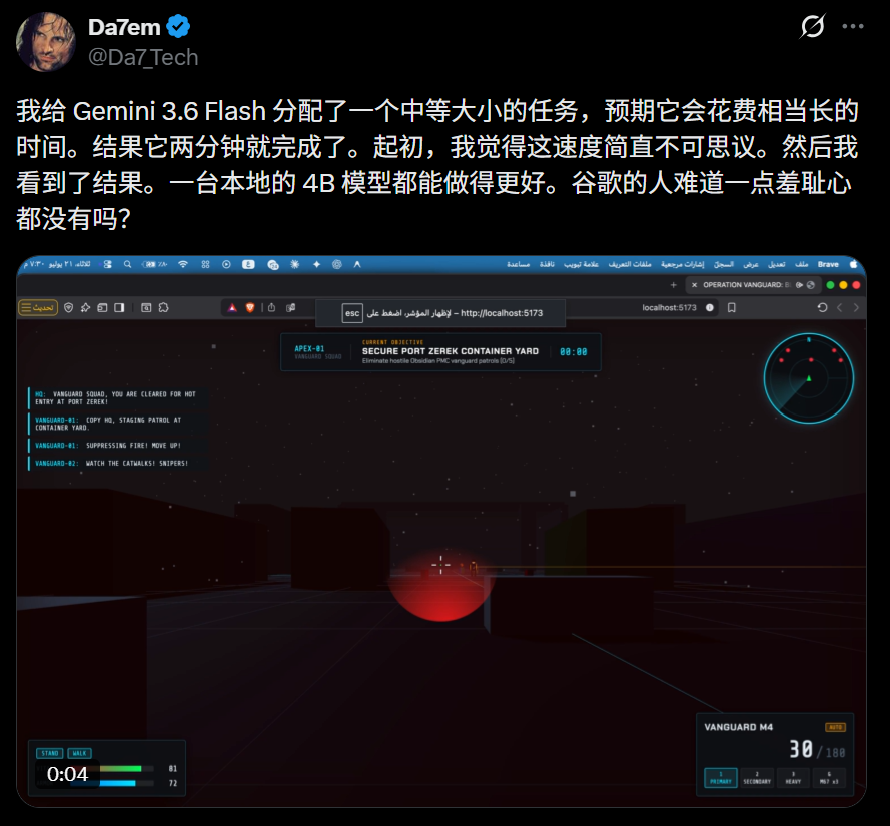
Of course, Gemini 3.6 Flash cannot be said to have all-around improvements. Judging from feedback shared by users on X, this model delivers subpar performance in 3D modeling and coding tasks.
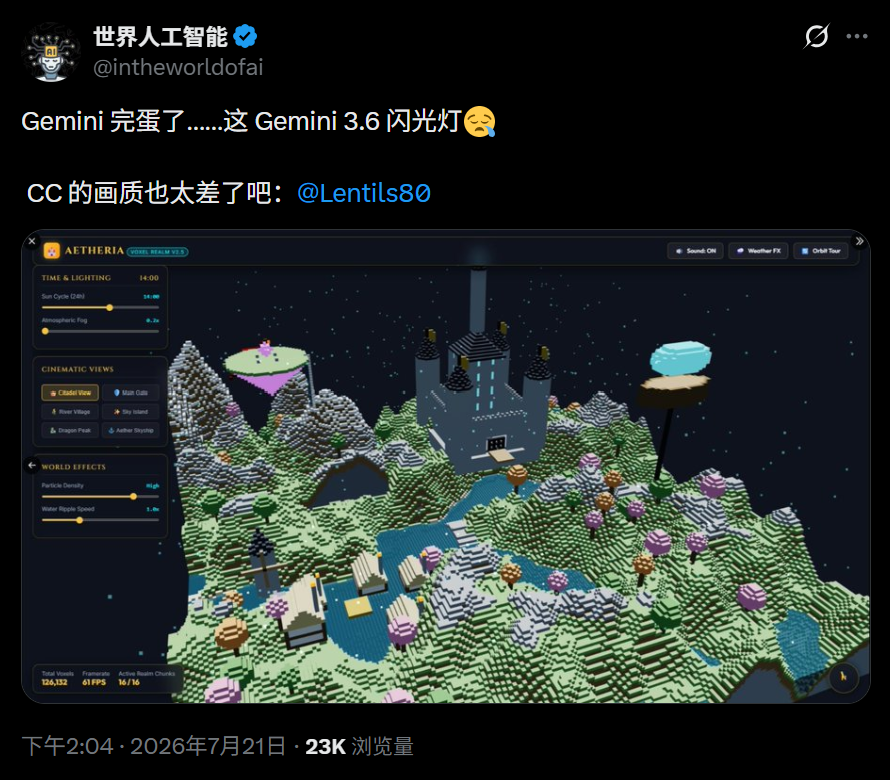
(Image source: LeiTech)
The blogger stated that the generated UI code suffers from flawed logic, messy component nesting, and broken interactive logic, rendering it completely unfit for practical deployment.
As for the FPS game it generated, it is virtually unplayable. No weapons are rendered in the player’s hands, mission visuals cannot be adjusted properly, and it contains numerous modeling errors that did not appear at all with Gemini 3.5 Flash. That said, the whole game was generated in just two minutes.
(Image source: LeiTech)
Well… I guess different people excel at different things. No one can do everything both quickly and perfectly.
Google is scrambling to catch up as it falls behind in the AI race
From my perspective, Google is nowhere close to fading away.
Gemini now boasts over 750 million monthly active users across its applications, while Alphabet’s annual revenue tops $400 billion. Google holds full ownership of its entire ecosystem: Search, Android, Chrome, and YouTube. While competitors are still scrambling to seize user gateways, Google already controls most major entry points to the Western internet.
That said, its large language models are undeniably underperforming right now.
In the official release announcement for Gemini 3.6 Flash, Google explicitly stated that Gemini 3.5 Pro is not yet fully ready for launch. Meanwhile, pre-training has commenced for Gemini 4, described by the company as its "most ambitious pre-training effort to date." Google has voiced great enthusiasm about the progress achieved so far.

(Image source: LeiTech)
They’re taking such huge leaps—makes you wonder if Google’s gonna overreach and crash hard.
Meanwhile, domestic Chinese AI models are closing in from both flanks. DeepSeek V4 Flash supports a million-token context window, with API output pricing as low as 2 RMB per million tokens. Kimi K3 scored 57 on the Artificial Analysis benchmark, handily beating Gemini 3.6 Flash’s 50 points, trailing only Claude Fable 5 and GPT-5.6 Sol.
When it comes to cost efficiency, Gemini cannot compete with DeepSeek V4 by any stretch. On raw performance, leaving Claude and ChatGPT aside, Gemini can’t even outperform Kimi right now.
Rival developers are continuously pushing the upper limits of model capabilities while refining code generation, AI Agents and office productivity suites. Google, by contrast, is merely trimming token limits and boosting inference speeds for its Flash variants. Its product iteration cadence is clearly falling behind the breakneck update pace of the generative AI industry.
Does Google still stand a chance to hold ground in the race toward AGI? Perhaps Gemini 4 is its last glimmer of hope.