
 雷科技
雷科技






The main forum of the 2026 World Artificial Intelligence Conference and the High-Level Meeting on Global AI Governance (WAIC 2026) was officially held from July 17 to 20. As an annual grand event for the AI industry, this year’s conference brought together domestic and foreign large model developers, AI application providers and hardware manufacturers. Lei Tech’s AI-focused new media channel Lei Tech AGI (leikejiagi) dispatched a reporting team to cover the event on site in Shanghai.
Robotics undoubtedly stole the spotlight at this WAIC. Even their casual movements around the exhibition halls drew crowds three layers deep. Yet several quieter scenes left a far deeper impression on us: RoboTime robots continuously hauled boxes on simulated production lines; Qianjue robots slowly folded cardboard boxes; Agile Robots staffed exhibition navigation services wearing yellow vests; the rear camera on Honor smartphones popped out and automatically rotated to track people’s faces.
Official conference statistics show WAIC 2026 spanned four exhibition halls across three locations, covering an exhibition area of over 100,000 square meters. More than 1,100 enterprises showcased 3,000 exhibits, including 300 globally debut products. Even so, the true highlight of this year’s WAIC lies not in its massive scale, but in tangible hardware innovation.
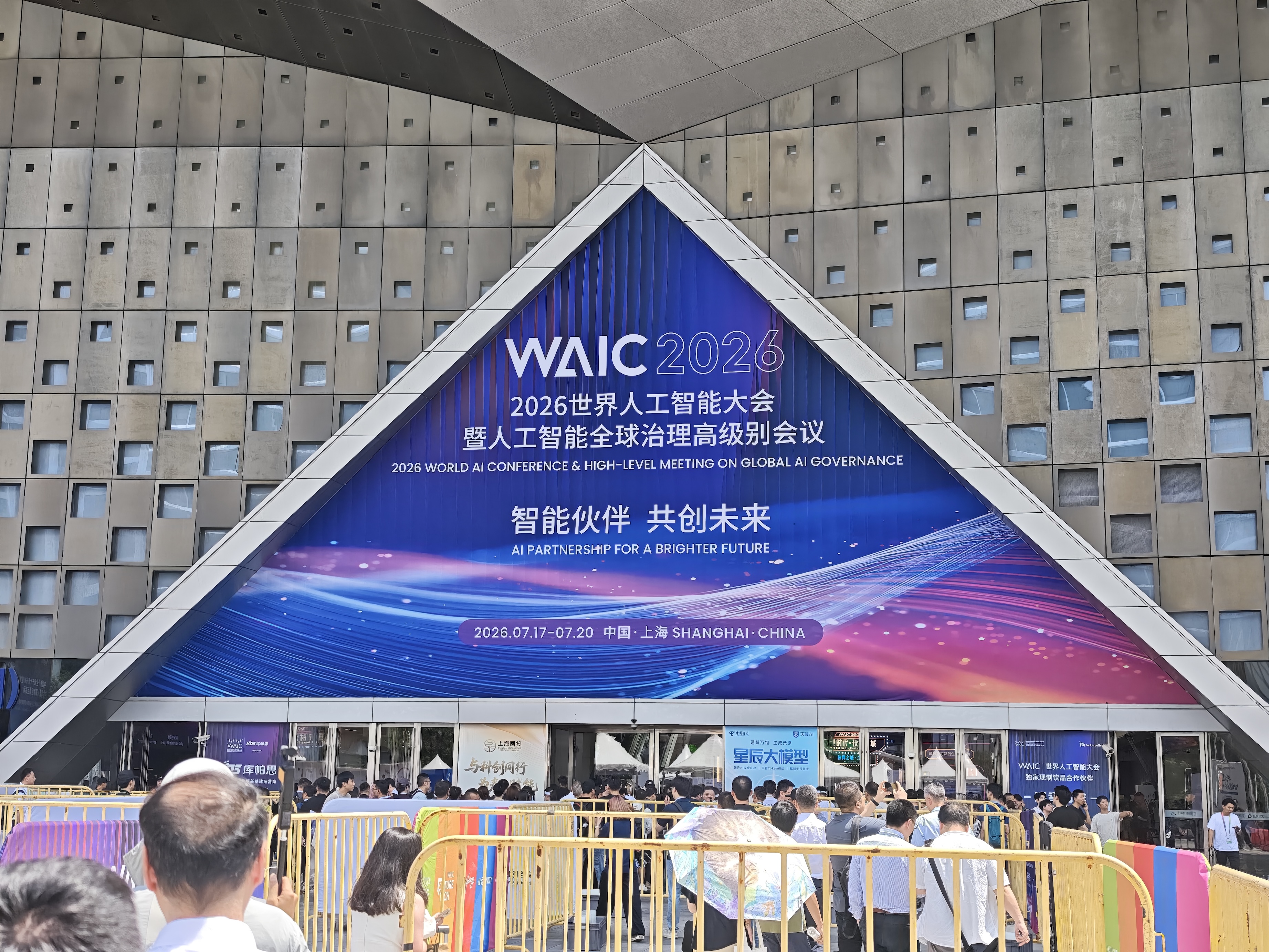
Image source: LeiTech
Large language models are still around, and chatbots have not vanished. However, AI is no longer content with answering questions on screens. Instead, it is embedded into smartphones, smart glasses, computers, vehicles and robots, taking control of sensors, accessing applications and manipulating mechanical components, thereby reaching out to interact with the physical world.
Arguably, this is the most hardware-focused WAIC over its nine editions. It also marks the first time AI has extensively stepped into the real world via hardware carriers including humanoid robots, agent-enabled cellphones, AI glasses and Agent Computers.
I. How high is the hard-tech content of this WAIC?
The "hardware orientation" is first and foremost visible to the naked eye.
Smartphones are equipped with mechanical structures; smart glasses are competing for operating system dominance; robots are moving from exhibition booths to factories; automobiles featuring world models and AI agents make their appearance at the AI conference. Beyond that, domestic AI chips are no longer merely displayed as individual boards. Instead, supernodes, clusters of 100,000 chips, near-memory computing and robot development boards have all been brought into the exhibition halls.
AI is hunting for diverse physical "bodies". Boasting mature computing power, displays, applications and payment ecosystems, cellphones serve as the most viable carrier for personal AI agents at the current stage. Smart glasses sit close to human eyes and ears, acting as the most intuitive first-person access point. Robots and cars come with actuators that can directly alter the physical environment.
Even personal computers are undergoing transformation. Conventional AI PCs mainly highlight NPU computing capacity and local large models. By contrast, Agent Computers (AC) and Agent PCs showcased at WAIC place greater emphasis on execution. Products such as Agentic Computers and Agentic Box presented by Xinnor Technology enable edge devices to handle model inference, task scheduling, permission management and data auditing all at once.
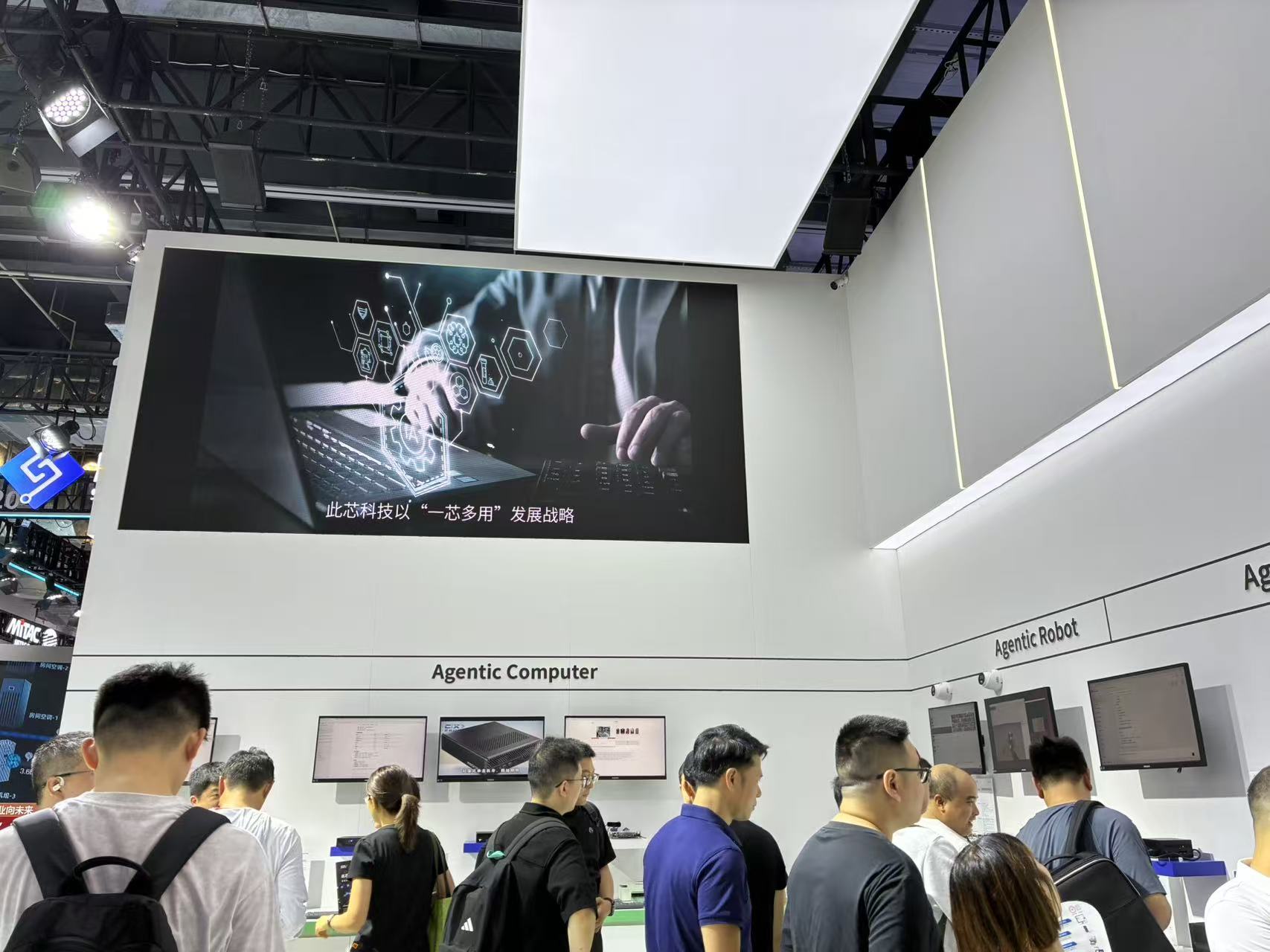
Image source: LeiTech
Likewise, Liulian Intelligence’s Agent PC solution integrates CPUs, GPUs, NPUs, local large models and enterprise management systems into a unified delivery chain.
This means the integration of AI and hardware is no longer simply adding a chat window to devices. AI models need to perceive surroundings captured by cameras, mobilize local computing power and cloud services, carry out operations across different apps, and prompt users for confirmation at critical steps. When deployed in robots and vehicles, AI must even take accountability for every brake, grab and movement.
Nevertheless, more hardware exposure makes AI errors far harder to conceal. Accordingly, the hardware-focused features of this WAIC stem not only from physical hardware, chips and robotic arms, but also from a comprehensive supporting system covering latency, reliability, access permissions, security, costs and product delivery. These metrics have replaced raw benchmark scores as mandatory considerations for all AI products.
II.Which consumer electronic products stand out the most?
At this year's WAIC, consumer electronics feature two clear major trends: agent-enabled smartphones and AI glasses.
The Nubia NaviX Ultra, also known as the second-generation Doubao Phone, largely sticks to the GUI Agent development path. The phone can recognize screen content, simulate human taps, swipes and text input, and complete cross-app tasks such as price comparison, ticket booking and food ordering. Theoretically, AI can operate any interface accessible to human users.
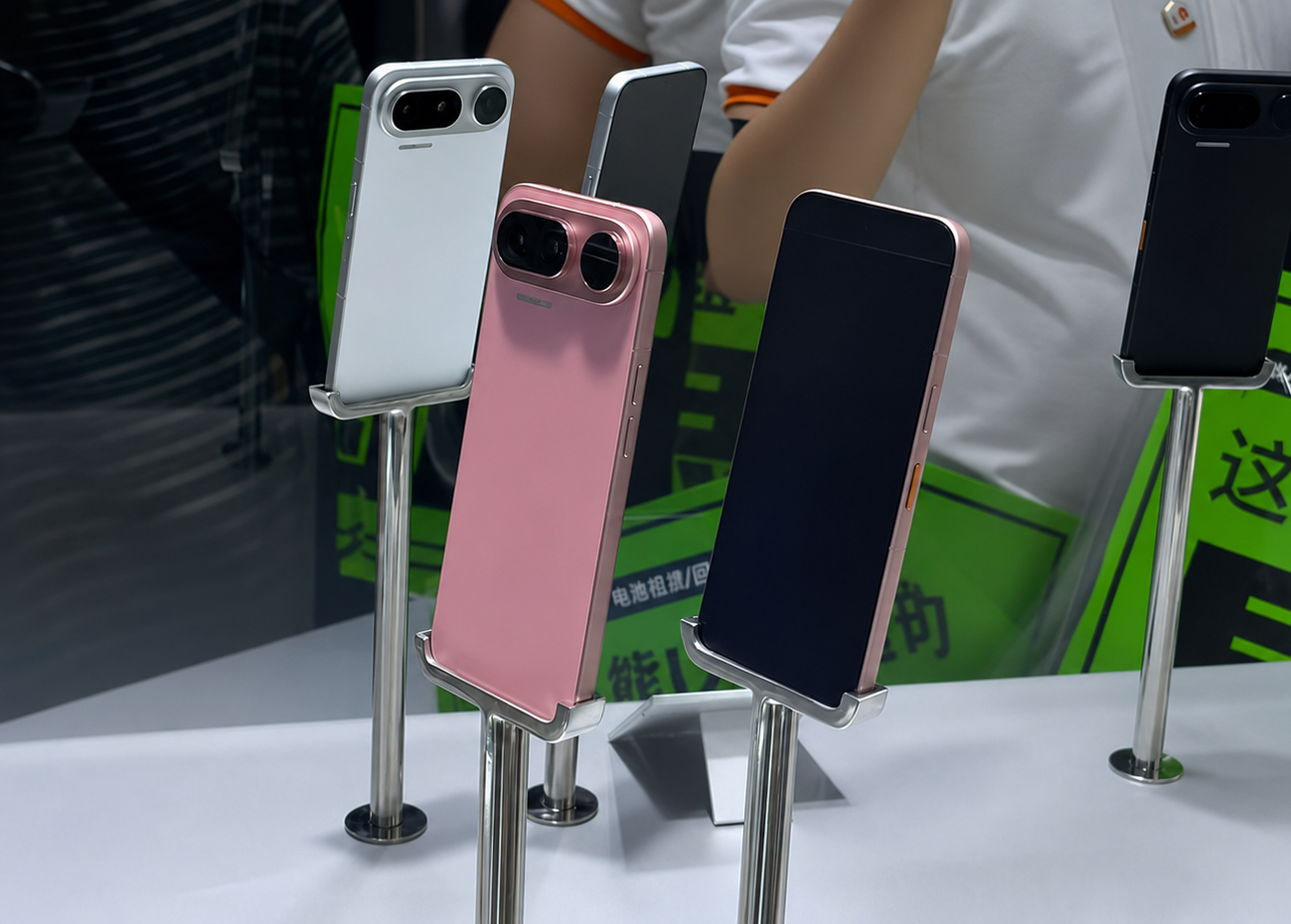
Image source: LeiTech
However, the NaviX Ultra features the design of a mass-produced flagship phone and a new dedicated AI key. More importantly, its capabilities go far beyond GUI. Consistent with Lei Tech’s earlier analysis, it connects to major platform applications via standard interfaces such as A2A and MCP, allowing the built-in agents of these apps to follow up and carry out subsequent operations and processing.
In contrast, Stepfun’s STEPX Neo takes a full redesign approach to smartphones. It centers user interaction around Amoo, the personal AI agent. Users no longer need to figure out whether to open Maps, Meituan, Ctrip or Alipay. They only need to state their goals and preferences, and Amoo will plan tasks and coordinate relevant services. The underlying Step AOS uniformly manages local and cloud-based models, CPU/GPU/NPU computing power, cross-app semantic memory and system permissions. It breaks down functions including communication and file management into atomic services accessible to agents.
Honor’s distinctive Robot Phone also boasts agent features yet prioritizes active perception. Equipped with an extendable, freely rotating mechanical gimbal, its camera actively tracks people and scans surroundings, lending a tangible physical dimension to follow shooting, video calls and contextual awareness. While this design draws massive attention, it brings challenges including mechanical durability, power consumption and privacy limits for continuous environmental monitoring.
While the NaviX Ultra and STEPX Neo focus on enabling cross-app workflows, the Robot Phone explores brand-new sensory capabilities for agent smartphones.
Agent smartphones aside, major upgrades to AI glasses also stood out at this WAIC. Tongyi announced on-site that its AI glasses will receive Skill and Agent upgrades. Instead of merely answering voice queries, the glasses can trigger third-party services according to users’ intentions.
With direct access to first-person vision, voice input and ambient data, smart glasses are inherently well-suited for translation, navigation, note-taking and object recognition. Integration with payment, travel and lifestyle services has the potential to make them the most user-accessible gateway within Alibaba’s agent ecosystem.
Rokid went a step further with its platform-focused strategy. Its new-generation Rokid AR glasses support 6DoF spatial positioning, gesture recognition, spatial audio and dual-camera sensing, paired with standalone spatial computing power. The YodaOS operating system unifies models, cameras, displays, spatial coordinates and third-party services within one integrated glasses system.
This path poses great challenges. Every glasses manufacturer aims to build the equivalent of Android for smart glasses. The real hurdles lie in attracting developers, retaining applications, and meeting daily-use requirements in terms of weight, battery life and privacy protection.
All these products compete for the same core advantage: being the fastest to perceive user needs and deliver outcomes through the most streamlined workflow.
III. Robots take center stage: Highlight demos worth noting
In terms of quantity, robots unquestionably dominated WAIC. This year’s most transformative industry shift is that manufacturers have largely moved past flashy gimmicks like dancing, robot fights and backflips.
Agile Robots serves as a prime example. Sixty of its robots were deployed throughout the venue to provide on-site guidance, patrols, interactive entertainment and unattended retail services. These robots were no longer mere exhibits but integral infrastructure supporting the whole event. Agile Robots also built a realistic 3C production line at its booth, demonstrating its Elf G2 robots handling loading/unloading, quality inspection and packaging.
Agile Robots released statistics reflecting key industry priorities: eight robots ran nonstop on a tablet inspection line for 105 days with a task success rate of 99.99% and efficiency hitting 80%–90% of human workers. Initial deployment took roughly four months, while follow-up rollouts were cut down to just one week.
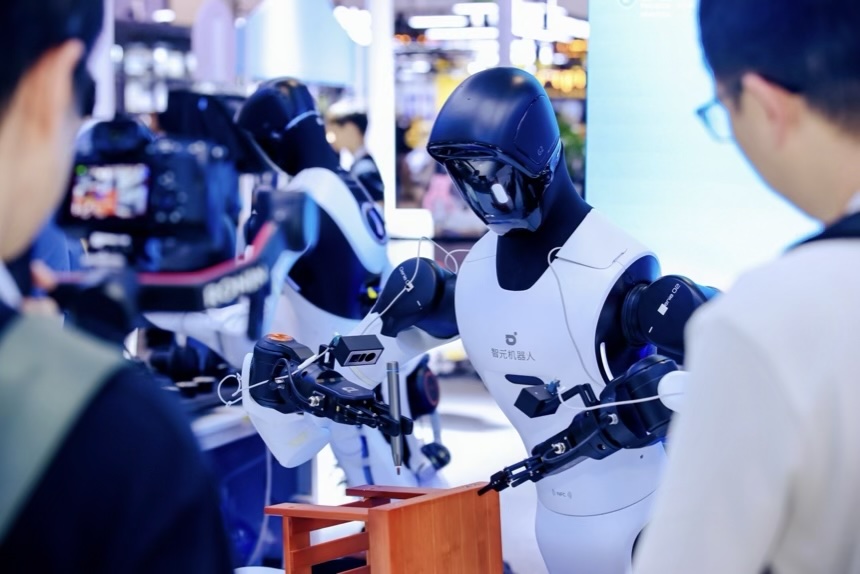
Image source: Zhiyuan
Another highlight that impressed us deeply is tactile sensing. At WAIC, Xense Robotics demonstrated robots slowly folding cardboard boxes, which could resume and complete the motion even after external interference. While computer vision tells robots where a box is, it can barely determine whether the gripper holds the box firmly or if the fold is properly aligned. For "last few centimeters" operations such as assembling earphones, plugging in connectors, and arranging flexible objects, tactile perception often makes or breaks task completion.
Leju Robotics replicated a full production line on-site, with its robots performing continuous material handling and depalletizing for hours on end. Instead of showcasing flashy humanoid robots, Maniformer presented grippers and vision devices built to collect real-world operation data. The former proves "whether robots can actually work", while the latter solves "how robots learn to work".
On-site observations at WAIC reveal that embodied AI is collectively breaking through three core bottlenecks that have long held the industry back: operational stability, high-quality training data, and return on investment. Language models can draw on massive text data from the internet, but robots struggle to acquire physical interaction data of the same scale and quality. Even when the technology is technically viable, enterprises still scrutinize equipment depreciation, maintenance costs, production line retrofitting expenses, and net labor cost savings.
As such, the outcome of the robotics industry will not be decided on exhibition floors. The real report card lies in whether a robot can run nonstop in a factory for months after leaving the spotlight, and whether clients are willing to order a second batch.
IV. After the "Lobster" (OpenClaw) brought AI agents into the spotlight, how prominent are agents at WAIC?
In early 2026, OpenClaw — affectionately nicknamed "Lobster" by Chinese users for its lobster mascot — exploded in popularity. For the first time, it showed the general public that AI can do far more than chat: it can read files, invoke tools, operate computers, and execute sustained task workflows. By WAIC 2026, AI agents are no longer a niche, standalone track; they have seeped into nearly every exhibition zone.
Agents in smartphones invoke cross-app services; agents in smart glasses activate skill modules; agents in PCs process local files; agents in vehicles connect vehicle controls with lifestyle services; and humanoid robots can be seen as agents embodied in the physical world.
Beyond consumer devices, Tencent unveiled its AI Buddy matrix covering office productivity, programming, global business expansion and content creation. Baidu showcased its Dazi (companion) agent ecosystem, while Alibaba presented a full lineup of agent platforms including Tongyi AI Glasses and Alibaba Cloud Bailian.
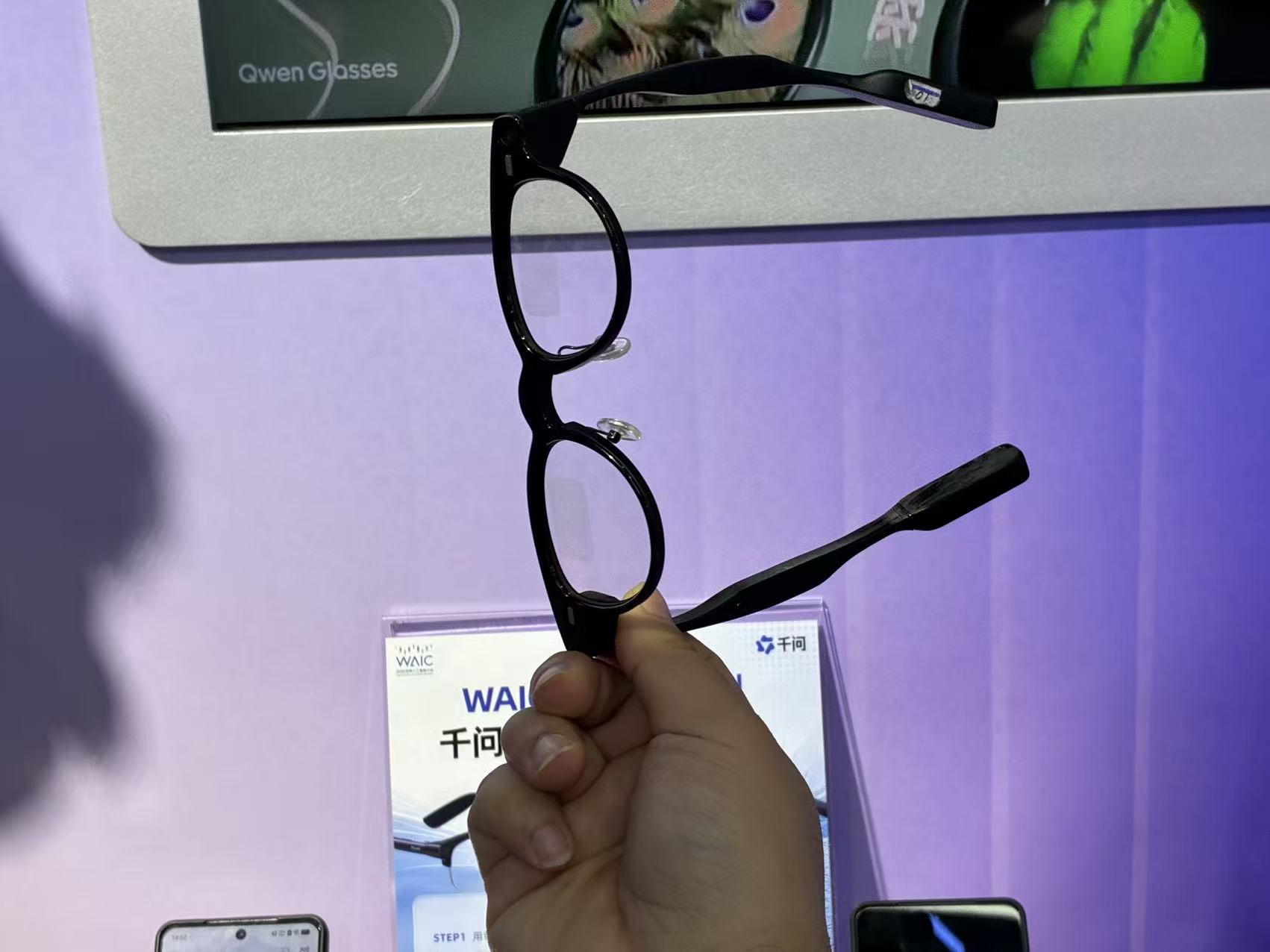
Image source: LeiTech
WPS Lingxi Professional Edition also brings AI agents into daily office scenarios. At WAIC, it manages context and user preferences on a per-project basis, taps into document, spreadsheet, browser and coding capabilities, and ultimately delivers editable, traceable native Office files. WPS Comate for organizations goes further to handle enterprise knowledge, collaboration and permission control.
Competition in office AI agents has advanced from "help me write a paragraph" to "deliver a polished output that remains fully editable".
However, AI agents hold high-level permissions for file read/write operations, system commands and API calls. The stronger their capabilities, the higher the risks of data leakage, misoperation and prompt injection. Once agents take over end devices, model intelligence is only the starting point. Tiered access control, critical operation confirmation, runtime isolation, log auditing and clear liability boundaries are what underpin the mass adoption of such products.
That is why AI agents have a pervasive presence at this WAIC, yet they no longer stand at the center of exhibition booths like large models did last year. Instead, they act as a new layer of operating system, quietly embedded beneath every device and every service.
V. Enterprise-grade AI deployment and industrial applications are undoubtedly the top priority. What impressive demonstrations or solutions were on display?
Enterprise customers seldom pay for a single well-crafted answer. What they actually purchase is a complete system that integrates with business workflows, manages permissions, retains data, runs stably and comes with dedicated maintenance support.
The full-stack AI terminal solution presented by Liulian Intelligence at WAIC hits right at this core demand. It integrates mobile AI PCs, workstations, servers, local models, agent execution, computing power scheduling and enterprise management into one unified framework, seeking to fill the gaps between computing power selection, software-hardware adaptation and vertical industry applications.
Liulian Intelligence’s SIXCLAW AI OS takes charge of model management, agent execution and computing power scheduling. Through industry matchmaking sessions, it discusses computing power adaptation and the ISV ecosystem with partners including AMD, the China Academy of Information and Communications Technology (CAICT) and Foxit Software.
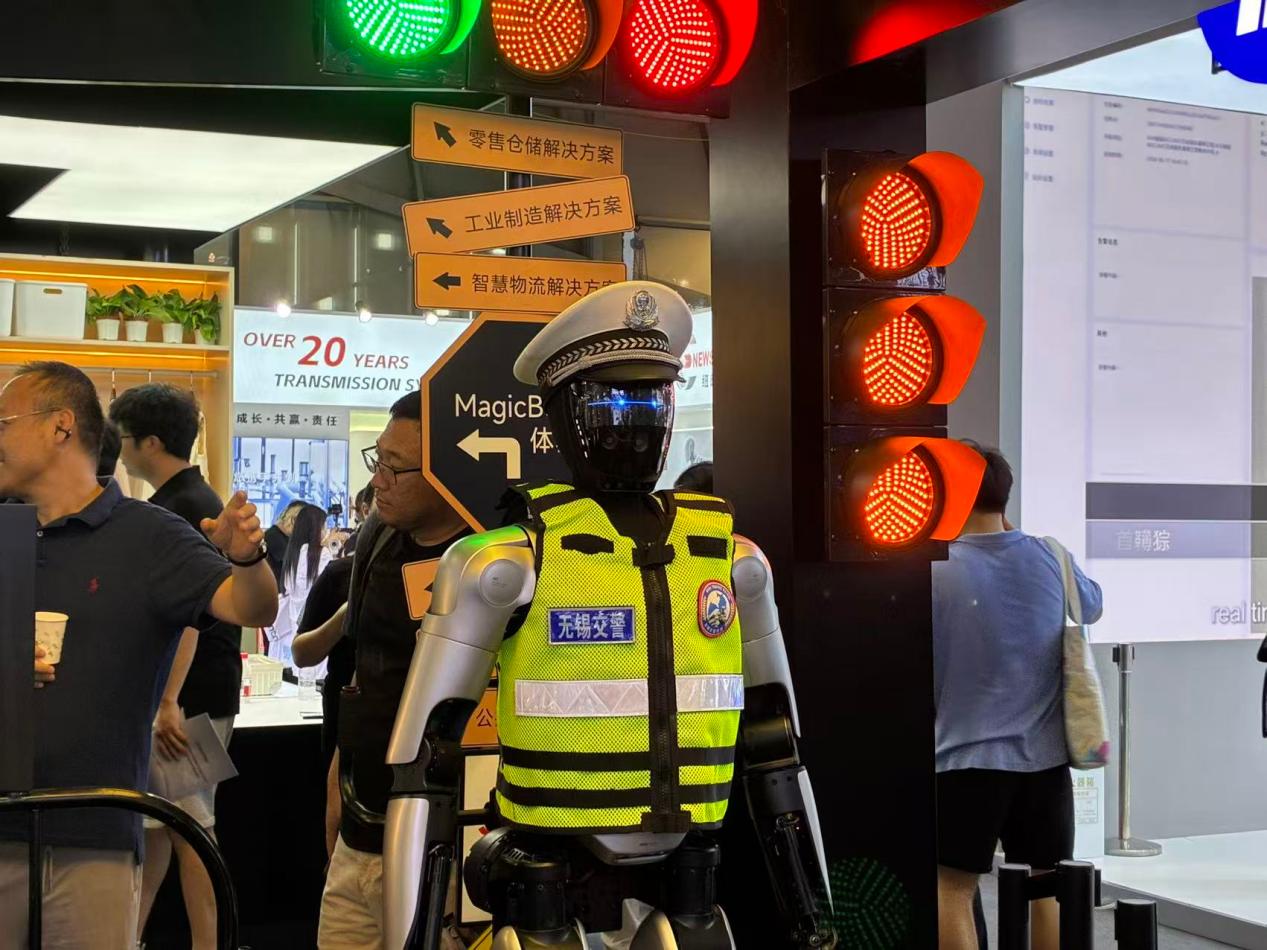
Image source: LeiTech
The core point is that enterprises do not need a pile of discrete components, but a complete solution that supports deployment, management and end-to-end delivery. The Agentic Computer and Agentic Box showcased by Xinnor Technology also apply local inference and data auditing to sensitive scenarios such as finance and government affairs. Tianwu Technology’s protein design agent integrates large models, automated experiments and feedback data to tackle scientific challenges including the development of plastic-degrading enzymes.
Meanwhile, companies like Agile Robots and Leju Robotics keep highlighting real production lines and non-stop operation, which essentially answers the question of whether AI can fit into existing industrial workflows.
The "last mile" of enterprise-grade AI may seem less glamorous, but it is the segment that most readily generates revenue and puts organizational capabilities to the test. Model developers, chipmakers, hardware manufacturers and software service providers are all moving toward this space, and the ultimate competition will boil down to project cycles, total cost of ownership, security and compliance, and after-sales response.
In other words, enterprises do not lack AI systems that can deliver impressive demos; what they lack is AI solutions with clear, accountable support when issues occur.
VI. Is the computing power shortage visible at WAIC? Will it keep spreading or ease in the future?
The computing power shortage has not vanished at WAIC — it has simply taken on a different form.
Previously, the biggest focus was the peak performance of a single accelerator card. This year, however, the most prominent exhibits in the intelligent computing zone are supernodes. Domestic players including Huawei, Alibaba, Baidu, as well as MetaX, Iluvatar CoreX and Moore Threads, are all demonstrating how to cluster dozens, hundreds or even thousands of accelerator cards into one larger, unified computing system.
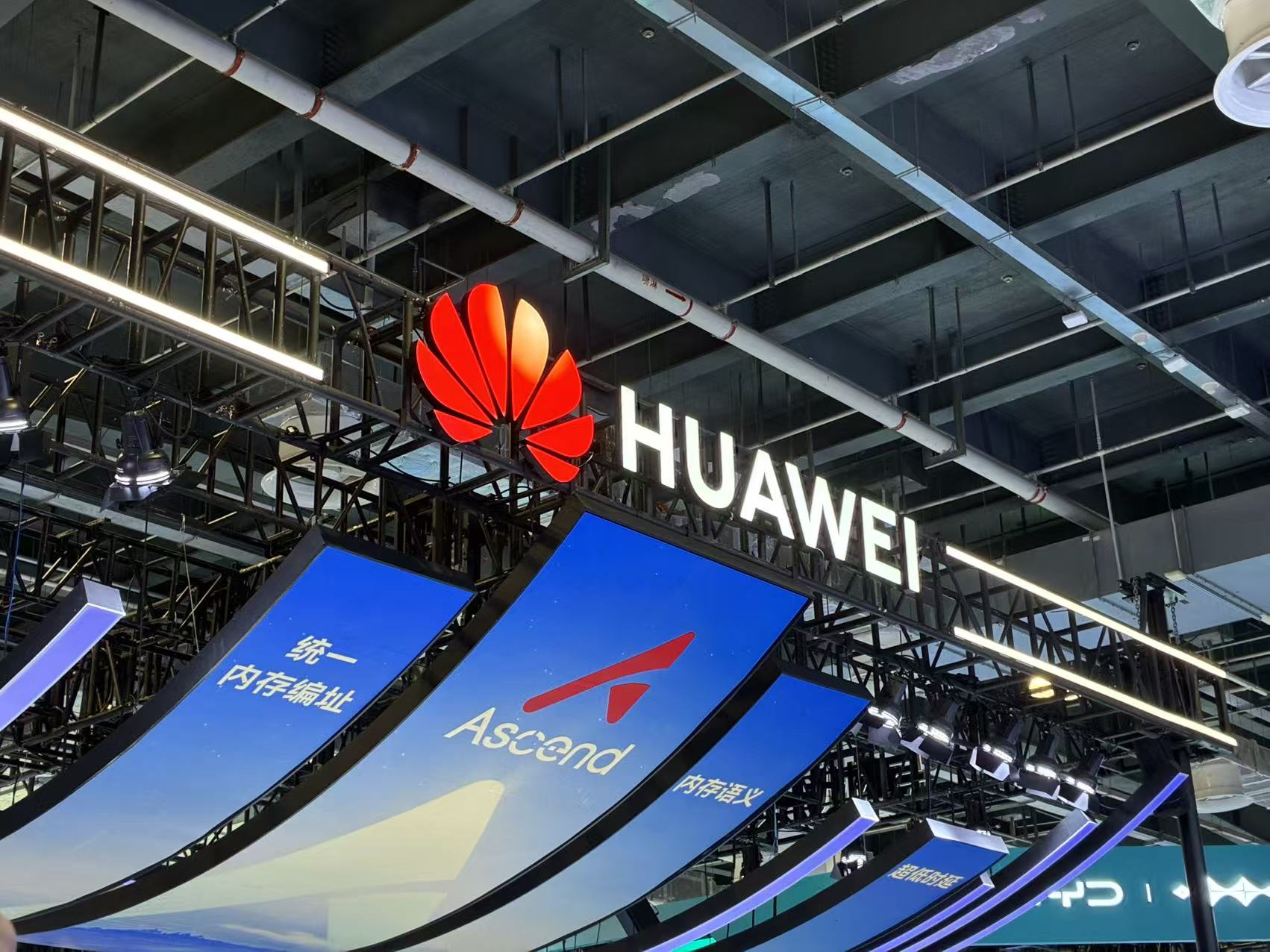
Image source: LeiTech
Core metrics have also shifted from the raw speed of a single accelerator card to chip utilization, interconnection bandwidth, unified memory, system stability and cost per token.
Moore Threads’ demonstration is highly representative. It categorizes model training, token generation and agent operation into three types of "AI factories", and showcases large model training and world model capabilities via its MUSA software and hardware stack. This also proves that domestic GPUs can deliver a seamless end-to-end workflow spanning cluster scheduling, model training and inference services.
Meanwhile, D-Robotics’ RDK S600 adopts an 18-core Arm Cortex-A78AE processor and the in-house developed Xuri S600 chip, delivering up to 560 TOPS of edge inference computing power. It aims to handle perception, large model inference and real-time motion control on a single platform. Its significance goes beyond a more powerful development board — it enables robots to run more tasks locally, cutting latency, bandwidth consumption and cloud service bills.
Storage has also moved from a supporting role to the forefront. Model parameters, long context windows, concurrent agent workloads and multimodal data generated by robots are all mounting pressure on HBM, DRAM, NVMe storage and data movement. No matter how fast computing chips are, they will still hit the "memory wall" if data cannot reach the computing units efficiently. For this reason, near-memory computing, high-bandwidth memory, CXL expansion and tiered storage will all become critical components of next-generation computing systems.
Storage is also stepping into the spotlight. Model parameters, extended context windows, concurrent Agents, and multimodal robot-generated data continue escalating pressure on HBM, DRAM, NVMe storage, and data-movement infrastructure. Even the fastest compute chips hit the “memory wall” if data cannot reach processing units efficiently. Hence, near-memory computing, high-bandwidth memory, CXL interconnects, and hierarchical storage architectures will become vital components of next-gen compute systems.
So will the computing power shortage ease? Judging from what’s on display at WAIC, localized efficiency may improve, but overall demand will continue to expand.
Supernodes, ASICs, Arm-based edge devices and new storage technologies can all reduce the cost per task. However, once agents run around the clock, and robots and vehicles continuously generate video and sensor data, new demand will likely outpace the computing power savings.
Supernodes, ASICs, Arm-based edge devices and new storage technologies can all reduce the cost per task. However, once agents run around the clock, and robots and vehicles continuously generate video and sensor data, new demand will likely outpace the computing power savings.
VII. What drives major internet companies to participate in WAIC?
Describing major internet firms’ WAIC participation simply as "veteran players scrambling for tickets to the AI era" is only half the story.
Anxiety is certainly present. The growth dividend of the mobile internet is gradually peaking, and AI agents may emerge as the new super entry point. If users no longer open dozens of apps but instead hand their goals directly to an agent, the landscape will be reshuffled in terms of who first understands demand, who distributes traffic, and who controls payments and transactions. None of Tencent, Alibaba, Baidu or ByteDance is willing to cede this entry point to others.
Yet focusing only on anxiety underestimates their existing strengths.
Alibaba’s portfolio spans cloud services, chips, models, e-commerce, payments and lifestyle services, allowing it to cover everything from underlying computing power to Tongyi smart glasses. Tencent boasts WeChat, social connections, content ecosystems and mini-programs, making it well-positioned to embed agents into services users are already familiar with. Baidu has search, maps, autonomous driving and large models, while JD.com controls merchandise, transactions, logistics, hardware distribution channels and after-sales services.
Lei Tech found JD.com’s JoyInside and Cami solutions in the automotive exhibition area particularly interesting. Instead of building cars from scratch, the solution equips existing vehicles with aftermarket devices to enable in-car agents, which then connect to JD.com’s service ecosystem. For JD.com, the value of AI ultimately translates into product purchases, service transactions and door-to-door fulfillment. This is exactly what internet companies excel at:
turning technology into a closed-loop business chain.
Zhihu has a different set of advantages. Its core assets remain professional creators, real-world questions and human discussions. As models become increasingly accessible, credible content, empirical judgment and community ties may become more scarce. Zhihu does not necessarily need to become the top model company, but it can continue to serve as infrastructure for AI to acquire knowledge, validate answers and connect with professional users.
Major tech companies attend WAIC with two goals in mind: defending their position in the next-generation entry point, and repackaging the cloud, accounts, payments, content, supply chain and service networks they have built over the past two decades to supply the AI industry.
More often than not, the so-called search for an "AI ticket" is not about boarding an unfamiliar ship, but refitting their existing vessels for the AI era.
VIII. What impressive model demonstrations stood out? How has the competitive direction of model development shifted?
Foundation models remain the bedrock of WAIC, but the spotlight has shifted from "who has the largest parameter count" to four directions: long-horizon tasks, on-device operation, multimodal action, and physical world understanding.
The Kimi K3, with approximately 2.8 trillion parameters, joins the 3T-class open model lineup, with a focus on long-horizon programming, knowledge work and complex agent tasks. Parameter scale still matters as it defines the upper limit of capabilities, but vendors are more eager to prove that models can work continuously for hours to complete an entire project, rather than just answering a single question correctly.
The Kimi K3, with approximately 2.8 trillion parameters, joins the 3T-class open model lineup, with a focus on long-horizon programming, knowledge work and complex agent tasks. Parameter scale still matters as it defines the upper limit of capabilities, but vendors are more eager to prove that models can work continuously for hours to complete an entire project, rather than just answering a single question correctly.
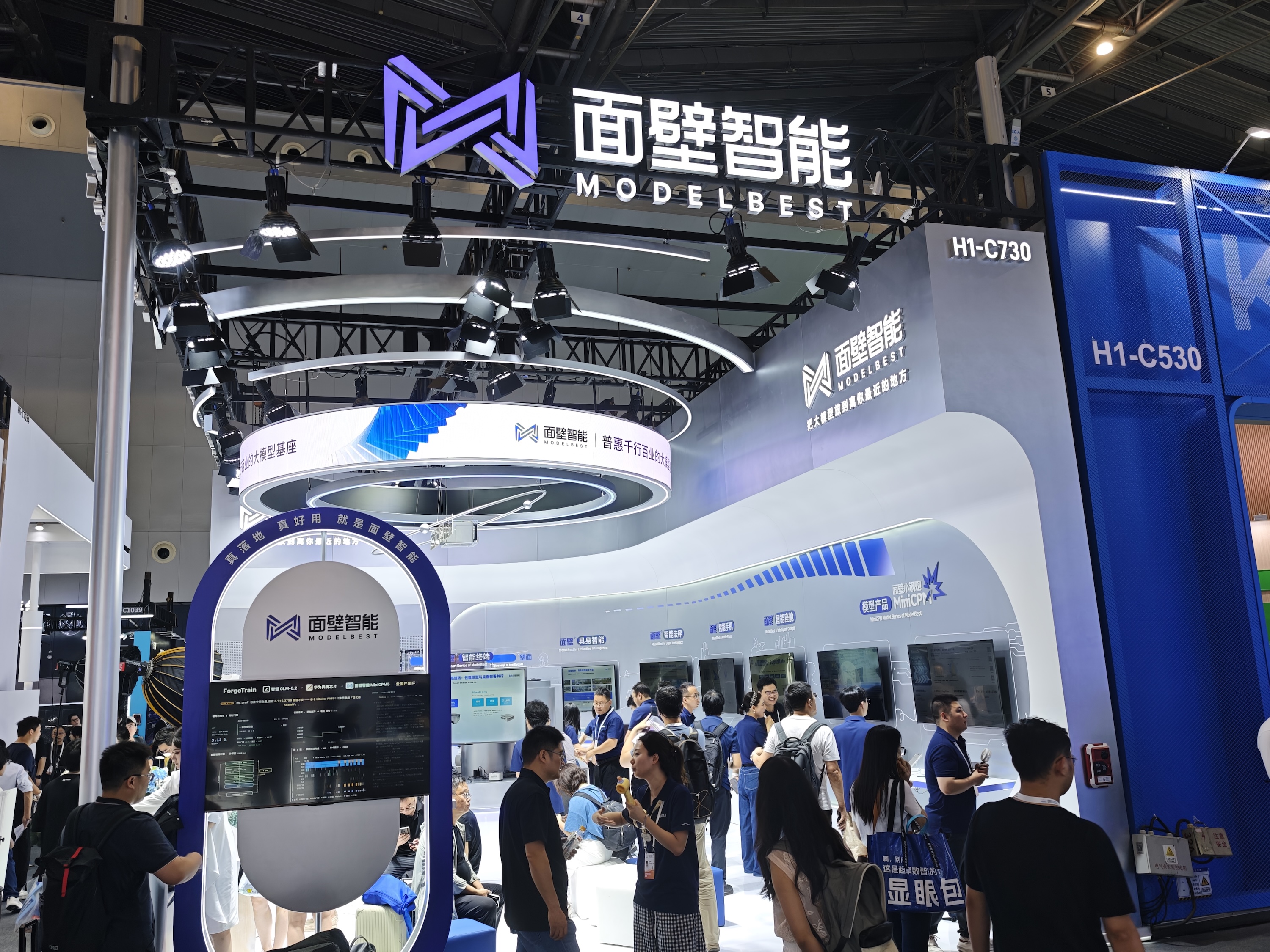
Image source: LeiTech
On-device models do not need to outperform cloud-based models across all capabilities. They can secure their own position as long as they offer irreplaceable advantages in latency, privacy, cost and offline usability.
Stepfun, on the other hand, integrates its models directly into operating systems. Powering the STEPX Neo, Step AOS and the personal AI agent Amoo centrally manage on-device and cloud models, cross-app memory, system permissions and third-party services. For automotive applications, Stepfun’s models are embedded into Geely Super EVA, linking in-cabin conversations, vehicle controls and travel services into a cohesive task chain. For Stepfun, the value of its models lies not in standalone demonstrations, but in becoming an integral part of smartphone and automotive operating systems.
Moving further into the physical world, Vision-Language-Action (VLA) and world models represent two popular pathways for embodied AI. VLA excels at connecting language, vision and action, while world models aim to learn the laws of object motion and environmental changes. Both approaches currently have their own limitations, and they are more likely to coexist for a long time and gradually converge, rather than one quickly emerging as the definitive solution.
WeRide WITT, unveiled by WeRide on the first day of WAIC, is also part of this wave of physical AI competition. It introduces the concept of "minimum physical fact units", extracting, reasoning about, verifying and orchestrating facts from real road videos, then converting these facts into training and evaluation signals. This can boost data processing efficiency by up to approximately 200 times and reduce token costs by around 98%.
The competition among models has not abandoned parameter scale, but has added more challenging evaluation criteria. Going forward, a model will be assessed on multiple dimensions simultaneously: its ability to complete long-horizon tasks, run on edge devices, invoke tools, comprehend physical laws, and the actual cost per task completion.
IX. Many automotive-related enterprises participated in WAIC. What trends do they reveal for AI + automobiles?
Automotive brands and autonomous driving companies are not attending WAIC because the AI conference is becoming more like an auto show. On the contrary, on-site observations from Lei Tech / Dianchetong show that the number of complete vehicle brands has not ballooned, while solution providers for world models, smart cockpits, autonomous driving and aftermarket services have increased significantly.
The reason is simple: automobiles are currently the largest and most commercially mature physical AI terminals.
Today’s smart vehicles are equipped with cameras, radars, in-vehicle computing platforms, actuators, batteries and a stable user base with willingness to pay, and they generate massive amounts of real-world data every day. While many robotics companies are still seeking their first batch of major clients, the automotive industry already has mature production lines and millions of mass-produced devices.
The most notable change in automotive AI this year is the growing convergence between in-cabin systems and driving functions. Geely Super EVA does more than just answer questions — it breaks down user intentions into tasks for navigation, vehicle control, content and lifestyle services. World models are used to understand and generate complex traffic scenarios, supplementing long-tail data that is difficult to collect repeatedly on real roads. JD.com’s Cami demonstrates another possibility:
Drivers can equip their fuel-powered and older vehicles with agent capabilities through aftermarket hardware, without having to replace their cars.
The combination of WeRide WITT and GENESIS further illustrates this trend. WITT extracts and verifies facts from real operational data, while GENESIS generates high-fidelity simulations and long-tail scenarios. Together, they support in-vehicle model training, advancing automotive AI from a simple "in-cabin AI assistant" to a system that continuously understands and learns from the real world.
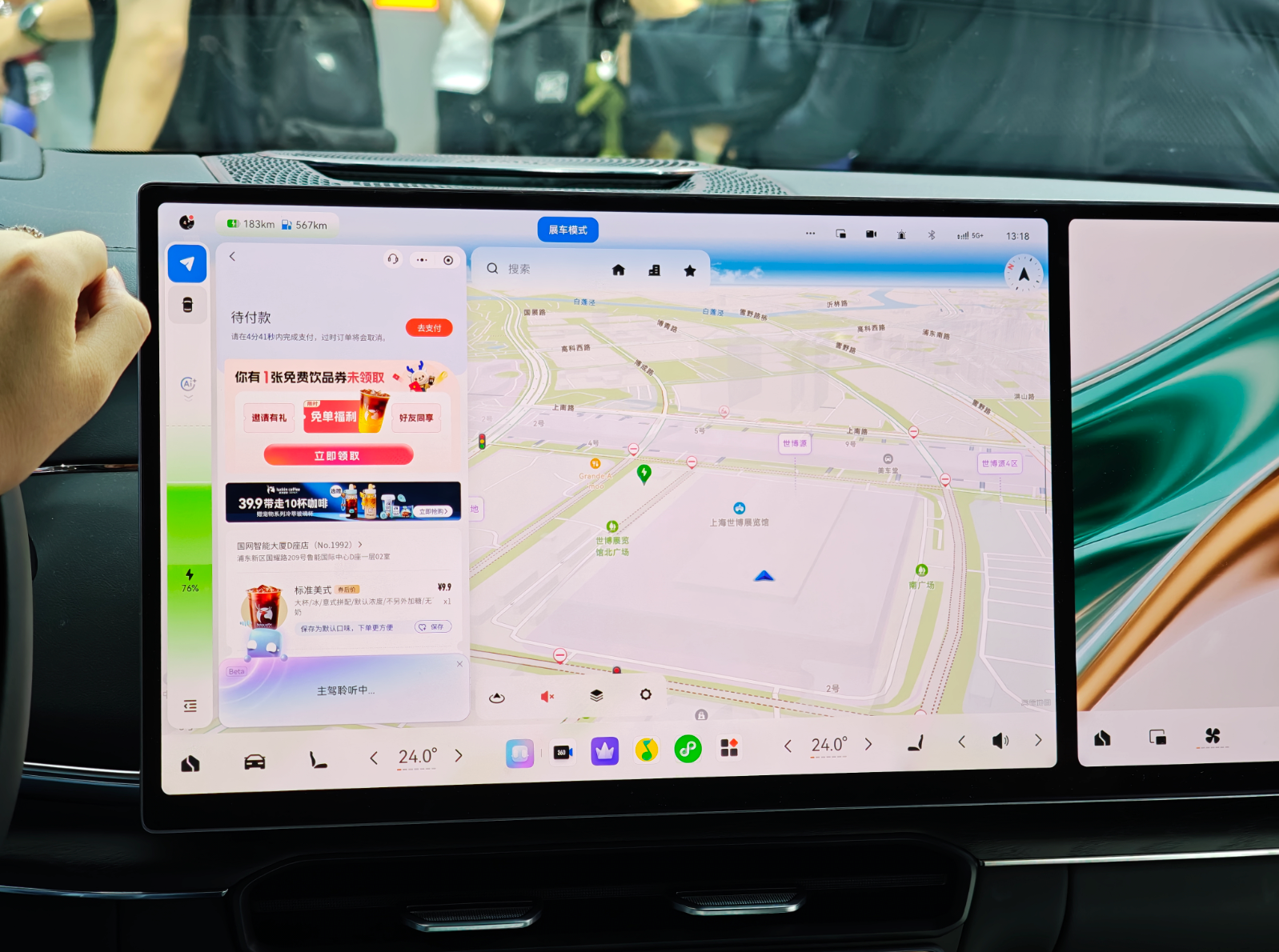
Image source: EV Channel / LeiTech
Yet automobiles are also the type of AI terminal that has zero tolerance for hallucinations. A mis-tap by a smartphone agent can be undone with a simple revert, but the stakes are entirely different when a vehicle misjudges pedestrians, traffic lights or road dynamics. Every advancement in world models, end-to-end systems and in-vehicle agents must be simultaneously validated against functional safety standards, liability frameworks and long-term operational data.
Automobiles have a place at WAIC because they already stand at the intersection of models, chips, sensors and physical actions. In a sense, they are wheeled robots that have been in mass production for many years.
X. What trends for the future AI industry can we glean from this WAIC?
If we had to sum up WAIC 2026 in one sentence, it would be this: AI has finally started to take accountability for its outcomes.
In previous years, a model that answered faster, at greater length and more human-likely was enough to make headlines. Stepping into the exhibition halls this year, the questions facing enterprises have shifted: Can agents see tasks through to completion across apps? Can robots operate nonstop on shift? Can on-device models function without internet access? Can domestic chips reliably support computing clusters? Who will provide maintenance after enterprise deployment?
This does not mean AI has fully realized industrialization. On the contrary, WAIC has also exposed many unfinished pieces: there are no unified rules for agent permissions yet, robots remain far from general-purpose capability, the battery life and ecosystem of AI glasses remain unsolved, supernodes still need validation under real workloads, and automotive world models can never equate demo performance with real-world safety capability.
But the direction of the industry has shifted. The most competitive companies in the next phase may not necessarily own the largest single model, nor deliver the most sensational demos. They are more likely to master a complete end-to-end chain: models interpret goals, chips deliver computing power, operating systems govern permissions, sensors perceive the world, hardware executes actions, and industry data feeds outcomes back into the models.
AI has grown its own physical form — this is the true signal left by what has been called "the most hardware-focused WAIC ever". Going forward, the industry needs to prove that this physical form can do more than just move; it can operate stably, at low cost, and with full accountability.
The WAIC 2026—themed “Intelligent Partners, Co-Creating the Future”—has concluded.
The AI narrative has pivoted from stacking model parameters toward deploying productive Agents; heterogeneous computing and photonic computing continue pushing computational ceilings upward; embodied intelligence accelerates real-world applications—with robots entering homes and factories, making physical AI a reality.
LeiTech’s WAIC coverage team has returned to Guangzhou and is conducting intensive post-event analysis—stay tuned!