
 雷科技
雷科技





Over the past two years of visiting robotics exhibitions, I have almost developed a conditioned reflex.
Whenever a crowd suddenly forms three layers deep in the distance, squeezing through reveals that more often than not, robots are boxing, dancing or doing backflips. The demos are undeniably lively to watch, yet once the showcase wraps up, the age-old question lingers: beyond putting on performances, when can robots genuinely get down to real work?
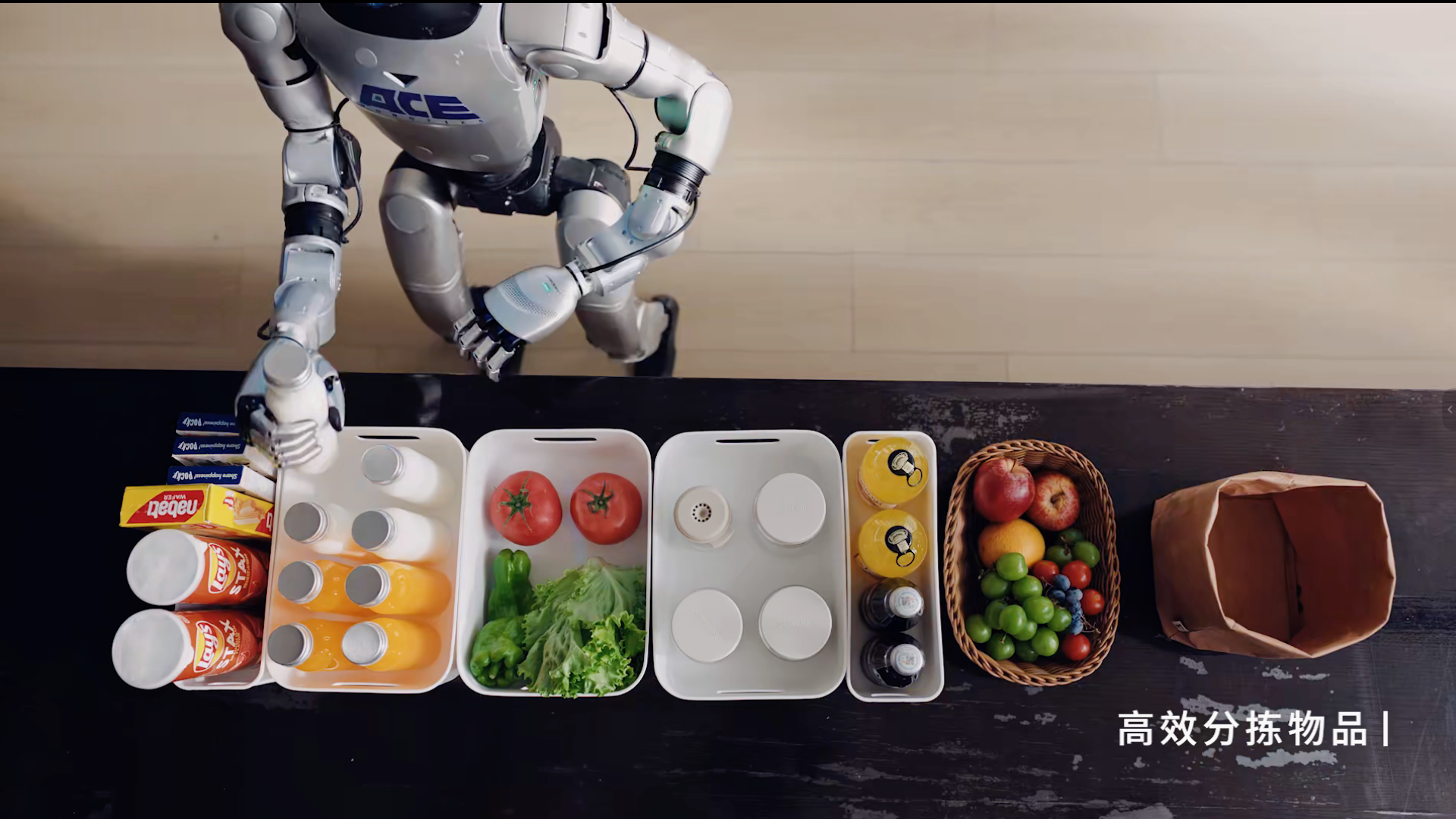
On July 19, at the 2026 World Artificial Intelligence Conference, Daxiao Robotics officially released Kairos 3.1, its natively action-integrated Kaiwu World Model, with open-source access available for all industries.
(Image source: Daxiao Robotics)
Currently, the embodied intelligence industry is not lacking in models.
Vision models perceive and interpret the environment, language models process human commands, and control models manage the robot’s limb movements. Each model works well individually, but these functions usually operate in isolation. Once deployed on physical robots, operational latency and poor cross-system coordination become major pain points.
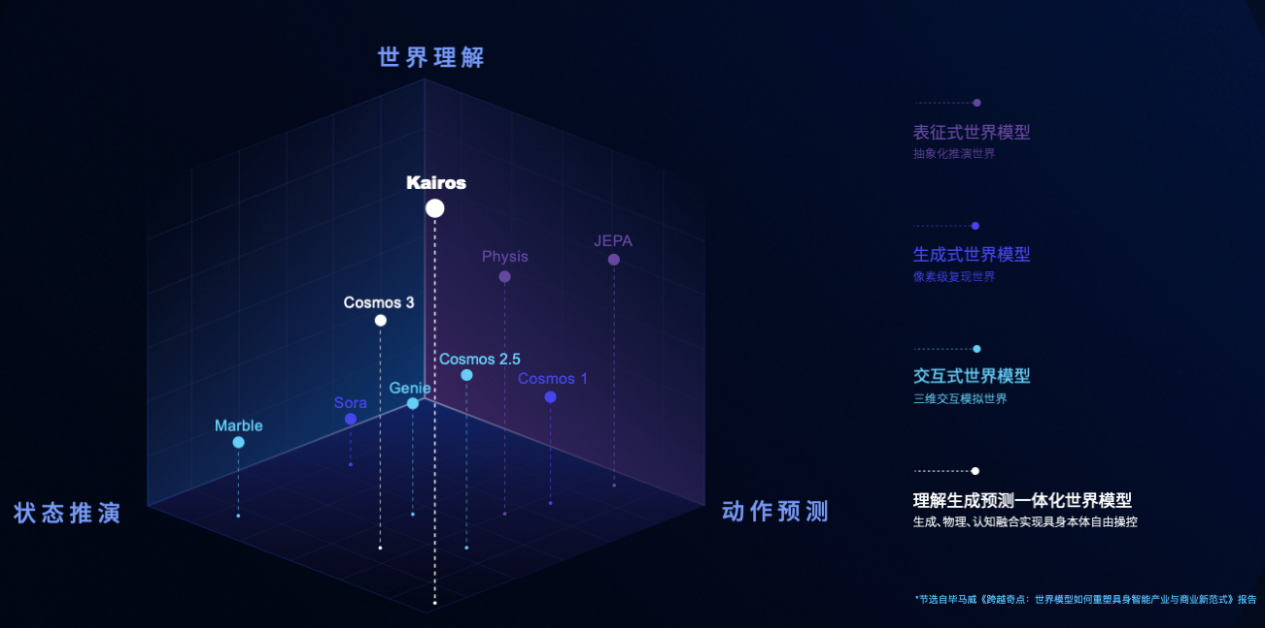
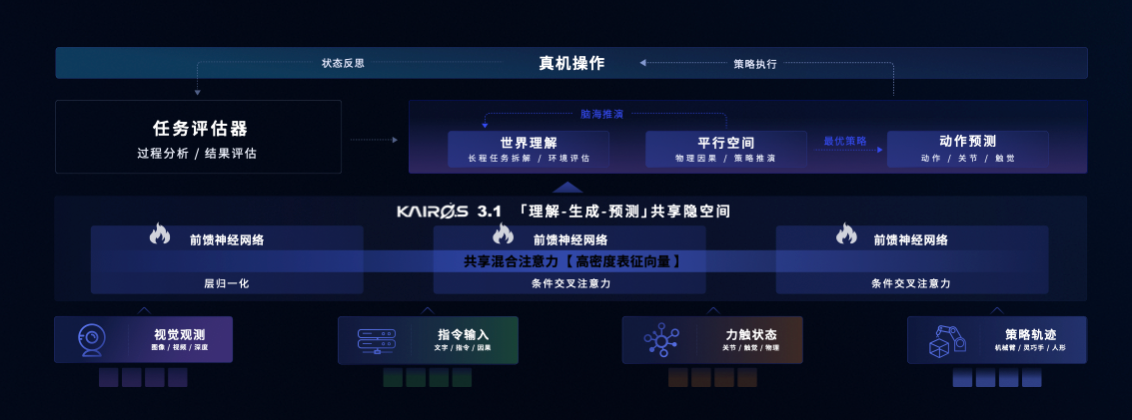
Kairos 3.1 is built on the concept of integrating world understanding, physical generation and motion prediction within a single native architecture.
Visual input, language instructions, tactile data and robotic motion trajectories are all mapped into one shared "unified latent space". When the robot sees a bottle on the table, it does not merely identify the presence of a bottle. It also analyzes the bottle’s position, surrounding obstacles, the best angle to extend its arm, and the root causes when movements fail.
(Image source: Daxiao Robotics)
This approach is highly consistent with the MWA world model I covered in earlier reports.
Specifically, Kairos 3.1 does not need to predict the next frame of images or reconstruct every detail of the physical world. Instead, it focuses on figuring out how objects move and what outcomes different actions will bring within a highly abstract cognitive latent space.
More impressively, it can not only perceive surroundings but also conduct predictive reasoning. Traditional models plan and react step by step. In comparison, Kairos 3.1 features parallel hypothetical reasoning capability. Taking Chinese chess as an analogy: amateur players only foresee the immediate next move, while this model can mentally simulate consecutive moves corresponding to various strategies beforehand.
Theoretically, robots can run multiple virtual trials in their "mind" before taking physical action. They pick out the plan with a higher success rate and lower execution cost, then execute the movement on the physical robot.
(Image source: Daxiao Robotics)
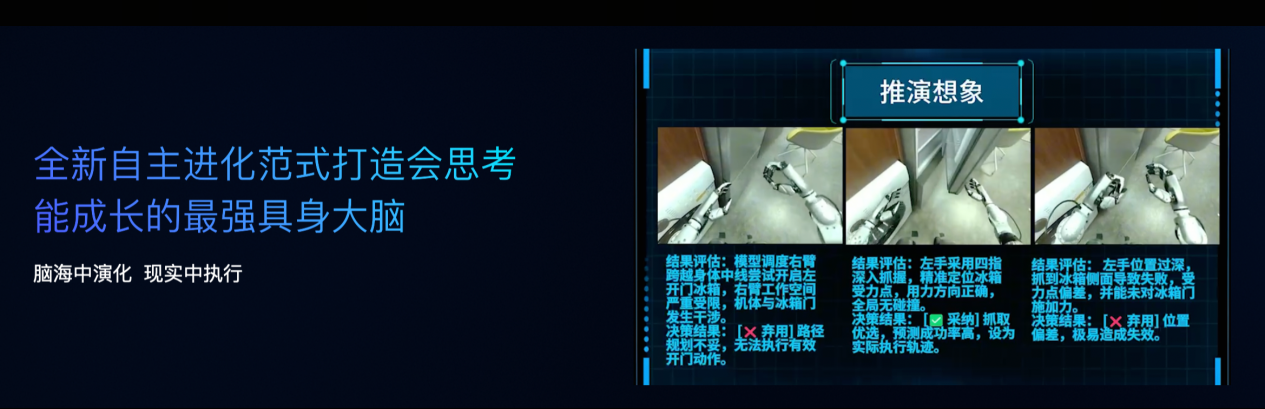
If the description is not vivid enough, the officially released case of the robot opening the refrigerator to get water is quite intuitive.
As illustrated in the picture, the robot first tried to pull the door with three fingers but failed due to insufficient strength. Instead of freezing on the spot or waiting for human help, the system independently located the problem, regenerated movements in the digital parallel space, switched to applying force with four fingers, and successfully opened the door on the second attempt.
For humans, thinking of "trying another method" is instinctive, yet this capability is far more complicated for robots.
(Image source: Daxiao Robotics)
Admittedly, real households and factories are never kept perpetually tidy like laboratory environments. Cups at home get moved around; refrigerator drawers may jam; delivery boxes can suddenly appear on tabletops. If robots only memorize fixed answers and freeze up when facing a different tabletop layout, they are far from ready for practical work.
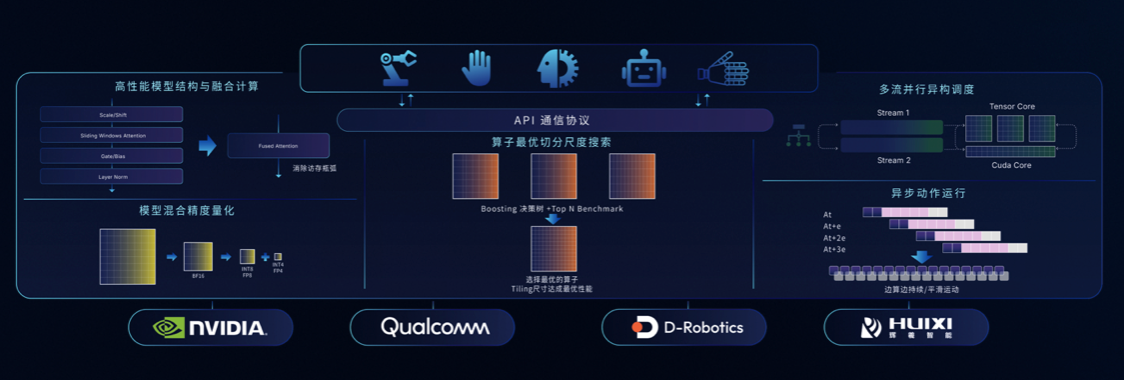
I have also tested robots empowered by such world models, and their reasoning speed is truly sluggish. It takes the robot at least one and a half minutes just to stretch out its arm and grab a bottle of water—slower than simply walking over to fetch it myself.
To tackle this issue, Daxiao has developed the supporting KairosRT computing engine. According to official test data, on the NVIDIA Jetson Thor platform with bfloat16 (BF16) precision, the average inference latency of the 8B model hits 125 milliseconds. Compared with Cosmos 3 Nano cited in official documents, inference efficiency is boosted by 52 times.
This figure still awaits third-party verification, yet the development direction is clear: world models must not only perform sound reasoning on the cloud but also run smoothly locally on physical robots.
(Image source: Daxiao Robotics)
Judging from this year's WAIC exhibition, the focus of the robotics industry is indeed shifting.
In previous years, manufacturers competed fiercely on robot hardware itself. Robots with stable movement and high speed easily grabbed public attention and went viral online. Hardware still matters today, yet basic mobility alone is no longer sufficient. Enterprises now compete to build robots capable of environmental perception, task planning, and autonomous adjustment after failed attempts.
In my opinion, the launch of Kairos 3.1 brings fresh momentum to the household robotics sector. It proves that enabling robots to comprehend physical laws is far more reliable than having them mechanically memorize human language.
Nevertheless, the open-sourcing of a model marks merely the starting point of industrial implementation. Transforming cutting-edge technology into everyday household assistants and popularizing embodied intelligence across all industries requires joint efforts from Daxiao Robotics and all its partners.
The WAIC2026—under the theme “Intelligent Partners, Co-Creating the Future”—is now underway!
The AI narrative is evolving: from stacking model parameters to deploying agent-driven productivity; heterogeneous computing and photonic computing continue raising the ceiling on computational performance; and embodied intelligence is accelerating real-world adoption—robots entering homes and factories are turning physical AI into reality.
The LeiTech WAIC reporting team has arrived in Shanghai to capture this year’s pinnacle moment of AI industrialization—stay tuned!