
 雷科技
雷科技





The 9th World Artificial Intelligence Conference (WAIC) officially kicked off at the Shanghai World Expo Center on July 17. As an annual grand gathering for the AI industry, this year’s conference brought together domestic and foreign large model developers, AI application creators and hardware manufacturers. Leitech (ID: leitech), through its AI-focused new media arm Leitech AGI (leikejiagi), dispatched a reporting team to cover the event on-site in Shanghai.
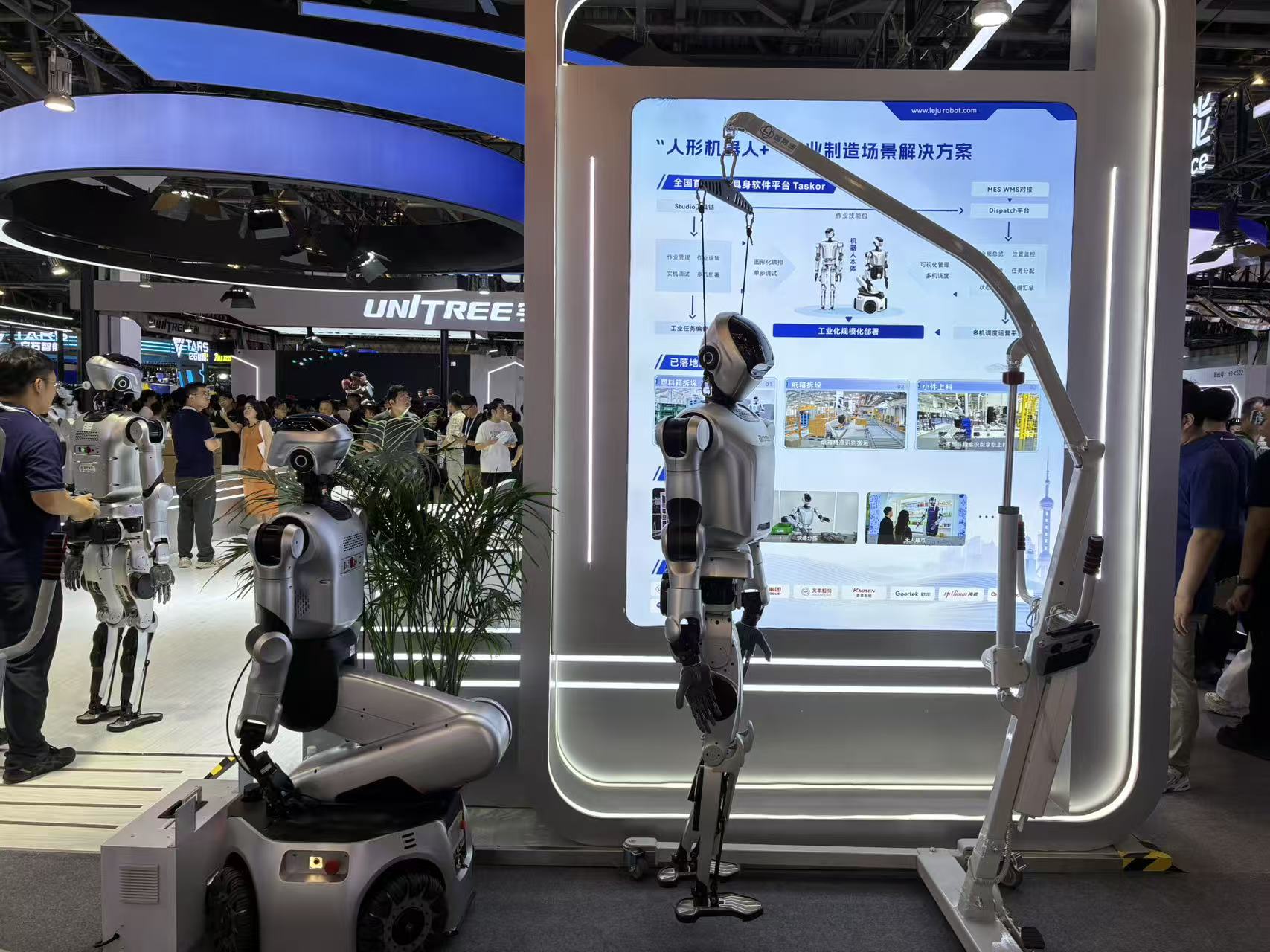
Embodied intelligence took center stage at this year’s WAIC. After spending an entire day touring the exhibition halls, I came across humanoid robot exhibits from no fewer than twenty brands. There were robots that dance, pour coffee, and hold conversations with visitors — a dazzling array of demonstrations. That said, after seeing so many of them, I got the distinct feeling that most offerings look largely identical. The vast majority of booths follow the same formula: a humanoid robot stands on display to take a few steps, paired with a display board listing its technical specifications. Most visitors simply snap photos to post on social media, and that’s the full extent of their engagement.
(Photograph credit: LeiTech on-site production)
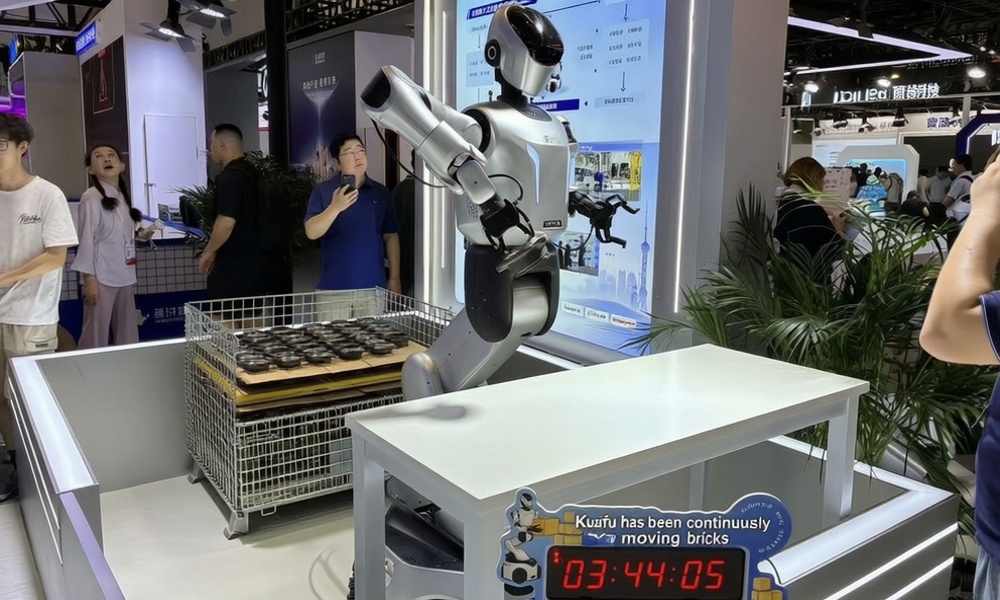
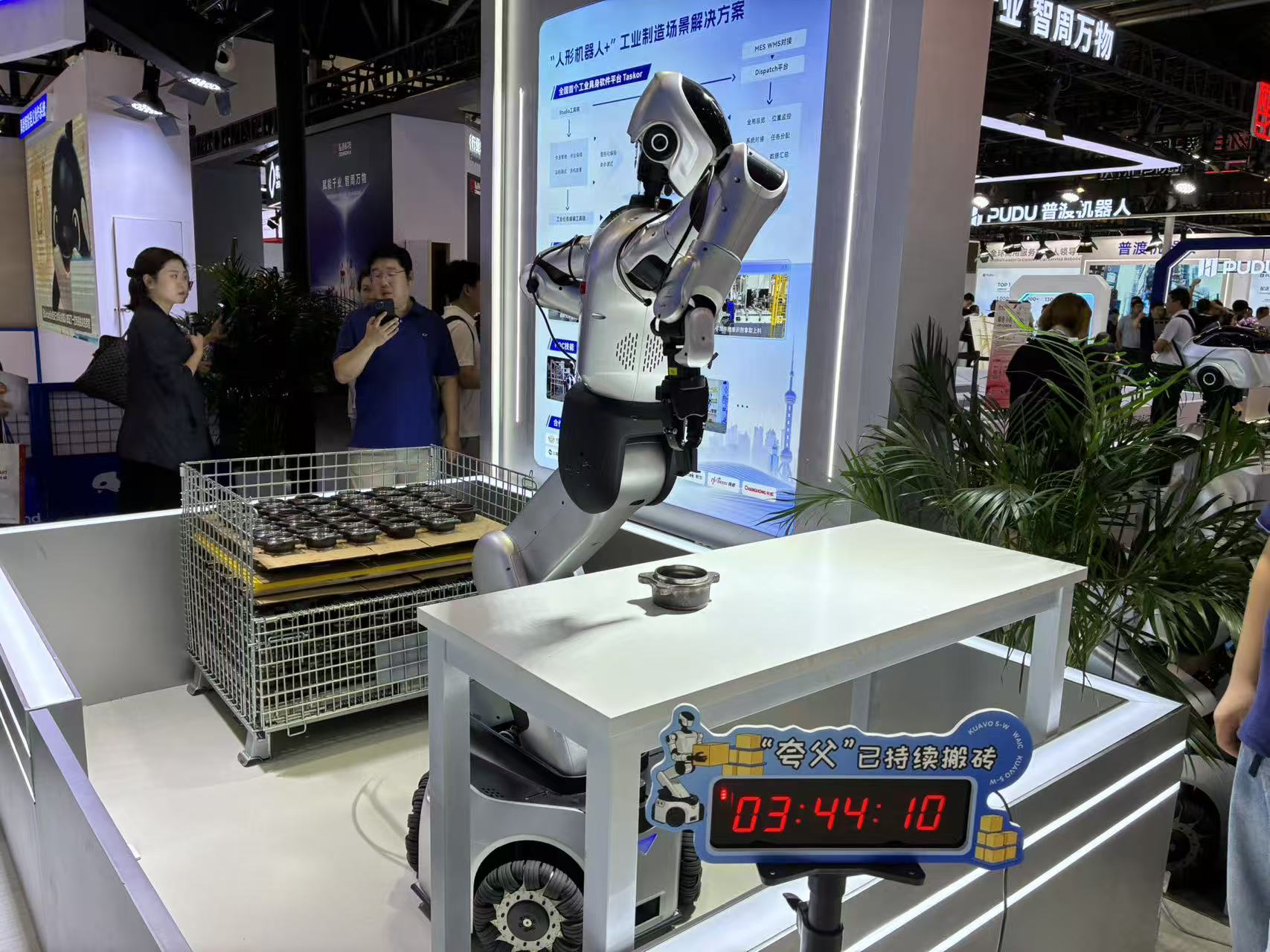
By contrast, the booth of RoboTime stood out from the crowd. There were barely any static display zones across the entire booth; most of the space was dedicated to real-scene operational demonstrations. On a full-scale replicated factory production line, several Kuafu humanoid robots performed their respective tasks, including depalletizing, transporting materials and feeding workpieces. There was even a timer showing how long the robots had been continuously moving goods, giving off a distinctly cyber foreman vibe.
(Photograph credit: LeiTech on-site production)
The demonstration tasks performed by the robots are actually straightforward: depalletizing cartons, depalletizing plastic crates, and feeding small workpieces. I watched the demonstration on-site for more than ten minutes, observing how these humanoid robots automatically realign misaligned boxes without any staff stepping in to assist at any point. According to the booth staff, these robots are designed to run nonstop for 8 to 10 hours per day, and some units have already been operating in real factory environments for three to four months.
The staff also shared detailed performance data for each solution. The carton depalletizing system has run stably for eight consecutive hours at Hichen Warehouse, delivering an overall operational success rate of 95.8%, with an average handling time of 28 seconds per carton. The plastic crate depalletizing solution has been deployed on production lines at FAW Group and JAC Group, achieving a 92% success rate for flexible cross-rack transportation. The small workpiece feeding system operates on production lines of Zhejiang Zhaofeng Mechanical and Electronic Co., Ltd., supporting the identification and gripping of over a dozen types of components with a 94.3% success rate.
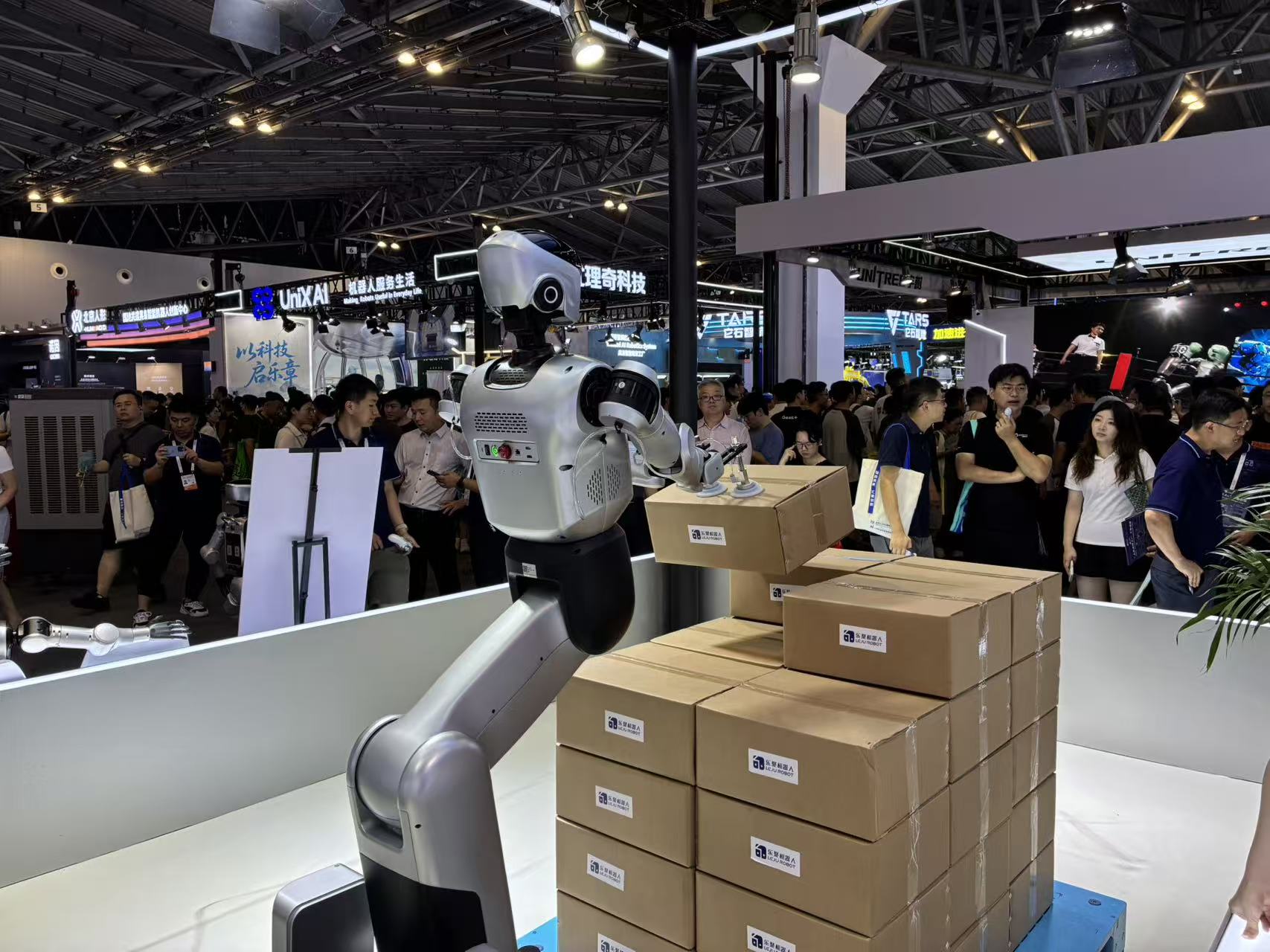
(Photograph credit: LeiTech on-site production)
At the Intelligent Embodied Intelligence Forum held concurrently with WAIC, Yao Maoqing, Partner of Agibot and Chairman & CEO of Mifeng Technology, pointed out plainly in his keynote speech that the shift of physical AI from "demo-ready" to "work-ready" hinges not on isolated model capabilities, but on breaking through three core barriers: the data barrier, the representation barrier and the closed-loop barrier. Authentic interactive data is extremely scarce and costly to collect; a unified physical representation applicable across diverse tasks and scenarios has yet to be established; real-world trial-and-error comes with high costs and slow feedback loops.
In other words, what the industry lacks is not algorithms or hardware, but the capacity to undergo repeated verification within real closed-loop operating environments. The production line solutions showcased at RoboTime’s booth, which have been running continuously for three to four months, serve as the perfect illustration of this point.
If real-world deployment data attests to RoboTime’s robust engineering capabilities, full-stack domestic localization demonstrates its profound technical strength. Leng Xiaokun, Founder of RoboTime, recounted that during the development of the first-generation Kuafu humanoid robot, nearly all core components relied on imports, with a domestic localization rate below 10%. The team spent millions of yuan sourcing components scattered across the globe just to assemble a single prototype. Today, however, the Kuafu robot boasts a domestic localization rate exceeding 95%, with applications spanning four major sectors: industry, commercial services, scientific research and training bases.
Why does a high domestic localization rate matter? It is not merely a matter of national sentiment, but critical for supply chain security and cost control. Only when full ownership of core components is secured can manufacturers credibly pursue large-scale deliveries and sustained cost reductions. The average selling price of RoboTime’s Kuafu series dropped from 413,900 yuan to 308,100 yuan in 2025, a reduction entirely driven by cost savings from domestic component substitution.
Lower costs also translate to lower barriers to real-world deployment. Two ecosystem cooperation solutions were displayed at the venue. The logistics solution co-developed with Ant Lingbo is built on the LingBot-VLA 2.0 model. It only requires roughly 300 pieces of training data and one to two days of fine-tuning to boost operational success rates above 80%.
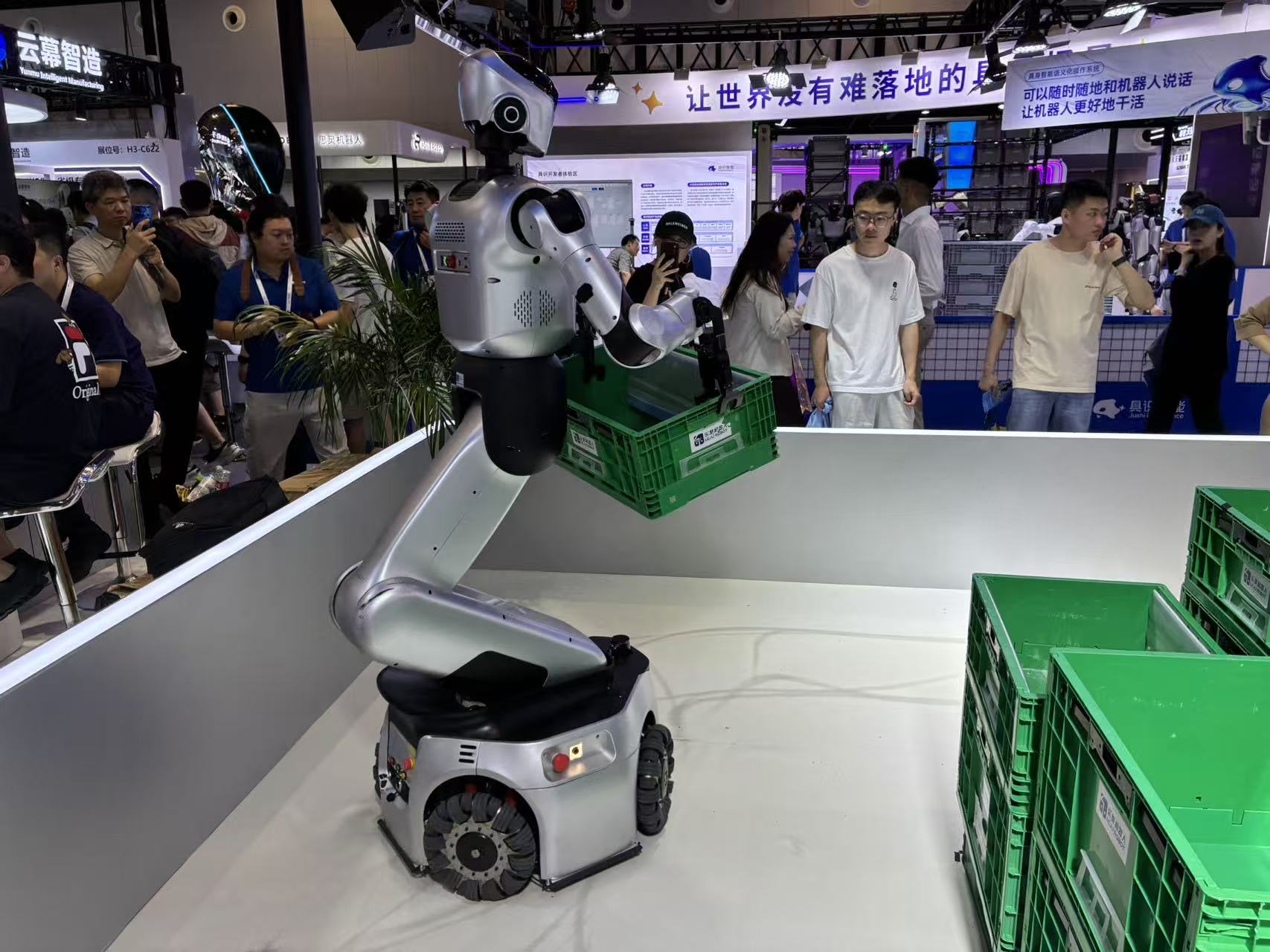
(Photograph credit: LeiTech on-site production)
What does a dataset of 300 samples actually mean? Traditional model training for a single scenario often requires thousands or tens of thousands of data points, with development cycles spanning months. Leju Robotics has cut this timeline down to just two days.
Its inspection and guided-tour robot, co-developed with Wall-E Intelligence, covers six major categories of commercial guided-tour scenarios. The robot can identify over 30 types of inspection anomalies, with a detection success rate exceeding 95%.
Powered by a full-stack development toolchain, exhibition hall deployments take merely 1 to 2 days, industrial standard scenarios 1 to 2 weeks, custom non-standard scenarios 1 to 2 months, and new skill testing and validation wraps up in 3 to 7 days. This unmatched speed drastically lowers enterprises’ costs for Proof-of-Concept (POC) validation, compressing trial-and-error cycles from "several months" to "a few weeks".
Furthermore, Leju Robotics has launched OpenLET, a national-level open-source dataset community for embodied intelligence. The platform brings together more than 70 universities, industrial chain enterprises, and over 10,000 developers.
Leju Robotics’ solutions are currently deployed across more than 10 industries, including automotive, telecommunications, logistics, 3C electronics, home appliances, power, and high-end equipment manufacturing. Its client roster boasts leading enterprises from every sector: FAW Group, JAC Motors, China Mobile, ZTE, Hisense, Changhong, Hachen Logistics, Dongfang Precision, Schaeffler, Zhaofeng Electromechanical, China Southern Power Grid, Shanghai Electric, and more.
Beyond commercial clients, Leju Robotics has secured national-level recognition. Its humanoid robot intelligent picking and transportation solution for automotive manufacturing was selected for the 2025 Typical AI Application Case List issued by the Ministry of Industry and Information Technology (MIIT).
Hard operational data backs its commercial service offerings as well. Its exhibition hall guided-tour solution serves government and financial institutions including Jiangsu Bank and Longhua Exhibition Hall. The robots operate stably for 10 to 12 hours daily, hosting a cumulative total of 4,306 guided sessions across a single venue. The system has run continuously for 455 days, with an error rate of only 0.0915% over the past four months.
That said, Leju Robotics still faces clear challenges. Figures from its prospectus show the company remains unprofitable, with a net loss attributable to parent shareholders of approximately RMB 69.78 million in 2025. The firm does not expect to turn profitable until as early as 2028. The commercialization of humanoid robots is still in its early stage, requiring sustained investment to optimize scenario adaptation and bring down hardware costs. Even so, Leju Robotics has delivered a highly compelling track record when it comes to real-world industrial deployment.
At this year’s World Artificial Intelligence Conference (WAIC), while many competitors were still racing to showcase flashy stunts like high jumps, Leju Robotics focused its innovation on reliability and stable industrial operation. This contrast signals a broader industry shift: embodied intelligence is moving past the demo phase of robots merely walking and jumping, and entering an industrial era defined by deployable, work-ready robotic solutions.
We can only wait and anticipate how these robots will evolve over the coming year.
The WAIC2026, themed “Smart Partners, Co-Creating the Future,” is underway!
The AI narrative is pivoting—from stacking model parameters to deploying agent-driven productivity; heterogeneous collaboration and photonic computing continue pushing computational ceilings upward; and embodied intelligence is accelerating real-world adoption, bringing robots into homes and factories to make physical AI a reality.
LeiTech’s WAIC exhibition coverage team has arrived in Shanghai—to witness firsthand the annual pinnacle of AI industrialization. Stay tuned!