
 雷科技
雷科技




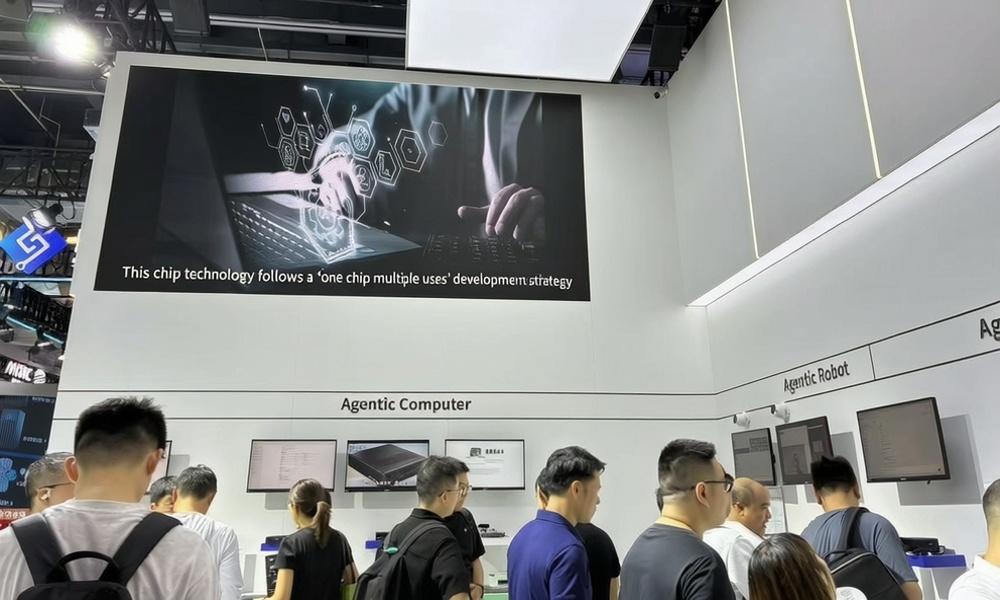

If intelligent agents are the hottest buzzword at WAIC 2026, then the computing power powering these agents has naturally taken center stage at the exhibition.
After being invited to visit CIX Technology’s booth, Xiaolei first laid eyes on a generative AI photo booth. Visitors step inside to take photos. Instead of waiting for files to be uploaded to the cloud, the local hardware equipped with CIX Technology’s P1 chip leverages Qwen2.5-VL-7B to analyze visuals and generate prompts. Qwen3 then crafts stories matching users’ selected styles, and the finished work is printed as a customized postcard.
The entire workflow seems straightforward, yet it vividly demonstrates the value of edge AI. Tasks including image analysis and text generation run entirely on local hardware rather than sending all data to cloud servers. This cuts response latency significantly while strengthening privacy protection.
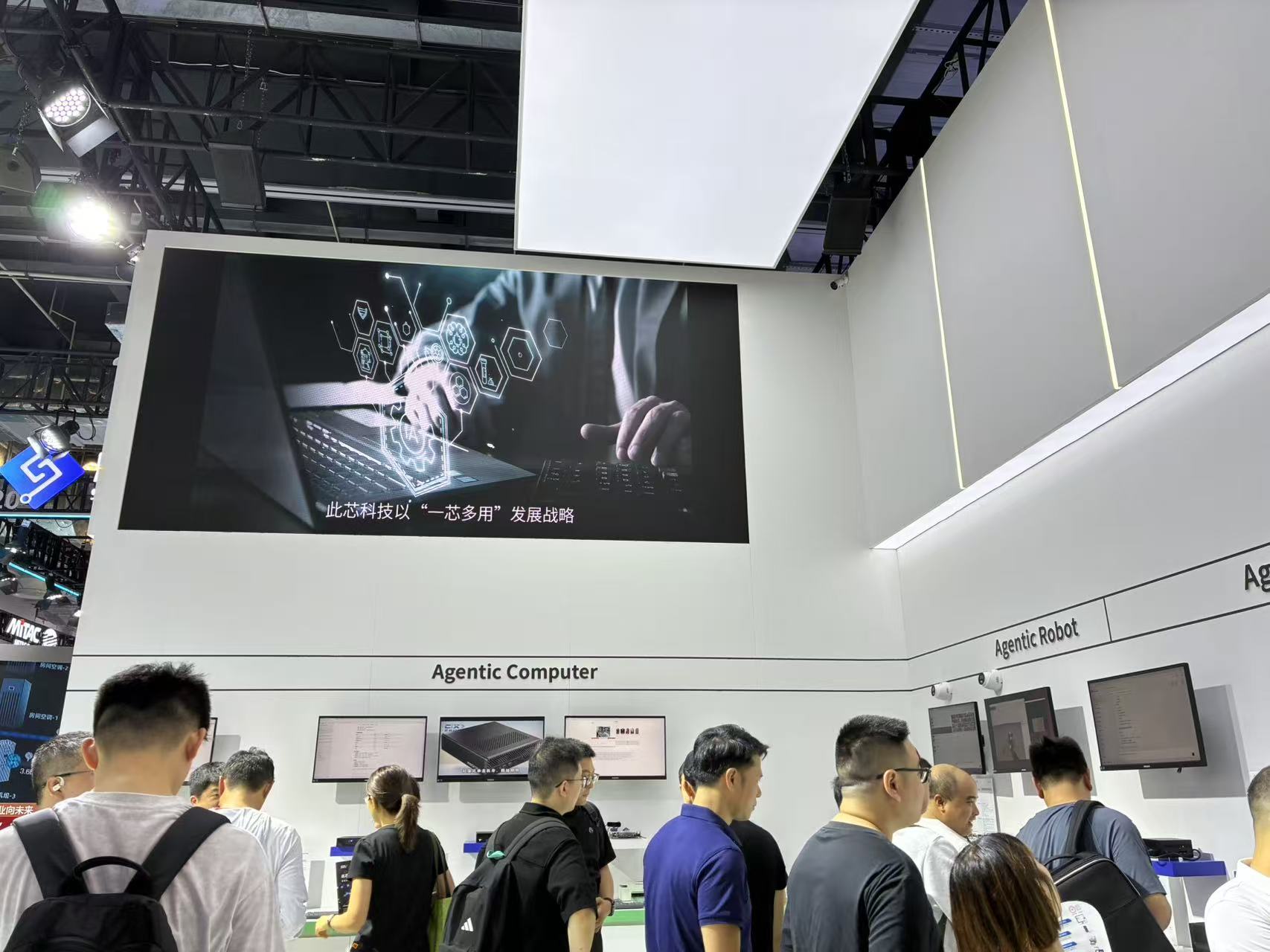
Centered around its self-developed P1 chip, CIX Technology unveiled five major product lines at this WAIC edition: AGX Station, Agentic Computer, Agentic Box, Agentic Infra and Agentic Robot. These products broadly cover scenarios such as personal computers, household devices, edge computing, robots and cloud servers.
Among them, the debut-displayed AGX Station is a desktop AI device measuring merely 150×150×60mm. Despite resembling a mini PC in appearance, paired with the self-developed Agentic OS 2.0, it allows enterprises to deploy AI services locally and implement management and billing based on Token consumption.
In the field of personal computing, CIX Technology partnered with Lenovo to showcase the AI Host mini equipped with the P1 chip. It delivers an aggregate AI computing power of 45 TOPS and comes pre-installed with Tianxi Claw. Users can complete pairing via WeChat for access, with support for multi-terminal connections including PCs, tablets and smartphones.
Moreover, intelligent agent computing boxes tailored for households and small and medium-sized enterprises are available. These compact devices integrate local private storage, offline AI inference and 4K video processing into one unit. They support local operation of models including Qwen3.5-35B-A3B, handling daily tasks involving sensitive information and data.
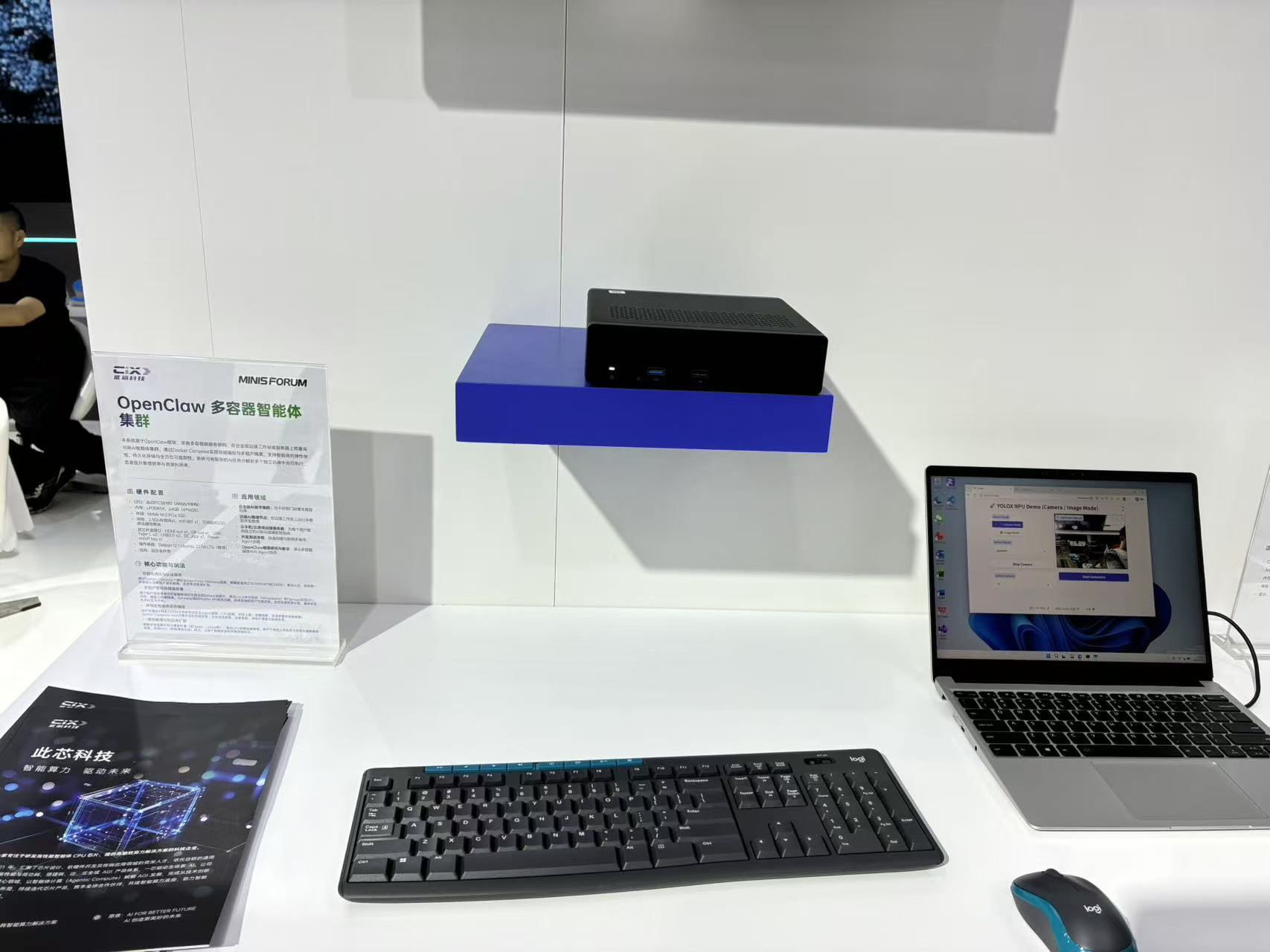
CIX Technology also rolled out a compact dedicated host in collaboration with Honghong Communication. Measuring only 135×86×40 mm, it is equipped with expansion interfaces including GMSL, CAN-FD and RS485, and supports 5G, 4G and Wi-Fi 6 connectivity.
During the on-site multi-agent collaboration demonstration, Agent frameworks such as ROS 2 and OpenClaw convert natural language commands into coordinated movements of robotic arms and mobile robots, effectively endowing robots with an edge-side brain.
In the cloud sector, CIX Technology exhibited a 2U Arm server fitted with 48 P1 chips, capable of running 576 cloud phones concurrently. Another 3U rack server incorporates 40 P1 nodes, targeted at high-concurrency scenarios including cloud rendering and cloud gaming.
Furthermore, the company partnered with China Telecom to showcase the Digital Employee Agent solution. According to on-site briefings, the solution has undergone trials and been adopted by industries such as finance and government administration, complying with data audit standards.
After touring the entire booth, Leitech believes CIX Technology has vividly illustrated the merits brought by self-developed chips in the AI era. Built to strike a balance among computing performance, energy efficiency and cost, CIX’s computing chips enable the company to deliver an end-edge-cloud computing foundation for intelligent agents of diverse forms.
As AI expands rapidly from cloud infrastructure into the physical world, such high-efficiency, localized computing platforms deployable across multiple scenarios are likely to become critical to the large-scale rollout of intelligent agents.
The WAIC 2026, themed “Intelligent Partners, Co-Creating the Future,” is now underway!
The AI narrative has shifted—from stacking model parameters toward deploying agent-driven productivity; heterogeneous computing and photonic computing continue pushing computational limits upward; embodied intelligence is rapidly advancing applications, bringing robots into homes and factories to make physical AI a reality.
The LeiTech WAIC Exhibition Team has arrived in Shanghai to capture the annual pinnacle of AI industrialization—stay tuned!