
 雷科技
雷科技





On July 17, the 9th World Artificial Intelligence Conference (WAIC) officially kicked off at the Shanghai World Expo Center. As the annual flagship event of the AI industry, this year's conference has once again gathered leading large model companies, AI application providers and hardware manufacturers from home and abroad. Leitech (ID: leitech), through its AI-focused new media outlet Leitech AGI (leikejiagi), has also dispatched a reporting team to Shanghai for on-site coverage.
(Image source: photography by Leitech)
At this year's WAIC, embodied intelligence is the undisputed star. After wandering the exhibition halls for a full day, Xiao Lei has seen no fewer than 20 humanoid robot exhibitors — models that pour coffee, haul boxes, tighten screws, and more. It was all dazzling at first glance, but to be honest, after seeing so many, they all start to feel pretty much interchangeable.
The booth from Mifeng Technology, however, is strikingly unconventional: there are no humanoid robots, no dexterous robotic hands, not even a single moving exhibit on display. Instead, the booth features a head-mounted data capture device and a gripper-shaped handheld gadget. After a brief hands-on trial, Xiao Lei realized that Mifeng isn't showcasing what robots can do — it's demonstrating how robots of the future will learn to perform tasks.
(Image source: photography by Leitech)
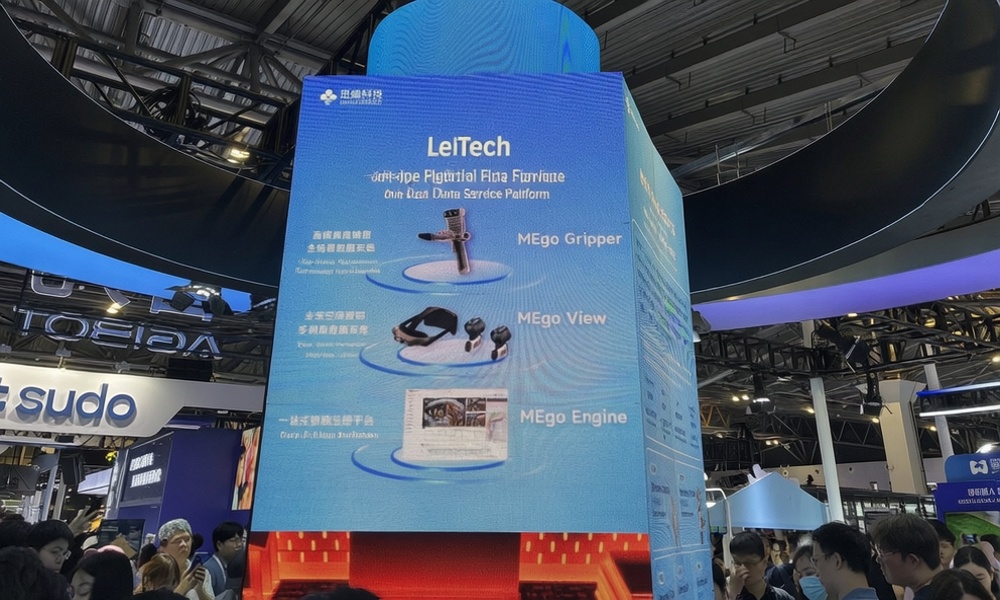
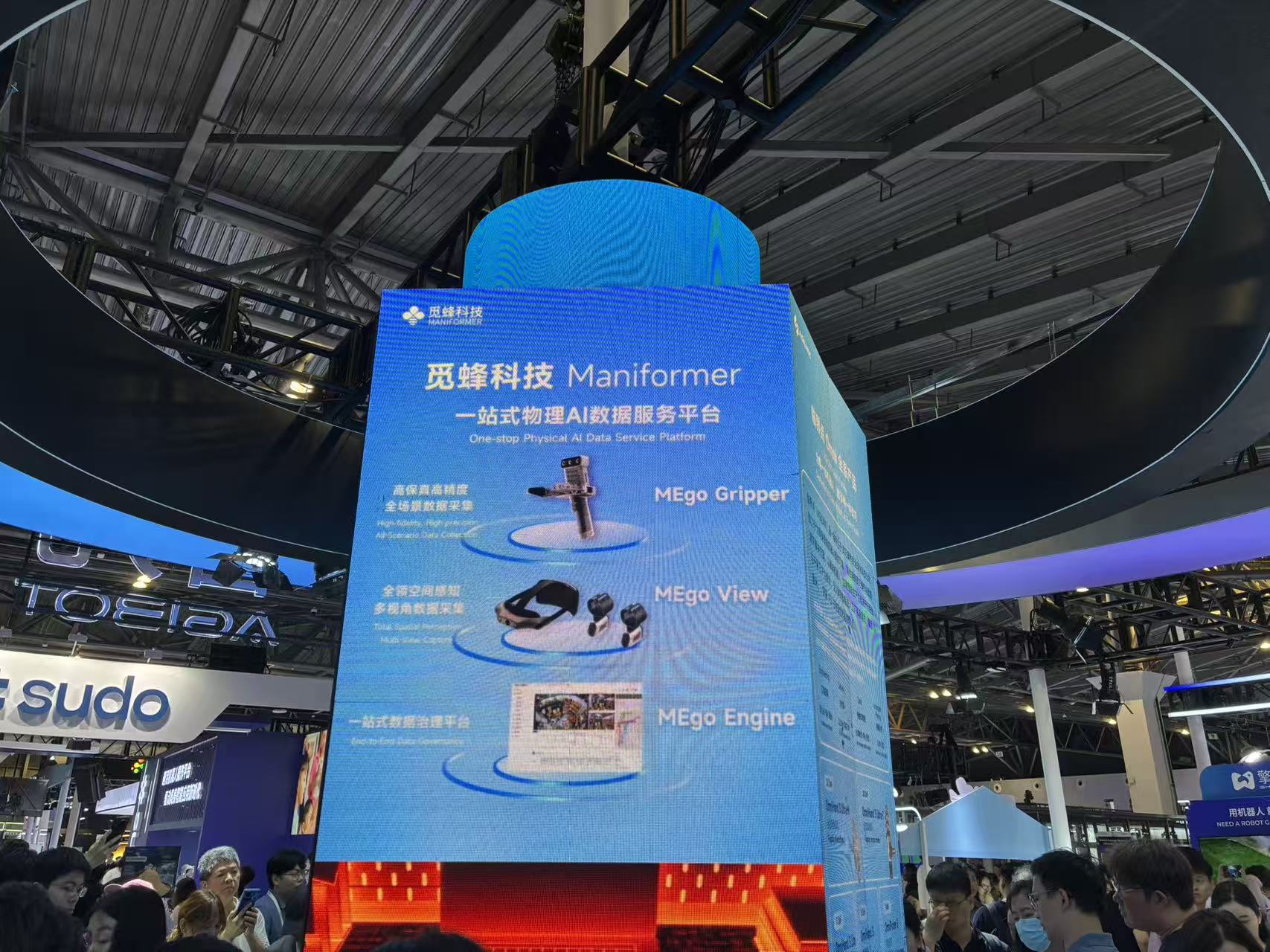
Mifeng's booth is compact but well-organized into distinct zones: two core hardware products from the MEgo series are placed on the left, an interactive experience area sits in the middle, and a large screen on the right displays real-time processing visuals from its data governance platform.
Xiao Lei first tested the MEgo Gripper, a handheld gripper device. The experience task was straightforward: pick up the object placed in front. Yet for just three simple movements — alignment, rotation and lifting — the gripper's 200° fisheye lens, 3D tactile sensor and 9-axis IMU all run simultaneously, recording visual data, depth information, posture, force perception and motion trajectories in real time.
On the large screen beside, the whole operation is reconstructed in real time with millimeter-level precision. How many Newtons of force a single finger applies, and what kind of arc it traces through the air — every detail is fully digitized.
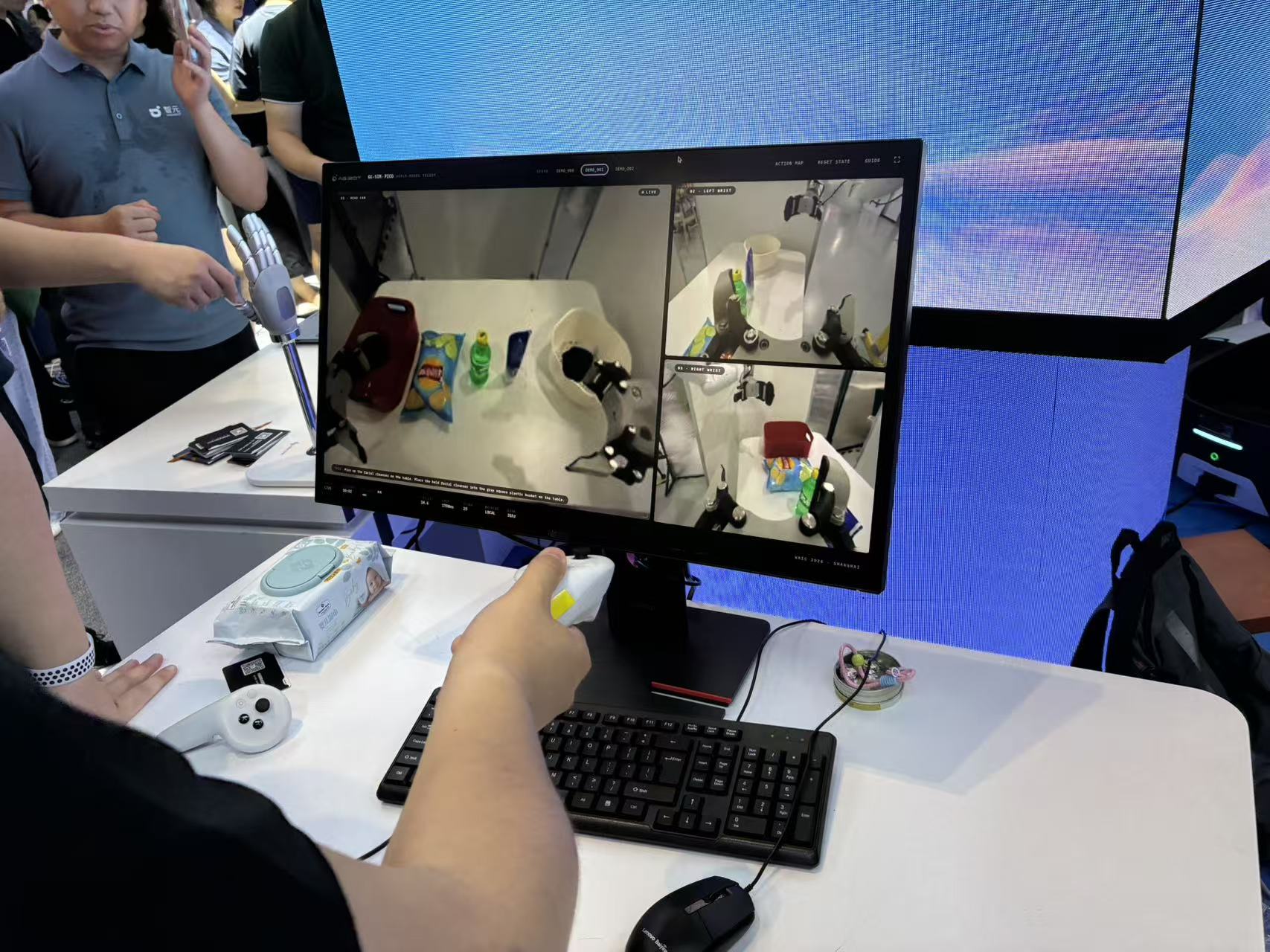
(Image source: photography by Leitech)
Next up is the MEgo View head-mounted device. Five cameras on the head unit deliver 300° panoramic coverage, while an additional camera on the wrist focuses on close-up shots of hand movements, enabling full-channel synchronization across all seven cameras. With just a few steps and several object-picking motions, both the full environmental panorama and fine operational details are captured simultaneously, and the temporal synchronization between the two viewing perspectives is accurate to sub-millisecond precision.
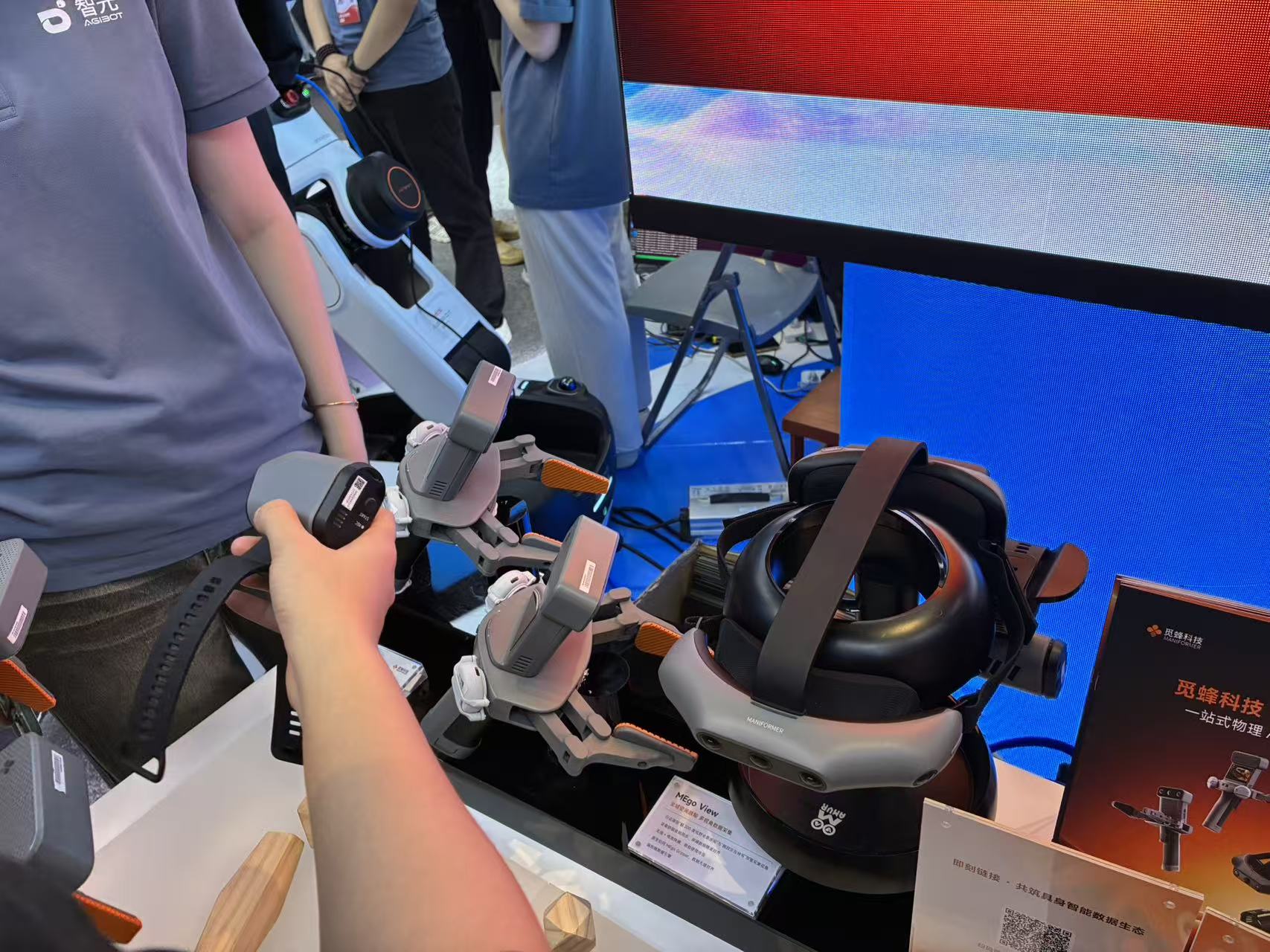
(Image source: photography by Leitech)
Anyone familiar with embodied intelligence will know that robots require massive volumes of training data to become intelligent, yet data collection relies on repeated operations using costly physical robot platforms — trapping the sector in a vicious cycle: an underdeveloped robot cannot generate high-quality data, and without high-quality data, the robot can never advance in intelligence. As a result, the total amount of high-quality real-robot interaction data across the global embodied intelligence industry is less than 1/20,000th of that used by leading large language models.
For reference, GPT-5 is trained on a corpus of 100 trillion tokens, while the entire embodied intelligence industry only has 500,000 hours of credible interaction data available.
Mifeng's solution to this bottleneck is to turn humans into the primary agents of data collection. The MEgo Gripper achieves a trajectory reconstruction accuracy of 1 millimeter, a major upgrade from the centimeter-level precision of previous industry-standard solutions. Paired with sub-millisecond global wireless time synchronization, multimodal data streams including vision, tactile sensing and posture are precisely aligned across the same timeline. Compounded by its natively isomorphic design with the AgiBot Genie G2 Air, the collected data can be seamlessly deployed onto physical robots, eliminating the common pain point of "collected data being unusable on real hardware". Shen Yujun, Chief Scientist of Ant Lingbo, also noted at WAIC that robot-free data collection scales far faster than teleoperated robot approaches. "In just half a year, many companies have reached data collection volumes on the order of 100,000 hours."
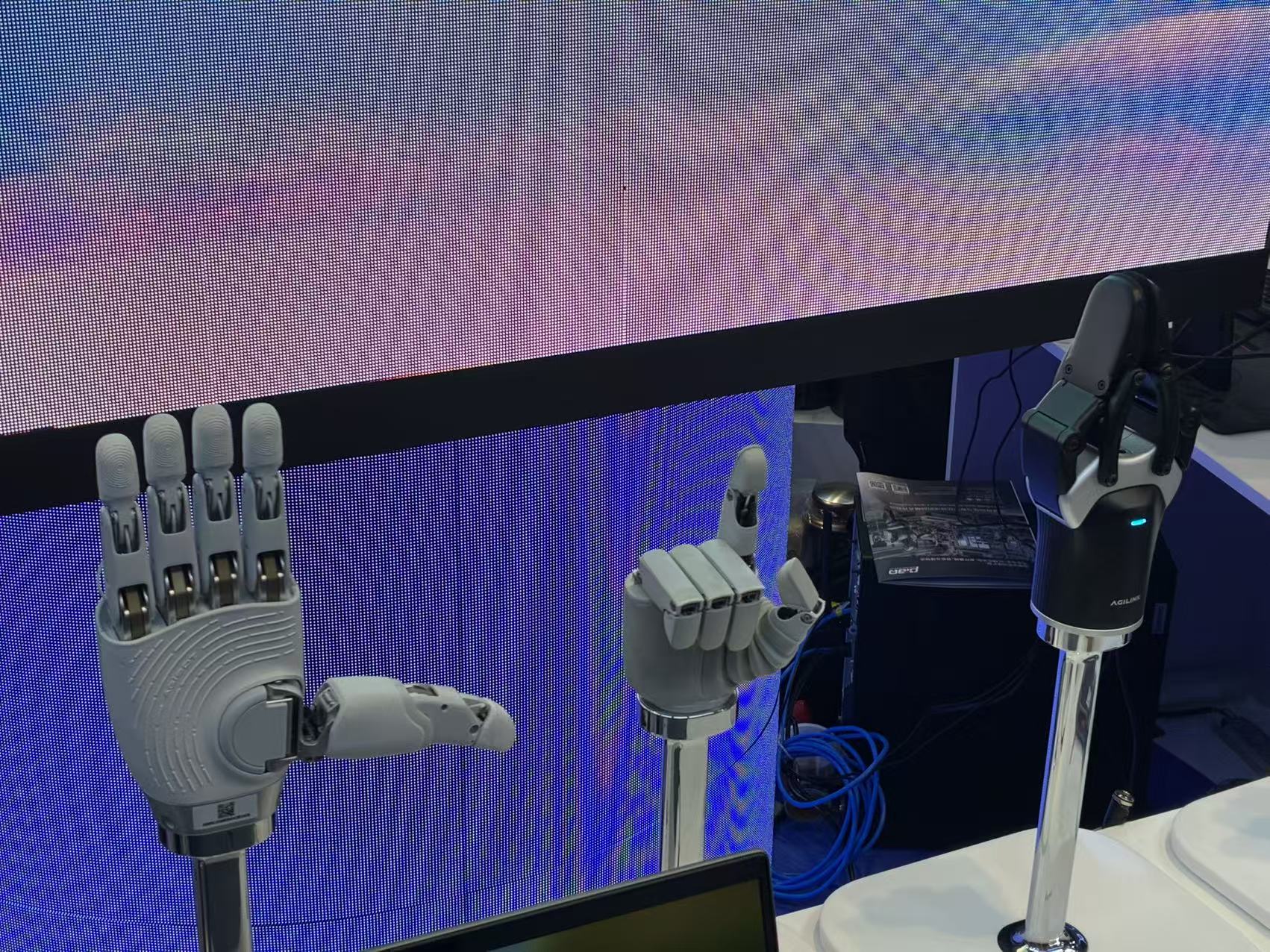
(Image source: photography by Leitech)
The large screen at the booth also demonstrates the MEgo Engine data governance platform in real time. Supporting one-click upload of raw data, the platform automatically performs temporal alignment, 6D trajectory reconstruction, quality assessment and intelligent annotation. It delivers over tenfold improvement in efficiency compared with traditional manual annotation, with an annotation accuracy rate of 99.7%.
At the main forum of the World Artificial Intelligence Conference, Yao Maoqing — Partner, Senior Vice President and President of the Embodied Business Division at AgiBot, and Chairman & CEO of Maniformer — stated: "A world model is essentially an AI system capable of understanding the operating laws of the physical world, and its most critical function is to predict the next state of the world."
Therefore, building a robust world model requires three core capabilities:
Multimodal fusion and understanding, to comprehend environmental changes
Mastery of physical laws, including dynamics and spatiotemporal understanding
Causal reasoning, with the ability to perform long-horizon reasoning without performance degradation
Yao Maoqing further pointed out that the essence of this technology lies in a full-capability multimodal large model natively built for the physical world. Almost all training data must come from real-world scenarios — robots must learn the laws of the physical world using data captured from reality.
This vision perfectly aligns with Maniformer's current development roadmap: reaching 10 million hours of data capacity in 2026, scaling to the 100-million-hour level in 2027, and targeting 10 billion hours by 2030. Its core team of only 100 to 200 staff focuses on standard prototyping, while large-scale production capacity is rolled out through a franchise foundry model.In terms of pricing, the current domestic transaction price for real-robot interaction data ranges from 500 to 1,000 yuan per hour. Maniformer expects its robot-free data solution to cost roughly one-third of the real-robot data price.
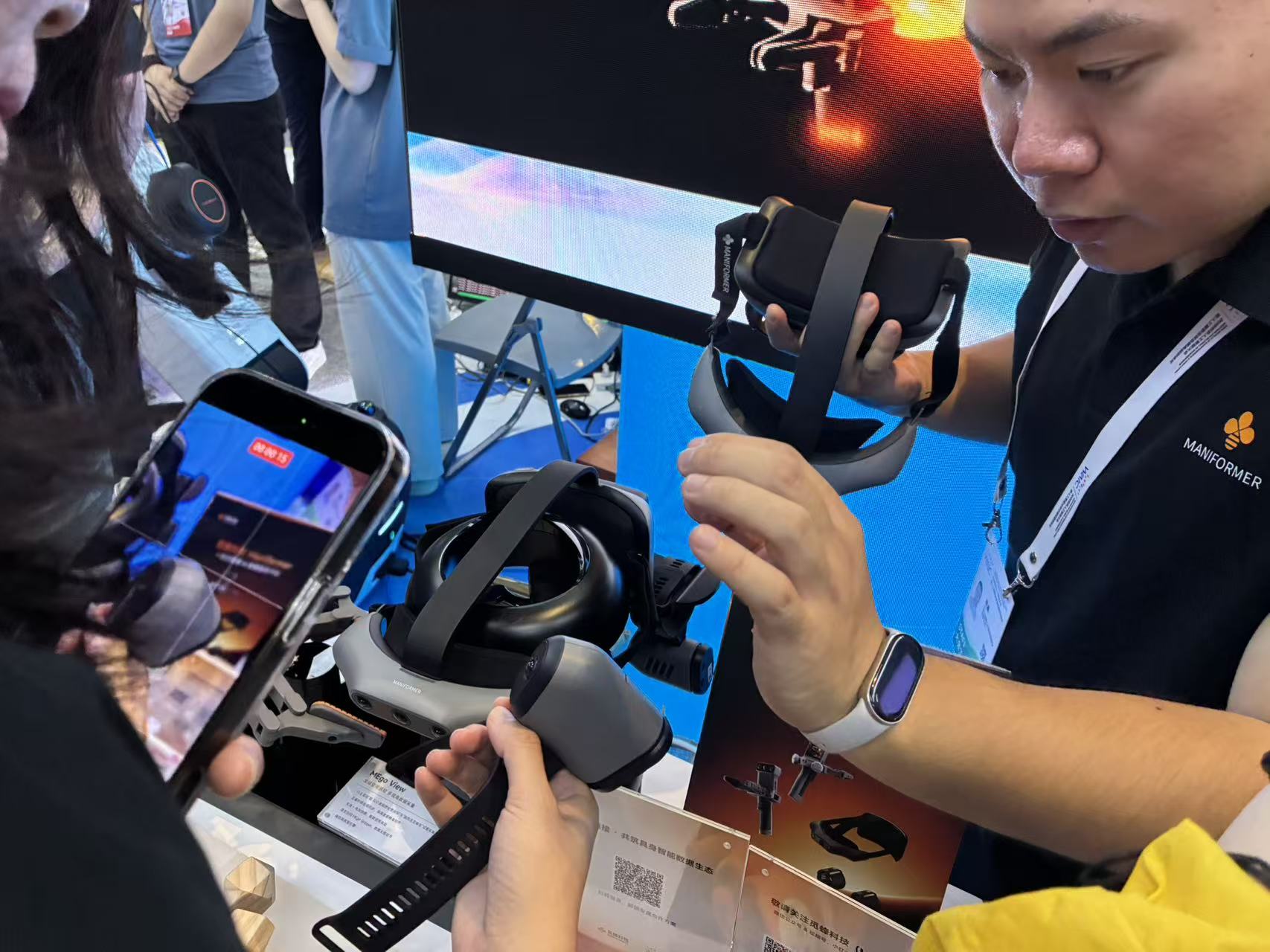
(Image source: photography by Leitech)
At this year's WAIC, every other exhibitor is showcasing what robots are capable of, while Maniformer alone is demonstrating how robots learn to perform tasks. What the embodied intelligence industry lacks is neither algorithms nor hardware — it is a massive supply of standardized, high-quality training data. Whoever first validates this path will emerge as the most irreplaceable link across the entire industrial chain.
If embodied intelligence is a gold rush, then what Maniformer is doing is selling the most essential shovel that this era demands.
The WAIC2026, themed “Intelligent Partners, Co-Creating the Future,” is now underway!
The AI narrative has shifted—from stacking model parameters to deploying agent-driven productivity. Heterogeneous collaboration and photonic computing continue pushing computational limits upward. Embodied intelligence accelerates real-world applications: robots entering homes and factories are turning physical AI into reality.
The LeiTech WAIC reporting team has arrived in Shanghai to capture the annual pinnacle of AI industrialization—stay tuned!