
 雷科技
雷科技







On July 17, the 9th World Artificial Intelligence Conference (WAIC) officially opened at the Shanghai Expo Center. This exhibition drew participation from more than 1,100 exhibitors, with over 300 products making their global debuts. New offerings spanned Huawei Atlas 950, MiniMax M3 multimodal large model, StepFun Agent Operating System, and the world’s first AI agent smartphone, showcasing an avalanche of newly unveiled products.
At this event where large models, intelligent computing chips and embodied intelligence compete side by side, the LeiTech reporting team spotted a rather intriguing booth. No new hardware was launched here, yet crowds of visitors kept gathering in front of it. This belongs to BleeqUp, an AI sports brand under Respect Unknown.

(Image source: BleeqUp Official)

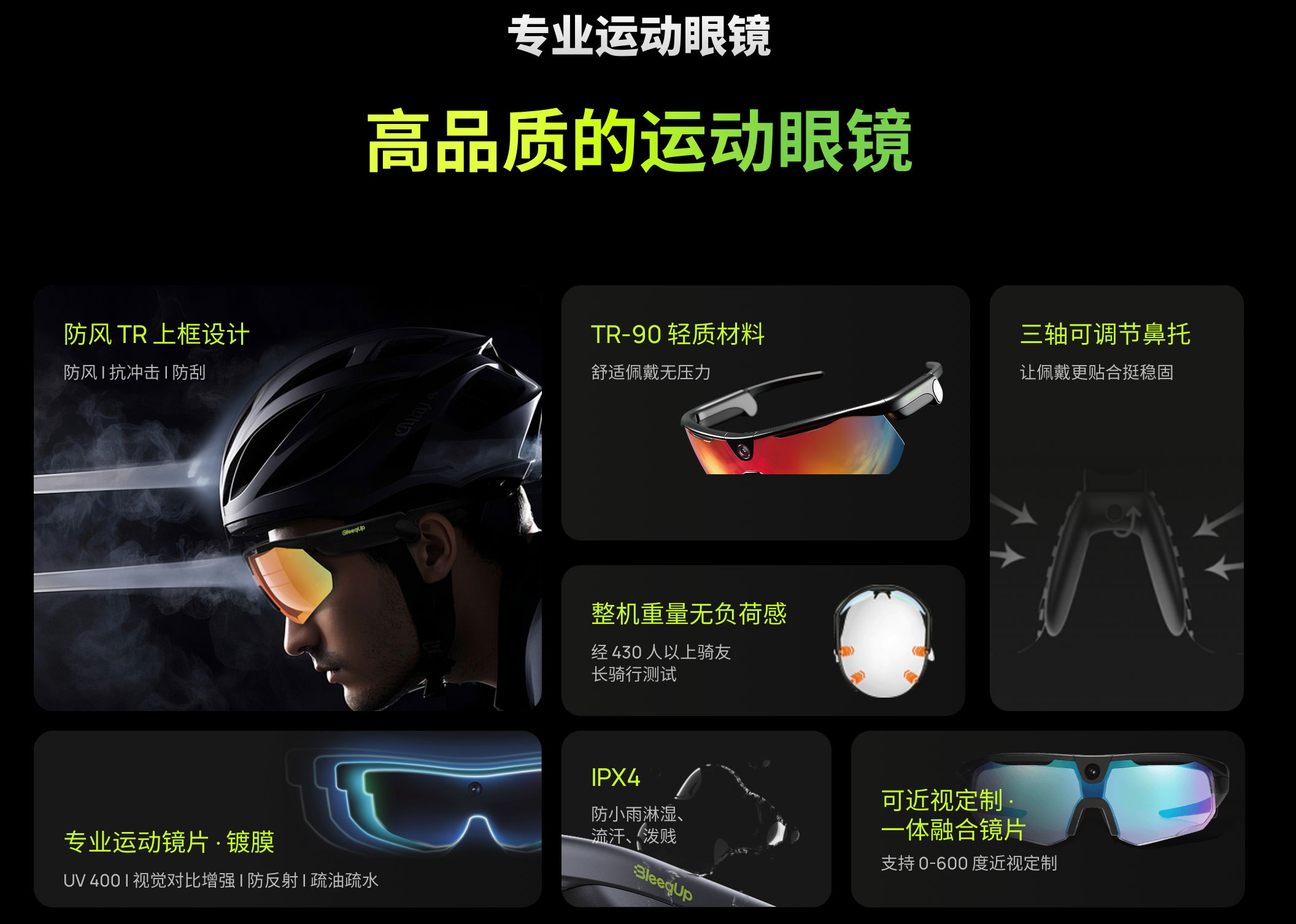
At the booth, I saw the Ranger AI sports glasses. Unlike similar mainstream products on the market, it abandons the conventional AI assistant route and focuses all its capabilities on outdoor sports. It integrates professional goggles, a 16-megapixel AI sports camera, an open directional audio system and real-time intercom function into a frame weighing merely 49 grams.
Since its launch, the product shipped over 10,000 units within its first 100 days on sale, boasting a user satisfaction rate of 98%. Its sales network covers more than 20 countries worldwide and over 1,000 offline retail channels. It even ranked second on the bestseller list for sports goggles during the 618 shopping festival. Such a promising start is remarkable for an emerging brand.
Nevertheless, a hit product alone does not stand out amid the bustling exhibition. Therefore, BleeqUp put forward a brand-new product philosophy at WAIC: building a human-centric "AI sports and health intelligent hub", which may thoroughly reshape the development trajectory of the smart wearables industry over the next decade.
In an interview, founder Wu Dezhou stated, "BleeqUp aims to be more than just a hardware manufacturer. We aspire to build an individual-oriented AI sports and health intelligent hub and act as an AI Agent tailored for outdoor sports. Our AI can proactively perceive scenarios, predict user demands and deliver decision-making support at critical moments."
Over the past decade, smartwatches, fitness bands and sports glasses have evolved from fancy gadgets into daily necessities for users. These devices accumulate massive volumes of health data, yet users mostly receive nothing but raw figures and charts that laypeople struggle to interpret. The gadgets log abundant information yet fail to drive tangible improvements.
Put simply, BleeqUp intends to transform these devices from functional tools into reliable companions. Wu Dezhou added that existing AI health devices generally fall into two categories. The first is the post-workout summary type represented by Garmin and Apple Health. They generate reports after workouts detailing average pace, heart rate zones and calorie consumption. The second is the daily reminder type exemplified by WHOOP and Oura Ring, which alerts users to insufficient sleep the previous night, subpar physical recovery status and other wellness metrics.

(Image source: BleeqUp Official)
BleeqUp targets the gap between these two categories: the real-time exercising process. When your physical strength nears its limit while cycling uphill, when your cadence suddenly goes irregular during trail running, or when your blood oxygen level drops amid climbing due to rising altitude, neither post-event reviews nor daily reminders can offer effective help. What you need is instant intervention the moment things unfold. BleeqUp sets its sights on this untapped market with no dominant players yet.
Take scenarios as examples. When exhaustion creeps in during uphill cycling, cadence gets disrupted abruptly on trail runs, or blood oxygen plummets while mountain climbing, post-workout reports and routine alerts cannot respond in time. Users require clear guidance and recommendations delivered by the device right when these situations occur.The reasoning behind choosing smart glasses is straightforward. While riding bikes, running outdoors or hiking halfway up a mountain, people can barely lift their wrists to check smartwatches. By contrast, it is easy to speak out loud and receive vocal feedback from the glasses.
(Image source: BleeqUp Official)
Furthermore, thanks to its position on the face, the glasses can capture surrounding environments and track the direction of your gaze, capabilities that smartwatches and smart rings can never match.
Directional advantages alone are insufficient, so BleeqUp unveiled its practical three-phase implementation roadmap for the first time at this event.
The first phase focuses on data recording. The brand builds a multimodal data system to fully log sports metrics and physical signs. The second phase centers on personalized companionship. Leveraging lightweight edge large models, it continuously accumulates users’ exclusive sports and physical data to grow more attuned to individual habits over time. The third phase features intelligent decision-making. By cross-referencing historical records, real-time scenarios and physical conditions, the device proactively provides workout tips and even safety alerts.
Wu Dezhou explained, “The device not only records your activities, but also determines what you ought to do. It can even intervene early before you notice potential risks yourself.” While this statement may sound futuristic, given how rapidly edge-based large AI models have advanced over the past year, I believe this vision is far from empty hype.
(Image source: BleeqUp Official)
In addition, BleeqUp also unveiled its roadmap for next-generation products, centered on "adopting smart glasses as the hardware gateway, taking sports AI Agent as the core, and building an open ecosystem by connecting sports gear and outdoor services". In other words, smart glasses mark merely its initial attempt; the brand aims to develop a complete set of AI-plus-sports infrastructure.
While exhibitors across the venue showcased hardware specifications, BleeqUp shifted its focus to the future. The next era of smart wearables should move beyond simply logging users’ activities, and evolve into independently analyzing and advising on appropriate actions.
Wu Dezhou has worked in the hardware industry for more than a decade, with career stints at Smartisan, Huawei and Honor before launching his own startup. He has repositioned the company from an AI glasses brand to an AI sports and health platform. While most players in the sports wearable market compete fiercely on battery life and sensors, Wu chooses to advance up the industrial chain and build an ecosystem based on hardware tools.
In an era where AI continuously redefines boundaries of possibility each day, this may well be the most worthwhile area to bet on.
The WAIC2026, themed “Intelligent Partners, Co-Creating the Future,” is currently underway!
The AI narrative has shifted—from stacking model parameters toward tangible Agent-driven productivity gains; heterogeneous computing and photonic computing continue pushing computational ceilings upward; embodied intelligence accelerates real-world deployment, bringing robots home and into factories to make physical AI a reality.
LeiTech’s WAIC reporting team has arrived in Shanghai to cover this annual pinnacle of AI industrialization—stay tuned!