
 雷科技
雷科技




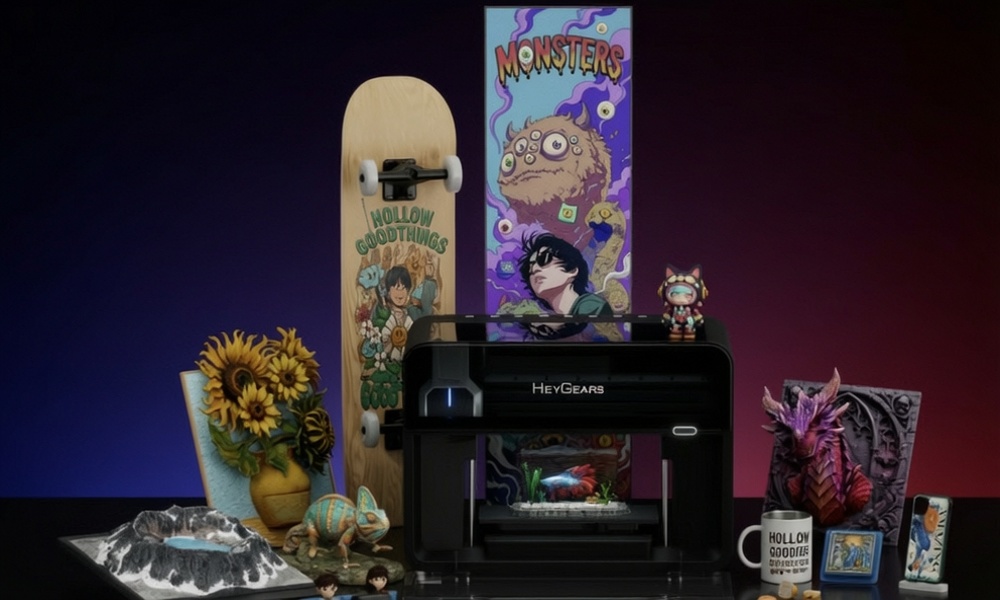

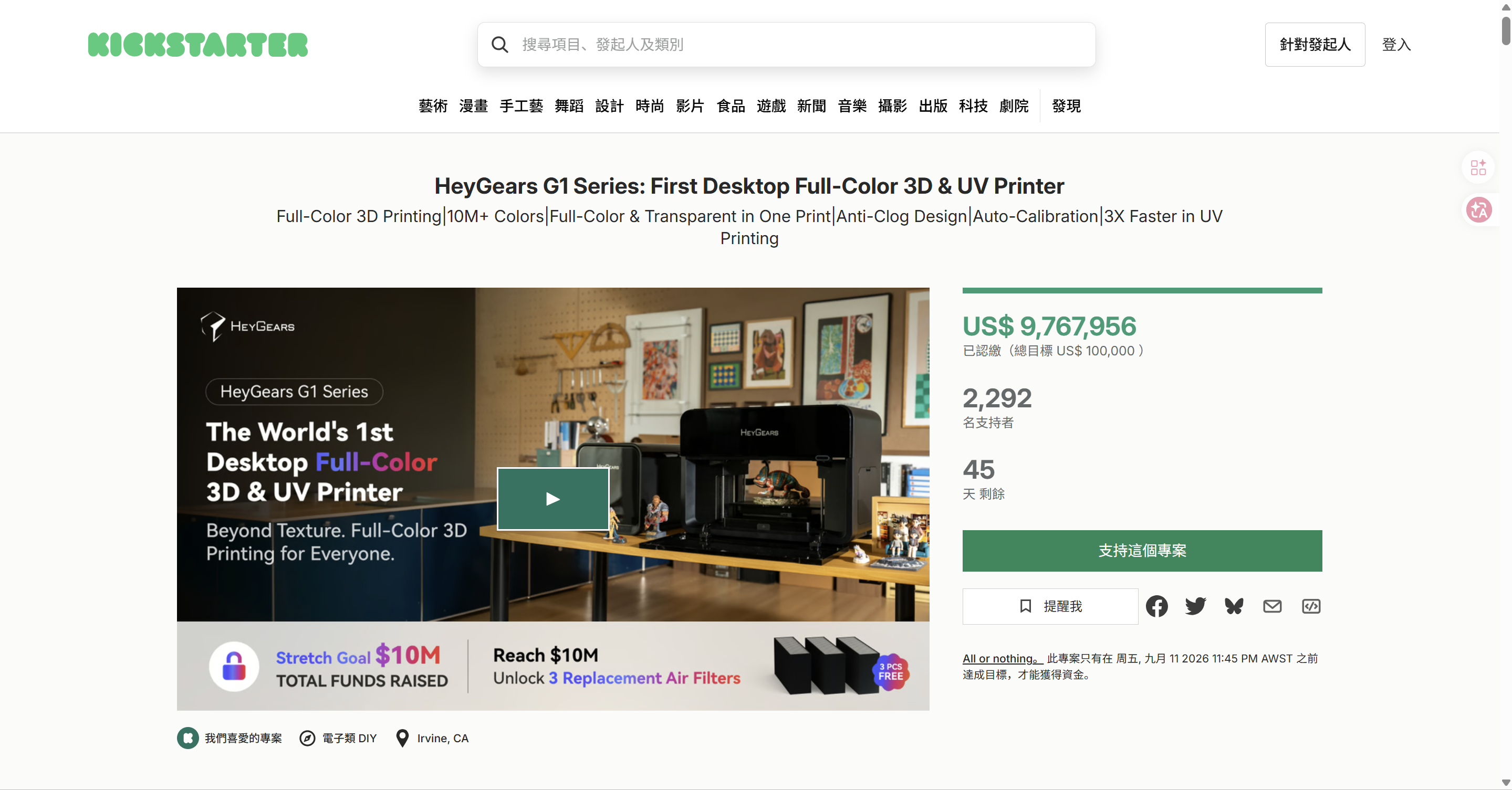
On July 24, HeyGears officially launched its G1 Series 3D printers on Kickstarter. The crowdfunding revenue hit 50 million Chinese yuan within the first 24 hours, and neared 10 million US dollars in one week. It has become a standout product among DIY tech gadgets released in 2026, and is arguably a blockbuster hit rarely seen in the consumer-grade 3D printing market in recent years.
photography by Leitech
In LeiTech’s view, it comes as no surprise that the G1 series has garnered so much attention, as the product aims to tackle a long-standing headache for 3D printing enthusiasts: why do users still have to paint finished models manually after printing?
Most mainstream consumer-grade 3D printers now adopt FDM (Fused Deposition Modeling) technology, achieving multi-color printing with filaments of various hues. This method is relatively affordable and easy to operate, yet it suffers from numerous drawbacks in model precision, surface texture and color rendering. Even with multi-material filament systems, it can hardly deliver the delicate gradient effects seen in conventional color printing.
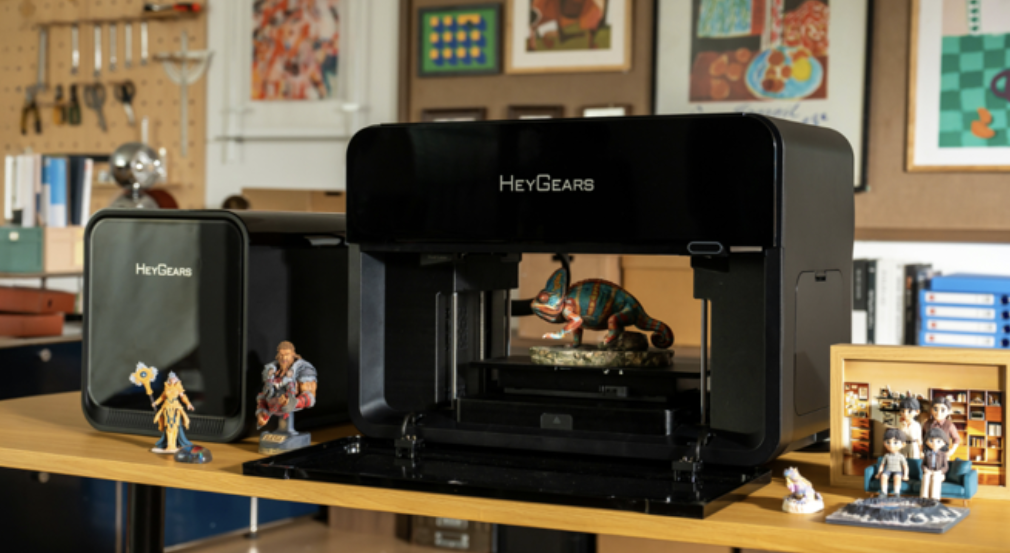
To address this pain point, HeyGears G1X adopts the material jetting approach. Put simply, the printer precisely sprays different materials and inks onto designated areas, followed by UV light curing. This allows users to directly produce three-dimensional objects with fully formed colors and detailed surface textures.
photography by HegTech
This technology was previously mostly deployed on industrial-grade equipment. Such machines usually cost more than 45,000 US dollars, weigh over 140 kilograms, and are too bulky to fit into homes or regular studios.
As one of the leading enterprises in the industrial 3D printing sector, HeyGears has ultimately overcome the challenge of equipment miniaturization. According to official specs, the G1X delivers full-color printing performance comparable to industrial machines at roughly one-tenth the price, with one-third the weight and footprint.
That said, the biggest hurdle HeyGears encountered while designing the G1 series was not downsizing the hardware itself. Instead, the team needed to figure out how to streamline printer maintenance without expanding the machine’s size. Traditional industrial full-color 3D printers rely on rollers to wipe away excess liquid. However, these rollers tend to cause color bleeding and add extra bulk to the device.
The G1X abandons roller components entirely, relying instead on algorithms, visual recognition and LiDAR for operational control. HeyGears also redesigned the ink pathways, ink cartridges, print heads, cleaning mechanism and curing system, enabling the printer to run reliably in household environments without constant temperature and humidity control.
Another standout feature of the G1X is its compatibility with three interchangeable material systems: UV resin, UV ink and water-soluble ink. It seamlessly caters to common creative needs, including full-color 3D model printing, flat printing, textured 3D surface printing and fabric transfer film production.
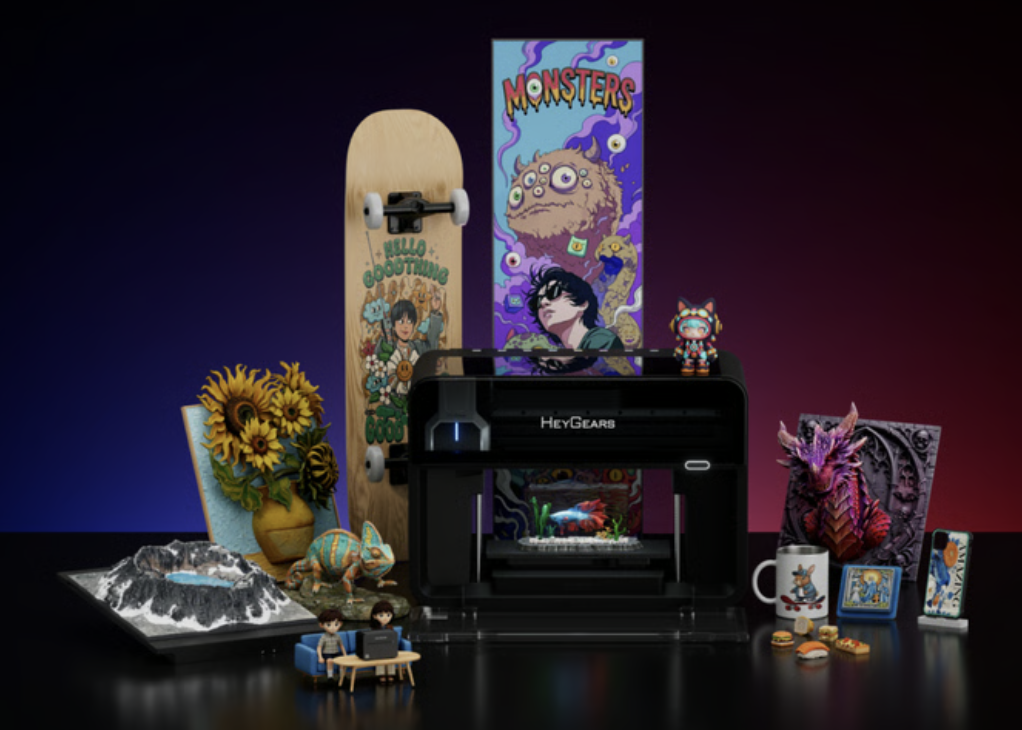
Image source: HegTech
Some people may wonder: With such abundant functions, do users have to master a wide range of skills? HeyGears has clearly noticed this concern. To remove obstacles in content creation, HeyGears teamed up with VAST to launch the HeyVerse platform. Users can leverage AI to generate various printing templates such as full-color 3D models, perform intelligent slicing via Blueprint Studio, and send files straight to the printer.
Powered by AI, users with zero relevant expertise can finish the entire workflow covering model generation, slicing, material matching and final printing, greatly lowering the entry barrier. Even so, while HeyGears has made the G1X much easier to use, it remains a productivity tool at its core. It is best suited for individual creators, studios and small businesses to customize and manufacture all kinds of goods.
Additionally, HeyGears disclosed that the company independently controls over 90% of its production chain. Therefore, its consumables cost only one-tenth of comparable overseas supplies or even less, which is fantastic news for 3D printing hobbyists.
The product is still in crowdfunding. Nevertheless, Xiaolei’s team is expected to be among the first batch of domestic media outlets to test this device. We will conduct an in-depth review later on its real-world performance and whether it can become a game-changing tool for creative professionals.
On July 31, ChinaJoy 2026—themed “Journeying with AI”—kicks off with fanfare.
A total of 900 entertainment-focused exhibitors—including Tencent, NetEase, Sony, Qualcomm, MaiCong, and QingXian—will jointly present a global feast for the entertainment industry;
How will hardware-tech brands—including those specializing in AI-enhanced devices, peripherals, robotics, displays, and chips—collaborate across sectors with game developers to deliver next-generation entertainment experiences?
Led by Founder & Chief Editor Luo Chao, the LeiTech ChinaJoy 2026 reporting team will descend upon Shanghai—stay tuned for comprehensive coverage.